Facts
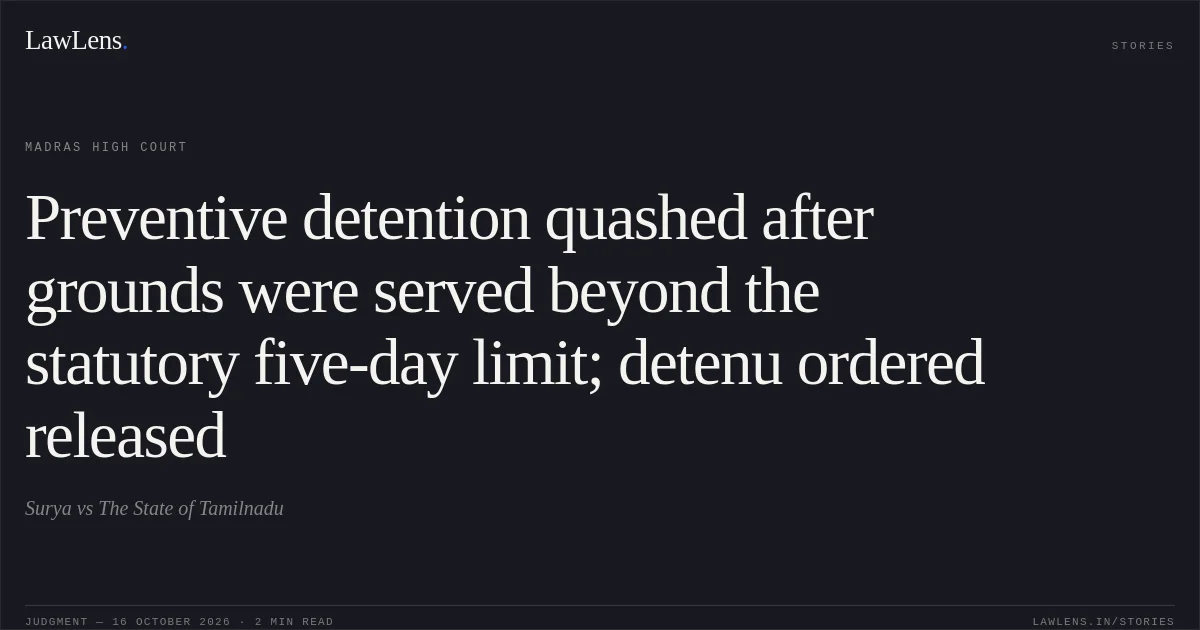
The petitioner, the detenu’s wife, challenged the order dated 4 July 2026 detaining Babu @ Mittai Babu as a “Drug Offender” under Section 2(e) of the Tamil Nadu Prevention of Dangerous Activities Act, 1982 (Act 14 of 1982).
Source reference: p. 2, 5Her principal ground was that, although the detention order was made on 4 July, the grounds of detention were served on the detenu only on 11 July 2026. The detenu was already in State custody when the order was made
Source reference: p. 2, 5Issues
Whether service of the grounds of detention on 11 July 2026, following the detention order of 4 July 2026, violated Section 8(1) of Act 14 of 1982 and the constitutional guarantee under Article 22(5)
Source reference: p. 2, 3, 5Whether that violation warranted setting aside the detention order and directing the detenu’s release
Source reference: p. 7, 8Law Applied
Section 8(1) of Act 14 of 1982 requires the detaining authority to communicate the grounds of detention “as soon as may be,” and no later than five days from the date of detention, while affording the detenu the earliest opportunity to make a representation to the State Government; the Court treated this requirement as a facet of the guarantee under Article 22(5) of the Constitution
Source reference: p. 3Relying on Malleeswari v. State Government, (2011) 1 MLJ (Crl) 513, and M. Shylaja v. The Additional Chief Secretary to Government, 2023/MHC/193, the Court stated that service beyond the statutory five-day period constitutes a violation that can itself justify setting aside the detention.
Source reference: p. 5–7The Court also referred to Ashok Kumar v. Delhi Administration, (1982) 2 SCC 403, for the principle that preventive detention is not punishment.
Source reference: p. 3Reasoning
The detention order was made on 4 July 2026, but the grounds were communicated only on 11 July 2026—more than five days later. The Court noted that the detenu was already in State custody when the order was made and applied Section 8(1) to the dates shown in the record.
Source reference: p. 5, 7It concluded that the delay violated the statutory requirement, which safeguards the detenu’s earliest opportunity to make a representation and reflects Article 22(5). Following the cited Division Bench authorities, the Court treated that violation as sufficient to dispose of the petition.
Source reference: p. 5, 7Holding
The Court allowed the habeas corpus petition and set aside the detention order dated 4 July 2026.
It directed that the detenu be released forthwith, unless required in connection with any other case.
Source reference: p. 8Acts & Sections Cited
3 provisions across 2 statutes referred to in this judgment. Linked provisions open on LawLens.
Tamil Nadu Prevention of Dangerous Activities of Bootleggers, Cyber law offenders, Drug offenders, Forest-offenders, Goondas, Immoral Traffic Offenders, Sand offenders, Sexual-offenders, Slum-grabbers and Video Pirates Act, 19822
Tamil Nadu Ordinance 1 of 19821
Original Court PDF
SuryavsThe State of Tamilnadu
Click to open original judgment
Original judgment, available to read, download and summarize on LawLens.in