Facts
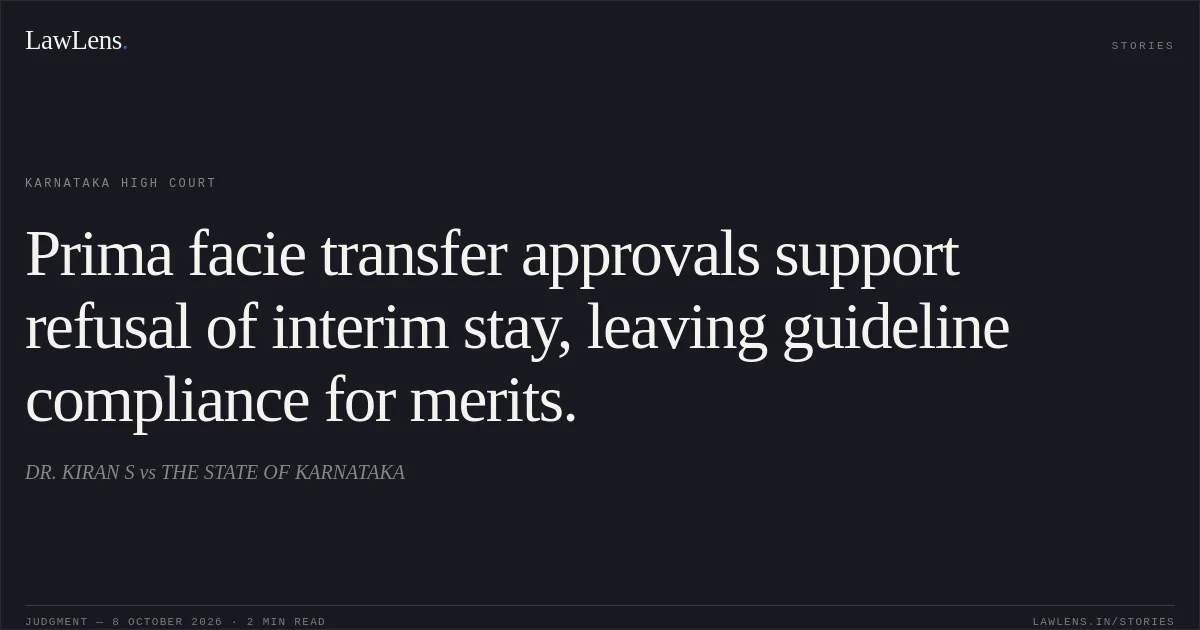
The petitioner, a State officer, challenged his transfer before the Karnataka State Administrative Tribunal (KSAT) and sought an interim stay. The Tribunal rejected that request by order dated 20 August 2026.
Source reference: pp. 3–5; paras. 2–5Before the High Court, the petitioner argued that the premature-transfer guidelines in Government Order dated 13 April 2026 required written reasons to be placed before the Chief Minister before approval was sought, and that this requirement had not been met. The respondents relied on memos before the Tribunal indicating that the Chief Minister and the Election Commission of India had approved the transfer.
Source reference: pp. 3–5; paras. 2–5Issues
1. Whether the High Court should interfere with the Tribunal’s refusal to grant an interim stay of the transfer order
Source reference: pp. 3, 6–7; paras. 2, 6–82. Whether compliance with Clause 9 of the transfer guidelines could be determined at the interim stage, in light of the approvals placed before the Tribunal
Source reference: pp. 4–7; paras. 3–7Law Applied
Under Articles 226 and 227 of the Constitution, the High Court may review a Tribunal’s interlocutory decision; however, when considering interim relief, the Tribunal need not determine the underlying merits in depth where prima facie material has been placed before it.
Source reference: pp. 4, 6–7; paras. 3, 6Whether the Chief Minister’s approval complied with Clause 9 of the Government’s transfer guidelines—including its requirements concerning written reasons for premature transfers—is a merits question to be decided after the relevant information is obtained and the parties are heard.
Source reference: pp. 4, 6–7; paras. 3, 6Reasoning
The High Court noted that the respondents had placed before the Tribunal material indicating that both the Chief Minister and the Election Commission of India had approved the transfer. It held that this material was sufficient for the Tribunal’s interim consideration, without deciding whether the Chief Minister’s approval complied with Clause 9.
Source reference: pp. 6–7; paras. 6–8That question, along with the parties’ other merits arguments, was left for the Tribunal to determine after hearing them; accordingly, the High Court found no infirmity in the refusal of interim relief.
Source reference: pp. 6–7; paras. 6–8Holding
The High Court dismissed the writ petition and declined to grant the requested interim protection.
It reserved the parties’ right to address all merits arguments before the Tribunal, directed that its observations should not prejudice either party, and expected the Tribunal to dispose of the matter as expeditiously as possible and within two months.
Source reference: pp. 7–8; paras. 8–9Original Court PDF
DR. KIRAN SvsTHE STATE OF KARNATAKA
Click to open original judgment
Original judgment, available to read, download and summarize on LawLens.in