Facts
The three Petitioners, originally Assistant Teachers at Raigad Zilla Parishad, sought inter-district transfers to Pune Zilla Parishad (Respondent No. 1) under the "Husband-Wife Ekatrikaran" scheme.
Source reference: p. 2/7Respondent No. 1 issued transfer/absorption orders in 2011/2012, directing Raigad Zilla Parishad to relieve the Petitioners.
Source reference: p. 2The Petitioners were relieved in April/May 2012 and reported to Pune, but were not issued posting orders until March–May 2013 due to an existing surplus of 88 primary teachers in Pune.
Source reference: p. 3/7During this interregnum, the Petitioners executed "Undertakings" (consent letters) agreeing to waive salary claims for the period they did not work.
Source reference: p. 6/9The Petitioners approached the High Court seeking a Writ of Mandamus for payment of monthly salary for the period between May 2012 and April 2013.
Source reference: p. 2Issues
1. Whether the Petitioners are entitled to salary for the interregnum period (May 2012 to April 2013) during which they were relieved from their previous posts but not yet assigned new postings by the transferee authority?
Source reference: p. 4, 102. Whether the principle of "No Work, No Pay" applies when the delay in posting is attributed to administrative surplus and the employees have executed voluntary waivers of salary?
Source reference: p. 10, 18Law Applied
The Court primarily applied the service jurisprudence doctrine of "No Work, No Pay," which is based on principles of justice, equity, and good conscience.
Source reference: p. 10-11Sukhdeo Pandey v. Union of India (2007) 7 SCC 455: established that remuneration is contingent upon the performance of assigned duties.
Source reference: p. 10State of Haryana v. O.P. Gupta (1996) 7 SCC 533: held that employees are not entitled to arrears for periods where they did not actually perform duties, even if they were willing to work.
Source reference: p. 12Government Resolution (GR) dated 13th July 2016: stipulates that surplus staff not yet absorbed should not be paid salary based on the "No Work, No Pay" principle.
Source reference: p. 14-17Reasoning
The Court observed that the Petitioners admittedly did not discharge any duties under Respondent No. 1 between May 2012 and May 2013.
Source reference: p. 3, 13The Court noted that Respondent No. 1 had proactively communicated the lack of vacancies (88 surplus teachers) to the Raigad authority, requesting them not to relieve the Petitioners; thus, the delay was rooted in administrative constraints rather than arbitrary denial.
Source reference: p. 6-8, 18The Court highlighted the significance of the "Undertakings" signed by the Petitioners on 16th March 2013, wherein they voluntarily waived salary claims for the period awaiting posting.
Source reference: p. 9, 18The Petitioners’ subsequent plea that these letters were obtained under duress was dismissed as a "bald assertion" lacking evidentiary support.
Source reference: p. 19Applying Sukhdeo Pandey, the Court reasoned that in the absence of service rendered, no legal or equitable right to salary exists.
Source reference: p. 13Holding
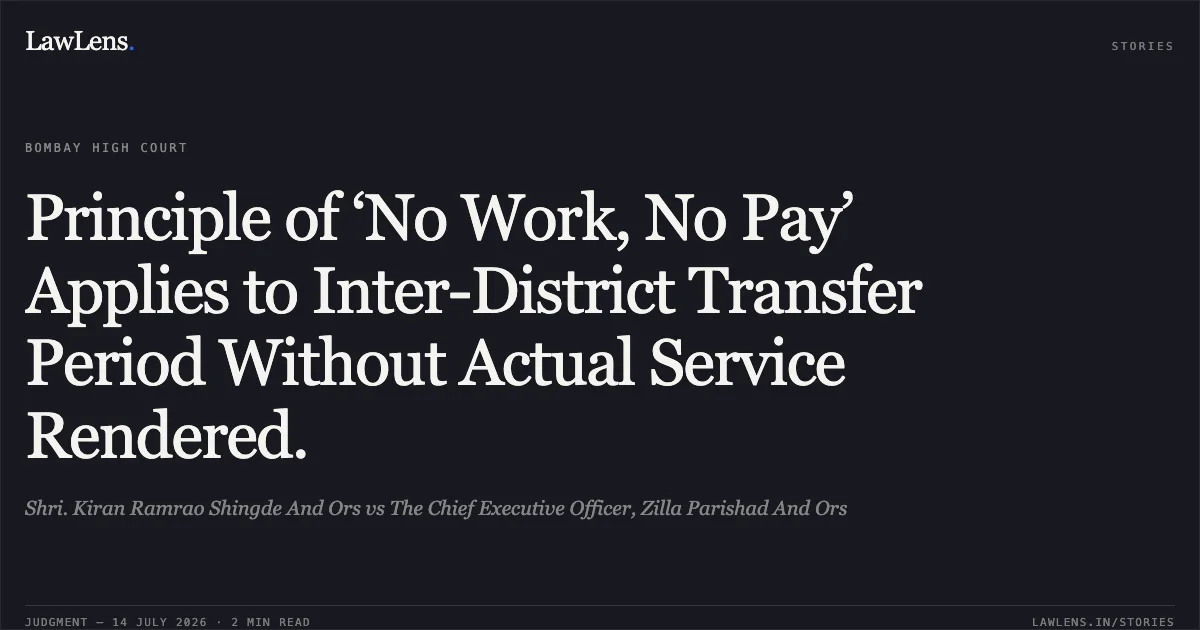
The Court answered both issues in the negative, holding that the Petitioners are not entitled to salary for the period they did not work, as the principle of "No Work, No Pay" squarely applies.
The Court dismissed the Writ Petition and granted no relief, finding no infirmity in Respondent No. 1's refusal to pay given the voluntary waivers and the surplus staff situation.
Source reference: p. 18-19Acts & Sections Cited
1 provisions across 1 statute referred to in this judgment. Each provision opens on LawLens.
Maharashtra Employees of Private Schools (Conditions of Service) Regulation Act, 1977.1
Original Court PDF
Shri. Kiran Ramrao Shingde And OrsvsThe Chief Executive Officer, Zilla Parishad And Ors
Click to open original judgment
Original judgment, available to read, download and summarize on LawLens.in