Facts
The Union of India (UOI) and the Director General of the ESIC challenged orders passed by the Central Administrative Tribunal which held that Laboratory Assistants in various hospitals were entitled to a revised pay scale of ₹ 4000-6000 effective from 1 January 1996.
Source reference: para. 1In several similar writ petitions involving both retired and serving Laboratory Assistants, the UOI and ESIC had previously made statements before the High Court that they would not seek recovery of the revised pay already granted, leading to the disposal of those cases while leaving the legal questions open.
Source reference: paras. 2-5In the present batch, the UOI argued it should not be bound by concessions made by the ESIC and sought to enforce undertakings signed by the respondents agreeing to recovery if payments were found to be in excess.
Source reference: paras. 8, 12Issues
1. Whether the Petitioners (UOI and ESIC) can seek recovery of the revised pay scale amounts from the Respondent Laboratory Assistants despite similar concessions being granted to similarly situated employees in previous orders.
Source reference: para. 92. Whether the distinction between serving and retired employees or the existence of recovery undertakings justifies a different legal treatment.
Source reference: paras. 10, 12Law Applied
The court primarily applied the constitutional guarantees of Equality before Law and Equal Protection of the Laws under Articles 14 and 16 of the Constitution of India.
Source reference: para. 9The court also followed the judicial precedent set by its own Coordinate Bench in UOI v. Kirat Ram (W.P.(C) 3136/2006) and The Director General (ESIC) v. Rakesh Saini (W.P.(C) 6414/2015), which disposed of similar disputes by leaving the question of law open while prohibiting recovery.
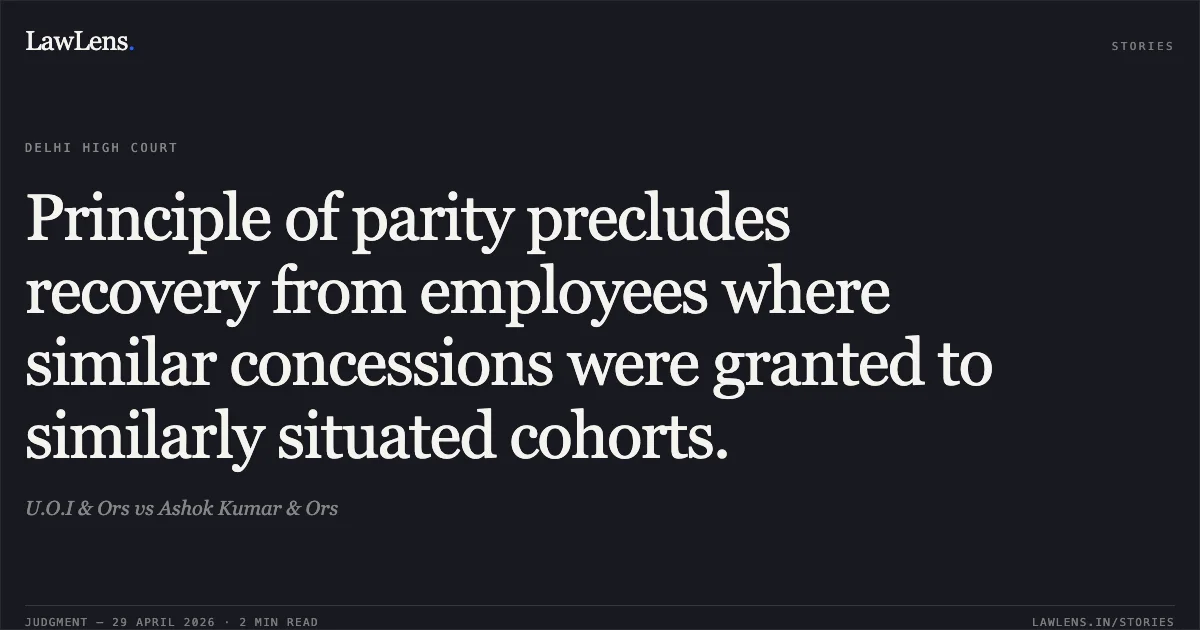
Source reference: paras. 3-5The principle of parity and non-discrimination in administrative action, ensuring that similarly situated employees (Laboratory Assistants across UOI and ESIC hospitals) receive identical treatment regarding pay recoveries.
Source reference: para. 9Reasoning
The Court rejected the UOI's attempt to distinguish itself from the ESIC’s concessions, noting that Laboratory Assistants in both organizations are functionally identical for the purpose of the pay scale dispute.
Source reference: para. 9The Court observed that allowing recovery for UOI employees while exempting ESIC employees would constitute a "clear violation" of Articles 14 and 16.
Source reference: para. 9The Court noted that the payments were made nearly two decades ago (between 2006 and 2009), and the distinction between "serving" and "retired" employees was irrelevant as previous orders covered both categories.
Source reference: paras. 7, 10, 12The Court held that even if undertakings for recovery existed, they were also present in the previously settled cases where the UOI chose not to effect recoveries; therefore, the UOI must be held to the same standard of conduct to ensure judicial consistency.
Source reference: paras. 12-13Holding
The Court held that the respondents are entitled to equal treatment with those in the previously disposed batches.
The Court disposed of the writ petitions by binding the Petitioners to their earlier undertakings that no recoveries would be made from the respondents.
Source reference: para. 13The petitions were closed with the "question of law left open," effectively preventing any recovery of the funds already paid out to the Laboratory Assistants.
Source reference: para. 13Original Court PDF
U.O.I & OrsvsAshok Kumar & Ors
Click to open original judgment
Original judgment, available to read, download and summarize on LawLens.in