Facts
The Petitioner (BPCL) challenged a demand notice and municipal bills dated May 15, 2008, amounting to ₹23,37,16,110/- issued by the Manmad Municipal Council for octroi/export fees.
Source reference: p. 2-3The Petitioner contended that its oil depots were situated outside municipal limits and thus exempt from such levies.
Source reference: p. 2This was the Petitioner’s fourth writ petition regarding the same cause of action. Three previous petitions (WP No. 625/1999, WP No. 5102/2005, and WP No. 8387/2006) had been filed and disposed of.
Source reference: p. 3-4Specifically, in WP No. 8387/2006, the High Court had upheld the Chief Officer’s order justifying the fee, finding a nexus between the export fee and the use of municipal roads.
Source reference: para. 5The Petitioner filed the current petition after the Municipal Council initiated coercive recovery measures following the dismissal of a Review Petition in the third round of litigation.
Source reference: para. 6Issues
1. Whether the present Writ Petition is maintainable in light of the dismissal of three previous petitions involving the same cause of action and legal challenges.
Source reference: para. 122. Whether the principles of res judicata and constructive res judicata apply to proceedings under Article 226 of the Constitution of India.
Source reference: para. 14Law Applied
The Court primarily applied the doctrine of res judicata and the rule of constructive res judicata under Section 11 and Explanation IV of the Code of Civil Procedure, 1908.
Source reference: para. 13-14It relied on Daryao v. State of Uttar Pradesh and Devilal Modi v. Sales Tax Officer to establish that these principles are based on public policy to ensure finality of litigation.
Source reference: para. 13Further, it applied Direct Recruit Class II Engg. Officers Association v. State of Maharashtra, which held that adjudication is final not only for matters determined but also for every matter which the parties "might and ought" to have litigated.
Source reference: para. 17Finally, the Court cited Makardhwaj Ram v. Jagdish Rai (Dead) (2024), reiterating that constructive res judicata is a "deeming fiction" intended to prevent a party from being "vexed twice over" for the same litigation.
Source reference: para. 20Reasoning
The Court observed that the Petitioner had repeatedly litigated the same issue of liability for octroi/export fees across three prior proceedings.
Source reference: para. 12The Division Bench notes that in the third petition (WP 8387/2006), the Court explicitly found no merit in the Petitioner’s challenge and upheld the Chief Officer’s reasoned order dated June 8, 2006.
Source reference: para. 12The Court reasoned that the current petition did not assert any new rights that were unavailable during the prior litigations; rather, it sought to re-agitate the same non-liability claim.
Source reference: para. 21Applying Explanation IV to Section 11 of the CPC, the Court found that even if certain grounds (such as the 1999 amendment) were not raised previously, they "might and ought" to have been raised, thus attracting the bar of constructive res judicata.
Source reference: para. 10, 21Raising these issues now constituted an abuse of the process of the Court.
Source reference: para. 15-16Holding
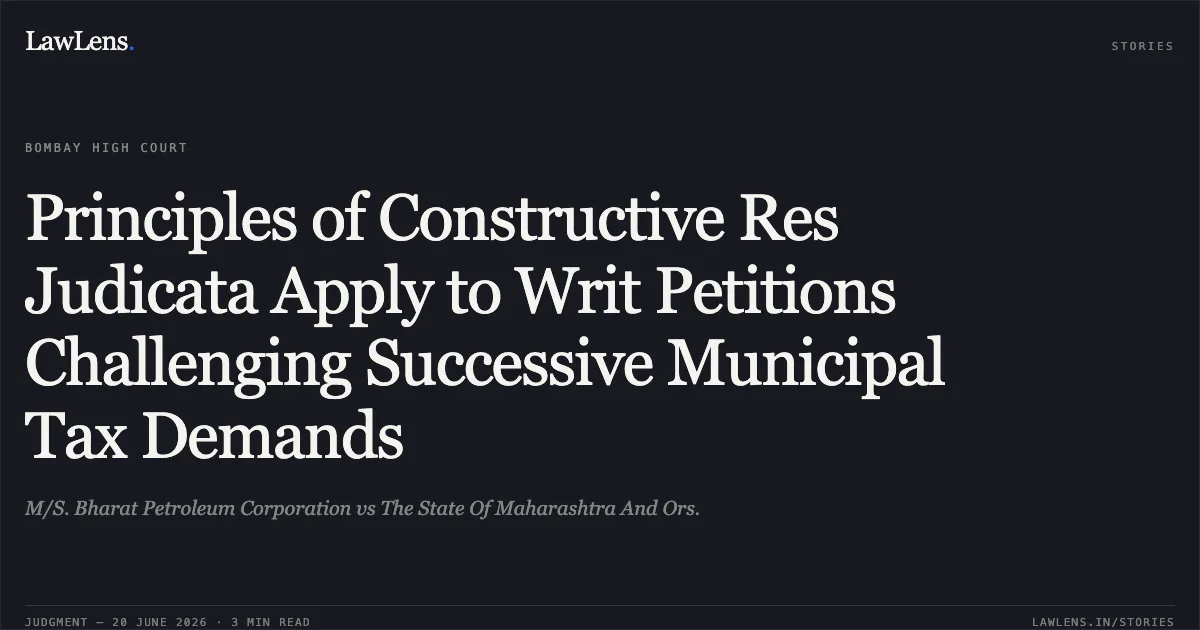
The Court held that the petition was barred by the principles of res judicata and constructive res judicata.
The Court answered the issue of maintainability in the negative, stating that the Petitioner could not re-agitate its liability after failing in three successive writ petitions.
Source reference: para. 21Consequently, the Writ Petition was rejected, the interim stay was vacated, and the Municipal Council was permitted to withdraw any amounts deposited by the Petitioner in Court. Rule was discharged with no costs.
Source reference: para. 22-24Acts & Sections Cited
3 provisions across 2 statutes referred to in this judgment. Each provision opens on LawLens.
Maharashtra Municipal Councils, Nagar Panchayats and Industrial Townships Act, 19652
Code of Civil Procedure, 19081
Original Court PDF
M/S. Bharat Petroleum CorporationvsThe State Of Maharashtra And Ors.
Click to open original judgment
Original judgment, available to read, download and summarize on LawLens.in