Facts
The Plaintiff (Respondent) filed a suit for specific performance of a contract dated 18.09.1982 for the sale of "Schedule B" property by Defendant No. 1 (Jugal Kishore Pathak) for Rs. 10,000/-.
Source reference: para. 4(e)The Plaintiff, an existing tenant, paid Rs. 3,000/- in total advances.
Source reference: para. 21Defendant No. 1 did not contest the suit.
Source reference: para. 5However, during the suit's pendency, Defendant No. 3 (grandson/GPA holder of Defendant No. 1) sold the property to Defendant No. 2 (son-in-law of Defendant No. 1) via a registered sale deed dated 20.12.1982.
Source reference: para. 50, 59The Defendants claimed this sale was based on a prior agreement to sell dated 20.08.1982.
Source reference: para. 6Both the Trial Court and the First Appellate Court decreed the suit in favor of the Plaintiff, holding that the Plaintiff was ready and willing and that the sale to Defendant No. 2 was hit by lis pendens.
Source reference: para. 29, 37Issues
1. Whether the concurrent finding that the plaintiff was ready and willing to perform his part of the contract suffers from perversity?
Source reference: para. 3(i)2. Whether the agreement dated 18.09.1982 (Plaint) or the agreement dated 20.08.1982 (Defendants) shall prevail and be given effect?
Source reference: para. 3(ii)3. Whether the receipt-cum-extension (Exhibit 2/1) was inadmissible due to being unstamped?
Source reference: para. 3(iii)Law Applied
The Court applied Section 16(c) of the Specific Relief Act, 1963, which mandates that a plaintiff must aver and prove continuous readiness and willingness to perform the contract.
Source reference: para. 39It followed the procedural requirements of Forms 47 and 48, Appendix A of the CPC as interpreted in Manjunath Anandappa v. Tamannasa (2003) regarding essential pleadings.
Source reference: para. 39-40Regarding agency, the Court applied the principle that a Principal (Defendant No. 1) retains concurrent authority to deal with property despite executing a General Power of Attorney (GPA), but actions by the Agent (Defendant No. 3) within their authority bind the Principal.
Source reference: para. 37, 59The doctrine of lis pendens under Section 52 of the Transfer of Property Act, 1882 was examined regarding sales pending litigation.
Source reference: para. 61Finally, Section 35 of the Indian Stamp Act, 1899 was applied regarding the inadmissibility of unstamped instruments.
Source reference: para. 47Reasoning
The Court found no perversity in the finding of "readiness and willingness," noting that the Plaintiff filed the suit immediately after the contract period expired and the Defendants failed to challenge the Plaintiff's financial capacity in their pleadings.
Source reference: para. 34, 45Although Exhibit 2/1 (the extension receipt) was held inadmissible for lack of stamping under the Stamp Act, the Court found the underlying agreement (Exhibit 2) and the second extension (Exhibit 2/2) were sufficiently proved through oral testimony and other records.
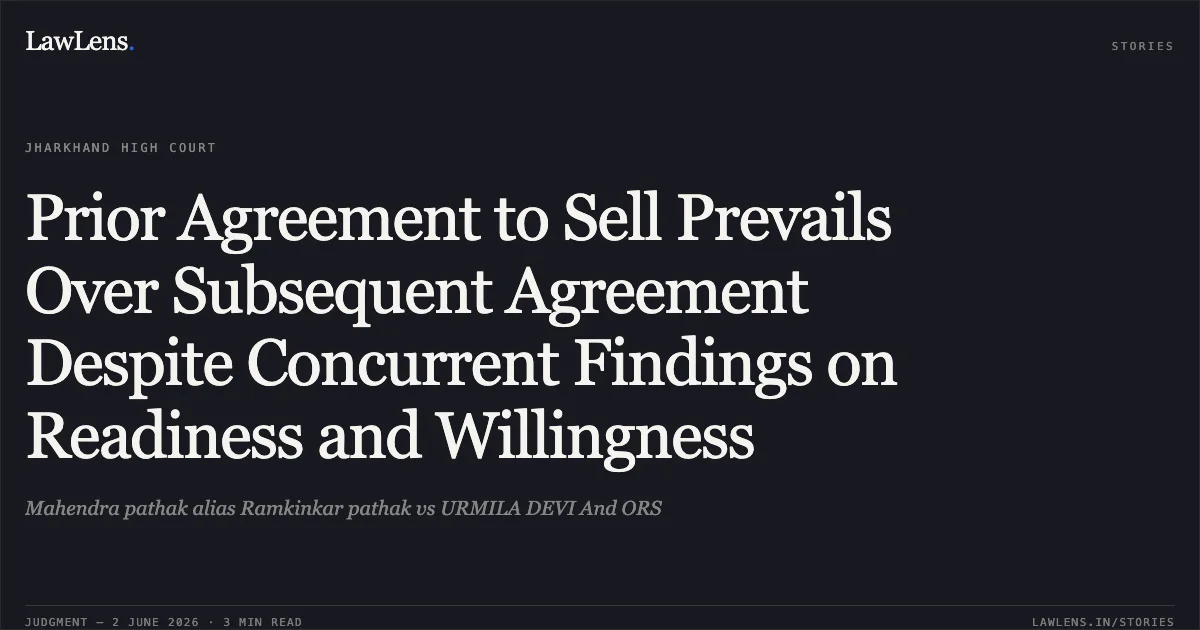
Source reference: para. 47, 48Crucially, the Court analyzed the priority of contracts. While the Plaintiff’s agreement was valid, the Defendants proved a prior agreement dated 20.08.1982 (Exhibit B).
Source reference: para. 54The Plaintiff failed to amend the plaint to specifically allege fraud or collusion regarding this earlier date, despite being aware of it.
Source reference: para. 52, 56The Court reasoned that since the GPA holder’s prior agreement was binding on the owner and preceded the Plaintiff’s contract, the subsequent sale deed dated 20.12.1982 was a fulfillment of that prior right, and thus was not hit by lis pendens.
Source reference: para. 60-61Holding
The Court answered Issue 1 in favor of the Plaintiff, finding no perversity in the readiness and willingness findings.
It answered Issue 3 by holding the unstamped document inadmissible, though this did not vitiate the entire claim.
Source reference: para. 48On Issue 2, the Court held that the Defendants' prior agreement (20.08.1982) must prevail over the Plaintiff's subsequent agreement (18.09.1982).
Source reference: para. 61, 63Consequently, the High Court set aside the lower courts' decrees, allowed the Second Appeal, and dismissed the Plaintiff's suit for specific performance.
Source reference: para. 62, 64Acts & Sections Cited
8 provisions across 4 statutes referred to in this judgment. Each provision opens on LawLens.
Indian Contract Act, 18723
Specific Relief Act, 19632
Indian Stamp Act, 18992
Transfer of Property Act, 18821
Original Court PDF
Mahendra pathak alias Ramkinkar pathakvsURMILA DEVI And ORS
Click to open original judgment
Original judgment, available to read, download and summarize on LawLens.in