Facts
The applicant filed a private complaint (P.H. No. 1/2023) before the Principal District Sessions Judge, Kheda, against respondent Nos. 2 to 9, alleging offenses under Sections 164, 165, and 120(A) of the Indian Penal Code (IPC) and Sections 7, 7(A), 8, 9, 11, and 12 of the Prevention of Corruption Act (PC Act).
Source reference: p. 2The applicant alleged a ₹50 Crore scam involving siphoning of government funds, specifically an excess payment of ₹65 lakh to an agency via forged tender orders.
Source reference: p. 2-3The complaint was primarily based on information received through an anonymous letter and RTI inquiries.
Source reference: p. 3-4The learned Sessions Judge dismissed the complaint at the stage of preliminary hearing.
Source reference: p. 2The applicant subsequently moved the High Court in revision under Section 397 read with Section 401 of the CrPC.
Source reference: p. 1Issues
1. Whether the learned Sessions Judge committed a palpable error in dismissing the private complaint at the preliminary stage.
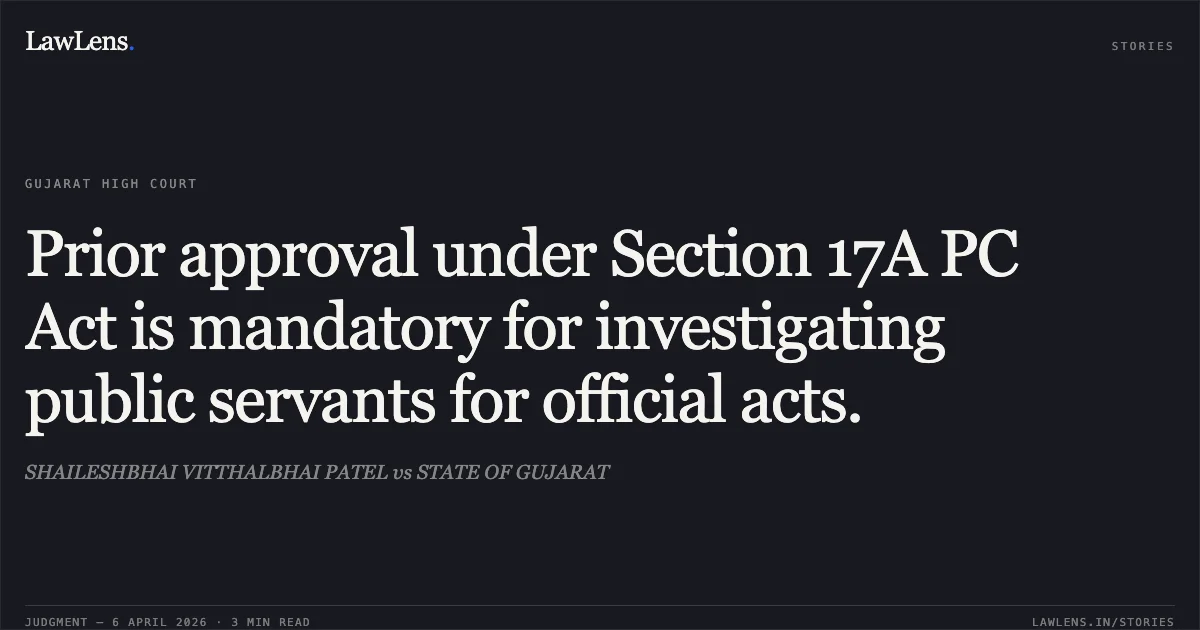
Source reference: p. 22. Whether a criminal complaint for corruption against public servants can be maintained without prior sanction/permission under Section 17A of the Prevention of Corruption Act.
Source reference: p. 53. Whether the allegations in the complaint met the statutory requirements of the PC Act and the IPC, particularly regarding repealed provisions.
Source reference: p. 4Law Applied
Section 397 and Section 401 of the CrPC regarding the limited scope of revisional jurisdiction, which is intended to correct patent defects or errors of jurisdiction rather than re-appreciate evidence.
Source reference: p. 5-6Sections 161 to 165A of the IPC were repealed following the enactment of the PC Act.
Source reference: p. 4Section 17A of the PC Act, which mandates prior permission from the government for conducting any inquiry or investigation into offenses alleged against a public servant relating to the discharge of official functions.
Source reference: p. 5Principles from Anil Kumar Ors. v. M.K. Aiyappa Anr. regarding mandatory sanctions.
Source reference: p. 5Principles from Amit Kapoor vs. Ramesh Chander Anr. and Malkeet Singh Gill vs. State of Chhatisgarh regarding the non-interference in findings of fact unless they are found to be totally perverse.
Source reference: p. 5-6Reasoning
The court observed that the applicant lacked personal knowledge of the allegations, relying entirely on an anonymous letter as "gospel truth".
Source reference: p. 3-4Legally, the court found the complaint fundamentally flawed as it sought prosecution under Sections 164 and 165 of the IPC, which have been repealed.
Source reference: p. 4Regarding the PC Act allegations, the court noted an absence of evidence or specific claims regarding a demand for "undue advantage" or illegal gratification, which are essential for an offense under Sections 7, 8, 9, or 11.
Source reference: p. 4The court reasoned that the alleged tender irregularities, even if true, were matters for departmental audits and institutional mechanisms rather than criminal complaints based on apprehension.
Source reference: p. 4The court held that the bar under Section 17A of the PC Act was absolute; since no prior permission was sought to investigate the public servants for actions taken in their official capacity, the Sessions Judge's dismissal was legally sound.
Source reference: p. 5The High Court concluded that there was no "palpable error" or "perversity" in the lower court's reasoning that would warrant the exercise of revisional jurisdiction.
Source reference: p. 5-6Holding
The High Court dismissed the revision application and discharged the rule.
The court held that the learned Sessions Judge committed no error in dismissing the complaint at the preliminary stage due to the mandatory requirement of Section 17A of the PC Act, the repeal of the relevant IPC sections, and the lack of prima facie evidence of criminal misconduct.
Source reference: p. 5-6The court affirmed that revisional jurisdiction cannot be used to substitute the lower court's finding of fact unless it is found to be arbitrary or perverse.
Source reference: p. 6Acts & Sections Cited
12 provisions across 3 statutes referred to in this judgment. Each provision opens on LawLens.
Code of Criminal Procedure, 19732
Indian Penal Code, 18605
Prevention of Corruption Act, 19885
Original Court PDF
SHAILESHBHAI VITTHALBHAI PATELvsSTATE OF GUJARAT
Click to open original judgment
Original judgment, available to read, download and summarize on LawLens.in


