Facts
The appellant, a Deputy Director (Law) at the Competition Commission of India (CCI), was charged with tampering with witness statements recorded during a CCI investigation.
Source reference: paras. 3–23, 29–30The CCI approved initiation of major-penalty proceedings on 27 June 2023 and approved a draft chargesheet on 4 August 2023, which was sent to the Central Vigilance Commission (CVC) for first-stage advice.
Source reference: paras. 3–23, 29–30The CVC concurred without suggesting changes.
Source reference: paras. 3–23, 29–30The Chairperson directed issuance of the charge memorandum on 3 October 2023; a corrigendum later amended the statement of imputations.
Source reference: paras. 3–23, 29–30The appellant challenged the memorandum and related inquiry orders in a writ petition, which the Single Judge dismissed on the approval issue while leaving document and defence-related objections for consideration in the disciplinary process.
Source reference: paras. 3–23, 29–30The appellant appealed.
Source reference: paras. 3–23, 29–30During the appeal, the CCI produced the departmental record containing the approved draft chargesheet.
Source reference: paras. 3–23, 29–30Issues
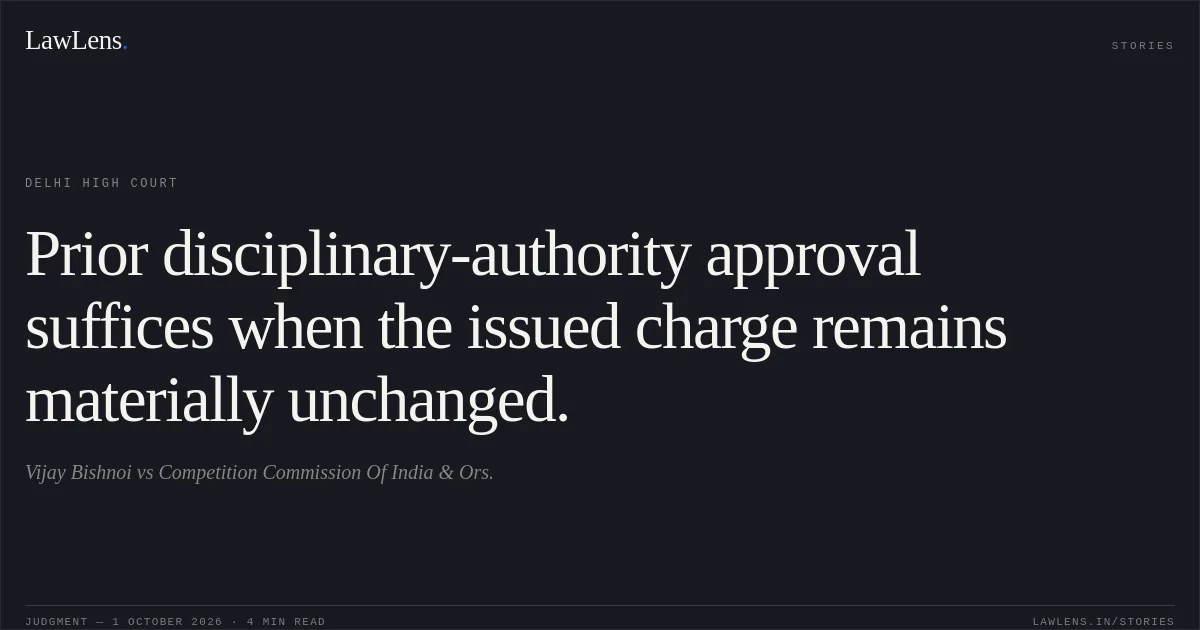
1. Whether the charge memorandum was issued with the approval of the CCI, acting as the Disciplinary Authority, as required by Rule 14(3) of the CCS (CCA) Rules, and whether the approved draft and issued memorandum were the same document.
Source reference: paras. 28–352. Whether the omission of the witness list from the material sent to the CVC, or the later corrigendum to the statement of imputations, required fresh approval by the CCI.
Source reference: paras. 28, 36–393. Whether the Chairperson’s direction to issue the charge memorandum was a valid administrative act under Section 13 of the Competition Act, 2002, and whether the CVC advice had to be placed before the CCI for a further decision.
Source reference: paras. 28, 40–464. Whether the appellant’s objections concerning defence documents and closure of his defence warranted appellate intervention at that stage.
Source reference: paras. 28, 47–48Law Applied
Rule 14(3) of the CCS (CCA) Rules requires the Disciplinary Authority’s approval of the charge memorandum; that approval must relate to the charge as issued, rather than merely to a general decision to initiate proceedings (Union of India v. B.V. Gopinath, (2014) 1 SCC 351).
Source reference: paras. 28, 45Rule 14(4) contemplates delivery of the approved articles of charge to the charged officer, including through an authorised officer.
Source reference: para. 43Section 13 of the Competition Act, 2002 gives the CCI Chairperson general administrative powers of superintendence, direction and control, but does not transfer the CCI’s disciplinary jurisdiction to the Chairperson.
Source reference: paras. 40–43The DoPT Office Memorandum of 29 November 2012 directs that, after receiving first-stage CVC advice, the matter be placed before the Disciplinary Authority; the Court treated it as an executive instruction whose breach, absent prejudice, would not invalidate the charge memorandum.
Source reference: para. 42The Court distinguished A.M. Kulshrestha v. Union of India, (1992) Supp (2) SCC 296, where the CVC advice was not brought to the disciplinary authority’s knowledge.
Source reference: para. 43Reasoning
The appellate court examined the departmental record produced during the appeal and found that the CCI’s authenticated meeting record established approval of the draft chargesheet, while the file noting linked that draft to the later charge memorandum.
Source reference: paras. 29–35The absence of signatures on the draft or of individual Members’ signatures on the forwarding letter did not displace the recorded decision of the multi-member body; no evidence showed lack of quorum, dissent, or a difference between the approved draft and the memorandum.
Source reference: paras. 29–35Although the witness list was not sent to the CVC, it had already formed part of the draft approved by the CCI and was procedural rather than substantive; the corrigendum was a clerical correction that did not change the imputation.
Source reference: paras. 36–39Because the CCI had approved the charge and the CVC had concurred without alteration, the Chairperson’s direction was administrative implementation, not an exercise of the CCI’s disciplinary power.
Source reference: paras. 40–46The court found no demonstrated prejudice from the CVC advice not being placed before the CCI.
Source reference: paras. 40–46The objections to document disclosure and closure of the defence were left for determination by the inquiry and disciplinary authorities before any final order.
Source reference: para. 47Holding
The appeal was dismissed, and the Single Judge’s judgment was affirmed.
The Court held that Rule 14(3) was satisfied; the charge memorandum was the charge approved by the CCI; neither the witness list nor the corrigendum required fresh approval; and the Chairperson validly directed issuance of the approved charge.
Source reference: paras. 49, 52The appellant remained at liberty to pursue his defence-document and inquiry-procedure objections before the appropriate authorities, which were to consider them on their merits by reasoned orders.
Source reference: paras. 47–48The inquiry and final disciplinary order were directed to be completed within six months from the judgment.
Source reference: paras. 50–51Acts & Sections Cited
2 provisions across 2 statutes referred to in this judgment. Each provision opens on LawLens.
Competition Act, 20021
Code of Civil Procedure, 19081
Original Court PDF
Vijay BishnoivsCompetition Commission Of India & Ors.
Click to open original judgment
Original judgment, available to read, download and summarize on LawLens.in