Facts
Following Complaint No. 243/2025, the Lokpal directed the CBI to conduct a preliminary inquiry under Section 20(1) of the Lokpal and Lokayuktas Act, 2013 (“the Act”)
Source reference: p.1Upon perusing the CBI report dated 27.01.2026, the Lokpal passed an order on 25.02.2026 finding allegations 1 and 3 prima facie substantiated against the petitioner
Source reference: p.2Subsequently, on 27.02.2026, the Lokpal issued a show cause notice under Section 20(3) of the Act
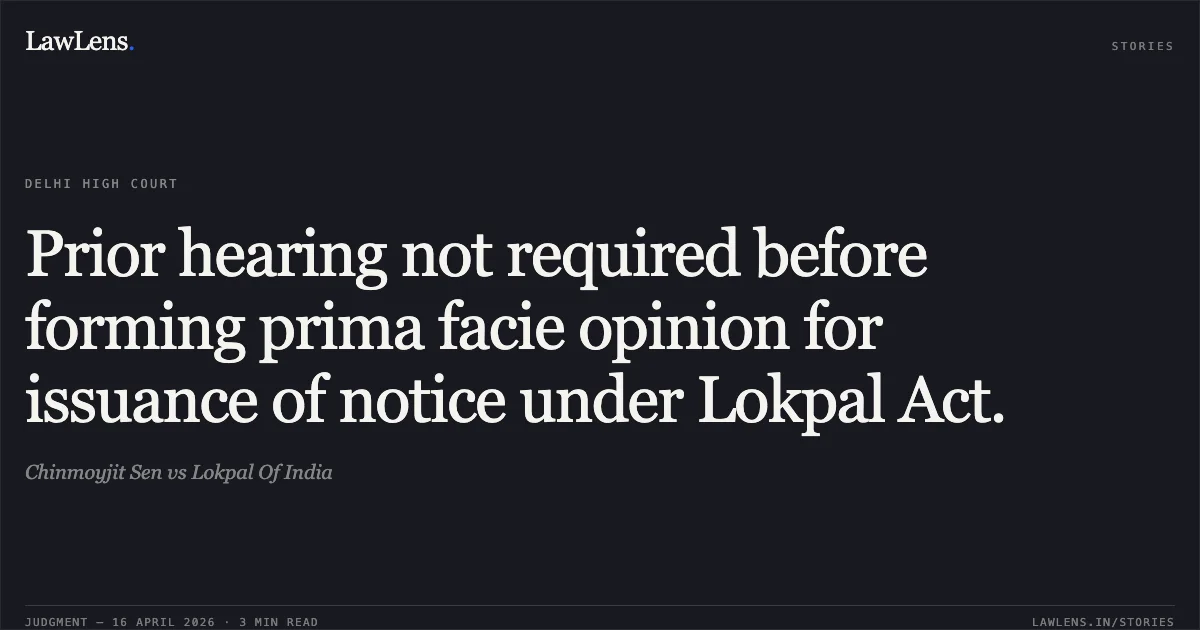
Source reference: p.2The petitioner challenged both the order and the notice, contending that the Lokpal failed to grant him a hearing before forming a prima facie opinion and had already "made up its mind," thus vitiating the proceedings
Source reference: p.2The petitioner appeared before the Lokpal on 18.03.2026 but filed the present writ petition instead of submitting a reply
Source reference: p.4Issues
1. Whether the Lokpal is legally mandated to grant a public servant an opportunity of hearing prior to the formation of a prima facie opinion and the issuance of a show cause notice under Section 20(3) of the Act
Source reference: p.42. Whether the formation of a prima facie opinion based on a preliminary inquiry report prejudices the final outcome or constitutes a violation of the principles of natural justice
Source reference: p.3-4Law Applied
The court primarily applied the Lokpal and Lokayuktas Act, 2013, specifically Section 20(1), which governs the initiation of preliminary inquiries, and Section 20(3), which mandates an opportunity of hearing for the public servant before final action is taken
Source reference: p.4The court distinguished the precedent Shri Shashi Shekhar Prasad v. Lokpal of India and Ors., 2026:DHC:2853-DB, noting it applied to challenges after final orders were passed, not at the show-cause stage
Source reference: p.2-3It further applied the principle of administrative law that a prima facie opinion formed for the purpose of issuing a notice does not constitute a final adjudication or a pre-judgment of the merits
Source reference: p.4Reasoning
The court reasoned that the Lokpal must necessarily apply its mind to the CBI's preliminary inquiry report to determine whether to drop the proceedings or proceed with a notice; failure to do so would result in the non-application of mind
Source reference: p.3It held that Section 20(3) of the Act contemplates an opportunity of hearing before a final decision is reached, and the legislature did not intend for a hearing to be granted prior to the mere issuance of a show cause notice
Source reference: p.4The court observed that the order dated 25.02.2026 was solely a prima facie view and that the petitioner’s apprehension of prejudice was misplaced, as the final decision would only be taken after considering his reply
Source reference: p.4Furthermore, the court noted that the petitioner sought to delay proceedings by filing the writ instead of participating in the Lokpal's inquiry
Source reference: p.4Holding
The High Court dismissed the writ petition, holding that the issuance of a show cause notice after forming a prima facie opinion does not violate natural justice
The court directed the petitioner to raise all grievances before the Lokpal and explicitly ordered the Lokpal to take a final decision based on the petitioner's reply without being prejudiced by the observations made in the prima facie order of 25.02.2026
Source reference: p.4-5All pending applications were disposed of accordingly
Source reference: p.5Acts & Sections Cited
1 provisions across 1 statute referred to in this judgment. Each provision opens on LawLens.
Lokpal and Lokayuktas Act, 20131
Original Court PDF
Chinmoyjit SenvsLokpal Of India
Click to open original judgment
Original judgment, available to read, download and summarize on LawLens.in