Facts
The petitioners, owners of agricultural land in Piludi village, Morbi, challenged an order dated 29.07.2025 passed by the District Magistrate (DM) under Section 16(1) of the Indian Telegraph Act, 1885.
Source reference: p. 2, 4The respondent company, M/s Halvad Transmission Ltd., was authorized by the Ministry of Power under Section 164 of the Electricity Act, 2003, to lay overhead transmission lines for the Khavda RE Park project.
Source reference: p. 2The petitioners resisted the installation of electric poles, alleging that the proceedings were premature, the notification lacked specific survey numbers, and the company lacked a final license from the CERC.
Source reference: p. 3-4Despite these objections, the DM exercised powers under Section 16(1) to permit the company to proceed with the work.
Source reference: p. 4Issues
1. Whether the District Magistrate is empowered under Section 16(1) of the Indian Telegraph Act to permit the exercise of powers when resisted by a landowner.
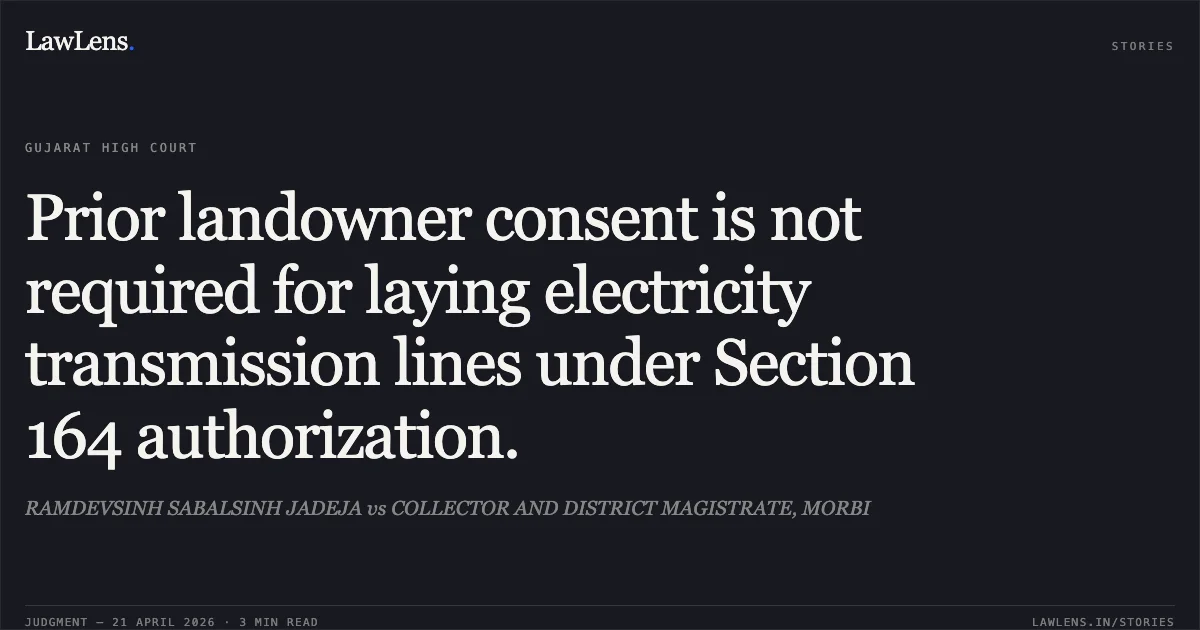
Source reference: p. 192. Whether the prior consent of a landowner is mandatory for laying electricity transmission lines under Section 164 of the Electricity Act, 2003.
Source reference: p. 253. Whether the absence of specific survey numbers in the public notification and the pendency of a compensation dispute vitiate the District Magistrate’s order.
Source reference: p. 11, 25Law Applied
The court applied Section 164 of the Electricity Act, 2003, which allows the government to confer the powers of a "Telegraph Authority" upon any licensee.
Source reference: p. 22It followed Sections 10 and 16 of the Indian Telegraph Act, 1885, where Section 10 grants the power to place telegraph lines without acquiring ownership of the land and Section 16(1) authorizes the District Magistrate to pass an order removing obstructions to such works.
Source reference: p. 5, 22, 6, 23The court relied on the Supreme Court's precedent in Power Grid Corporation of India Ltd. v. Century Textiles & Industries Ltd. (2017), which held that Section 10 does not require the consent of the landowner.
Source reference: p. 10It further applied the principle from Himatbhai Vallabhbhai Patel v. Chief Engineer, GETCO, affirming that the DM’s role under Section 16(1) is administrative and summary in nature.
Source reference: p. 10, 24Reasoning
The court reasoned that once authorization is granted under Section 164 of the Electricity Act, the licensee stands in the shoes of the Telegraph Authority, and the provisions of the Indian Telegraph Act apply in full.
Source reference: p. 25Under Section 10 of the Act, the authority acquires only a "right of user" and not the property itself; thus, prior consent is not a statutory prerequisite.
Source reference: p. 10, 22The DM’s jurisdiction under Section 16(1) is triggered solely by "resistance or obstruction" and is intended to prevent the stalling of public infrastructure projects.
Source reference: p. 11The court found that the Respondent company had issued broad public notices as required and that specific survey numbers need not be mentioned in the initial route notification.
Source reference: p. 25Regarding the petitioners' claims about compensation, the court clarified the distinction between Section 16(1) (to remove obstruction) and Section 16(3) (to determine the sufficiency of compensation), noting that the latter falls under the exclusive jurisdiction of the District Judge.
Source reference: p. 11, 13Holding
The High Court dismissed the petition, upholding the District Magistrate’s order dated 29.07.2025.
The court held that the DM acted within his jurisdiction to remove the obstruction for a project of national importance and that the project could not be stalled over consent or compensation disputes.
Source reference: p. 25The court granted liberty to the petitioners to approach the District Judge under Section 16(3) for any grievance regarding the sufficiency of compensation or to avail remedies as per State Government guidelines.
Source reference: p. 26Rule was discharged with no order as to costs.
Source reference: p. 26Acts & Sections Cited
6 provisions across 3 statutes referred to in this judgment. Each provision opens on LawLens.
Indian Telegraph Act, 18852
Electricity Act, 20033
Indian Penal Code, 18601
Original Court PDF
RAMDEVSINH SABALSINH JADEJAvsCOLLECTOR AND DISTRICT MAGISTRATE, MORBI
Click to open original judgment
Original judgment, available to read, download and summarize on LawLens.in