Facts
During the COVID-19 pandemic, the petitioner/complainant allegedly advanced ₹35,00,000 to the respondent’s business entity for the proposed supply of 3M masks.
Source reference: no citationAs the masks were not supplied, and after certain part-payments were allegedly made, the respondent issued Cheque No. 157774 dated 3 January 2022 for ₹25,00,000.
Source reference: no citationThe cheque was dishonoured on 19 March 2022 for “Funds Insufficient”. A statutory demand notice was issued on 15 April 2022, followed by a complaint under Section 138 of the Negotiable Instruments Act, 1881 (“NI Act”).
Source reference: p.2The Trial Court convicted the respondent and directed payment of a ₹25,00,000 fine with 7% simple interest as compensation.
Source reference: p.3On appeal, the Sessions Court set aside the conviction and acquitted the respondent, holding, inter alia, that the demand notice was defective, part-payments had not been endorsed on the cheque as required under Section 56 NI Act, the WhatsApp evidence did not satisfy Section 65B of the Indian Evidence Act, 1872, and the Trial Court had improperly compared disputed signatures.
Source reference: p.3The complainant consequently approached the High Court against the acquittal.
Source reference: pp.3–4Issues
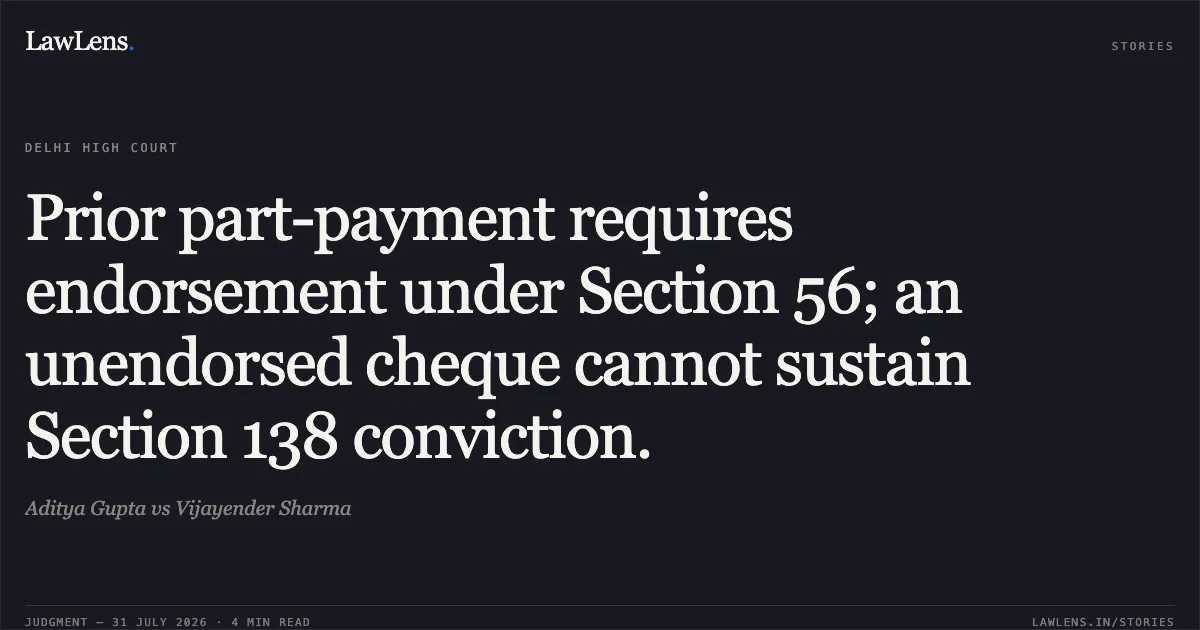
Whether the admitted part-payments made before presentation of the cheque, without corresponding endorsement on the cheque under Section 56 NI Act, affected the maintainability of the prosecution under Section 138 NI Act.
Source reference: pp.5–6, paras. 17–20Whether the statutory demand notice was invalid because it sought amounts in addition to the cheque amount and did not contain a clear and unequivocal demand for payment of the cheque amount.
Source reference: pp.6–7, paras. 21–22Whether the WhatsApp conversations were inadmissible or unreliable owing to deficiencies in the certificate under Section 65B of the Indian Evidence Act.
Source reference: p.7, para. 23Whether the Trial Court improperly compared disputed signatures without appropriate supporting evidence.
Source reference: p.7, para. 24Whether the High Court should interfere with the judgment of acquittal in the absence of perversity, illegality, or manifest error.
Source reference: p.5, para. 18Law Applied
The Court applied Section 419 of the Bharatiya Nagarik Suraksha Sanhita, 2023, corresponding to Section 378 CrPC, governing an appeal against acquittal.
Source reference: p.1, para. 3Sections 118(a) and 139 NI Act create presumptions regarding consideration and the existence of a legally enforceable debt or liability once execution of the cheque is established.
Source reference: p.4, para. 10Section 56 NI Act requires appropriate endorsement where part-payment is made after issuance of a negotiable instrument and before its presentation; the Court relied on Dashrathbhai Trikambhai Patel v. Hitesh Mahendrabhai Patel, (2023) 1 SCC 578, and Starkey Laboratories India Pvt. Ltd. v. Sanjay Gujral.
Source reference: p.6, para. 20A notice under Section 138 NI Act must contain a clear and unequivocal demand for payment of the cheque amount; additional incidental claims do not automatically invalidate a notice, but ambiguity as to the cheque amount may do so. The Court considered Suman Sethi v. Ajay K. Churiwal, (2000) 2 SCC 380, and Kaveri Plastics v. Mahdoom Bava Baharudeen Noorul, 2025 INSC 1133.
Source reference: pp.4, 6–7, paras. 12–13, 22Electronic records must satisfy the requirements of Section 65B of the Indian Evidence Act, including identification of the source device and necessary particulars establishing authenticity.
Source reference: p.7, para. 23In an appeal against acquittal, interference is justified only where the findings are manifestly erroneous, perverse, or contrary to the evidence; the mere possibility of another view is insufficient.
Source reference: p.5, para. 18Reasoning
The High Court found that the complainant’s own pleadings admitted receipt of aggregate part-payments of ₹12,51,000 before presentation of the cheque.
Source reference: p.5, para. 19Since the cheque was nevertheless presented for its original amount without an endorsement recording the reduced liability, the Appellate Court was justified in applying Section 56 NI Act, and its conclusion disclosed no legal infirmity.
Source reference: p.6, para. 20The demand notice also claimed losses, interest, and other amounts exceeding ₹1 crore, rather than clearly and unequivocally confining the demand to the ₹25,00,000 cheque amount.
Source reference: pp.6–7, paras. 21–22Accordingly, the Appellate Court’s finding that the notice did not satisfy Section 138 was supported by the record and was not perverse.
Source reference: pp.6–7, paras. 21–22The WhatsApp material was rightly treated as deficient because the Section 65B certificate did not identify the source device or provide the particulars necessary to establish authenticity; in any event, the chats did not conclusively prove the applicable interest rate or outstanding liability.
Source reference: p.7, para. 23The High Court also upheld the finding that the Trial Court had improperly compared disputed signatures without appropriate evidence.
Source reference: p.7, para. 24Given these concurrent evidentiary and statutory deficiencies, and the restricted scope of review in an appeal against acquittal, no ground for interference was established.
Source reference: pp.7–8, paras. 25–26Holding
The High Court held that the Appellate Court had correctly set aside the conviction because the cheque had been presented for the original amount despite admitted prior part-payments, the statutory notice lacked a clear and unequivocal demand for the cheque amount, and the supporting electronic and signature evidence was deficient.
The petition/appeal against acquittal was dismissed, the judgment dated 29 January 2026 acquitting the respondent was affirmed, and all pending applications were disposed of.
Source reference: p.8, paras. 27–29Original Court PDF
Aditya GuptavsVijayender Sharma
Click to open original judgment
Original judgment, available to read, download and summarize on LawLens.in