Facts
The CBI registered RC No. 2202022E0001 concerning alleged irregularities in a cash-credit facility extended by Punjab National Bank to M/s Skyworld Exim. A charge sheet dated 31 March 2023 was filed against Rajnish Gupta under Sections 120-B/420/468/471 IPC, followed by a supplementary charge sheet dated 23 June 2023 against Nisha Gupta. Neither petitioner was arrested during investigation; cognizance had not been taken and no summons had been issued.
Source reference: p. 2, paras. 2–3An LOC issued against the petitioners was challenged before the Trial Court. By order dated 30 April 2024, the Trial Court rescinded the LOC but directed that the petitioners could not leave India without its prior permission.
Source reference: p. 2, para. 4The petitioners challenged the continuing travel restriction under Article 226 of the Constitution read with Section 528 of the BNSS, contending that it imposed an undue restraint on their right to travel abroad.
Source reference: p. 2, para. 1; p. 3, para. 7Issues
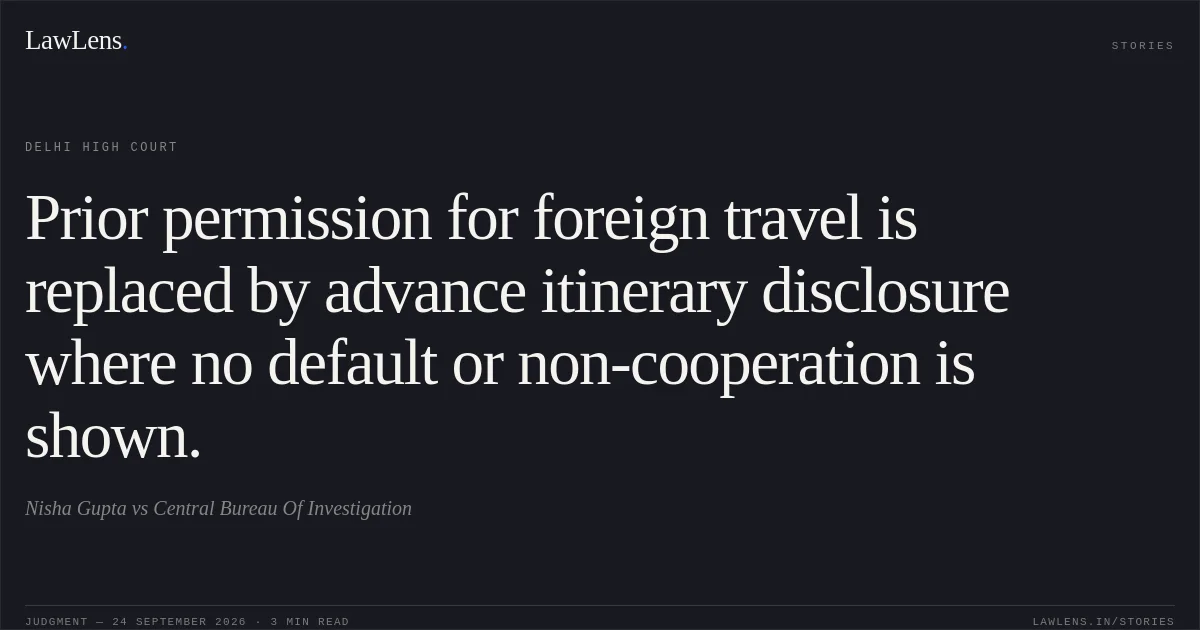
Whether, after rescinding the LOC, the Trial Court could sustain a condition requiring the petitioners to obtain prior permission before every foreign visit, particularly when they had not been arrested, cognizance had not been taken, and no non-cooperation or default was established.
Source reference: p. 4, paras. 10–13Whether the requirement of prior permission should be replaced with a less restrictive obligation to provide advance intimation of the petitioners’ travel details to the Trial Court and the investigating agency.
Source reference: p. 3, para. 7; p. 5, para. 15Law Applied
The Court exercised jurisdiction under Article 226 of the Constitution read with Section 528 of the BNSS.
Source reference: p. 2, para. 1It applied the principle that the right to travel abroad forms part of personal liberty under Article 21, and that any restriction must be lawful, reasonable, and connected with the purpose of securing the accused’s presence in criminal proceedings.
Source reference: p. 4, para. 12The Court relied upon Karti P. Chidambaram v. Central Bureau of Investigation, BAIL APPLN. 573/2018, for the principle that the purpose of regulating foreign travel may, where appropriate, be achieved through prior intimation rather than prior permission.
Source reference: p. 3, para. 7The CBI relied upon Seesa Santosh v. State of Telangana, 2026 SCC OnLine SC 1071, in support of the restriction.
Source reference: p. 3, para. 8Reasoning
The Court held that the restriction had to be assessed against the present procedural circumstances. The petitioners had joined the investigation, had not been arrested, and the charge sheets had been filed without arrest; moreover, cognizance had not been taken, summons had not been issued, and there was no material showing non-cooperation or default.
Source reference: p. 4, paras. 10–11Since the Trial Court itself had found continuation of the LOC unjustified, requiring prior permission for every foreign visit imposed a continuing and disproportionate restraint on personal liberty, without a demonstrated necessity to secure the petitioners’ presence.
Source reference: p. 4, paras. 11–14The Court therefore considered advance disclosure of travel particulars to be a sufficient and less restrictive safeguard.
Source reference: p. 5, para. 15Holding
The petitions were allowed in part. The condition in the Trial Court’s order dated 30 April 2024 prohibiting the petitioners from leaving India without prior permission was modified.
The petitioners must instead intimate the Trial Court and the CBI of their full travel itinerary, duration of travel, places of stay, and contact details at least two weeks before each foreign trip.
Source reference: p. 5, para. 15They must remain available to participate in the proceedings when required and may not seek adjournment on account of such travel.
Source reference: p. 5, para. 15All other directions in the Trial Court’s order remained unaffected, and the Court clarified that its decision was confined to the peculiar facts of the case and would not operate as a precedent.
Source reference: p. 5, paras. 16–18Acts & Sections Cited
4 provisions across 2 statutes referred to in this judgment. Each provision opens on LawLens.
Bharatiya Nagarik Suraksha Sanhita, 20231
Indian Penal Code, 18603
Original Court PDF
Nisha GuptavsCentral Bureau Of Investigation
Click to open original judgment
Original judgment, available to read, download and summarize on LawLens.in