Facts
The Petitioner (Defendant No. 4) challenged a Trial Court order dated 06.12.2023.
Source reference: p. 3Respondent No. 1 (Plaintiff) filed a suit for specific performance of an agreement of sale dated 23.06.2018.
Source reference: p. 3During evidence, the Petitioner objected to the marking of the agreement, alleging it was is insufficiently stamped and unregistered because it recited delivery of possession.
Source reference: p. 3The agreement contained a clause stating the Plaintiff was already in possession and residing in the house for approximately two years prior to the agreement's execution.
Source reference: para. 6The Plaintiff paid deficit stamp duty and penalty under Article 5(e)(ii) of the Karnataka Stamp Act, but the Petitioner contended it must be taxed as a conveyance under Article 5(e)(i).
Source reference: para. 2, 8Issues
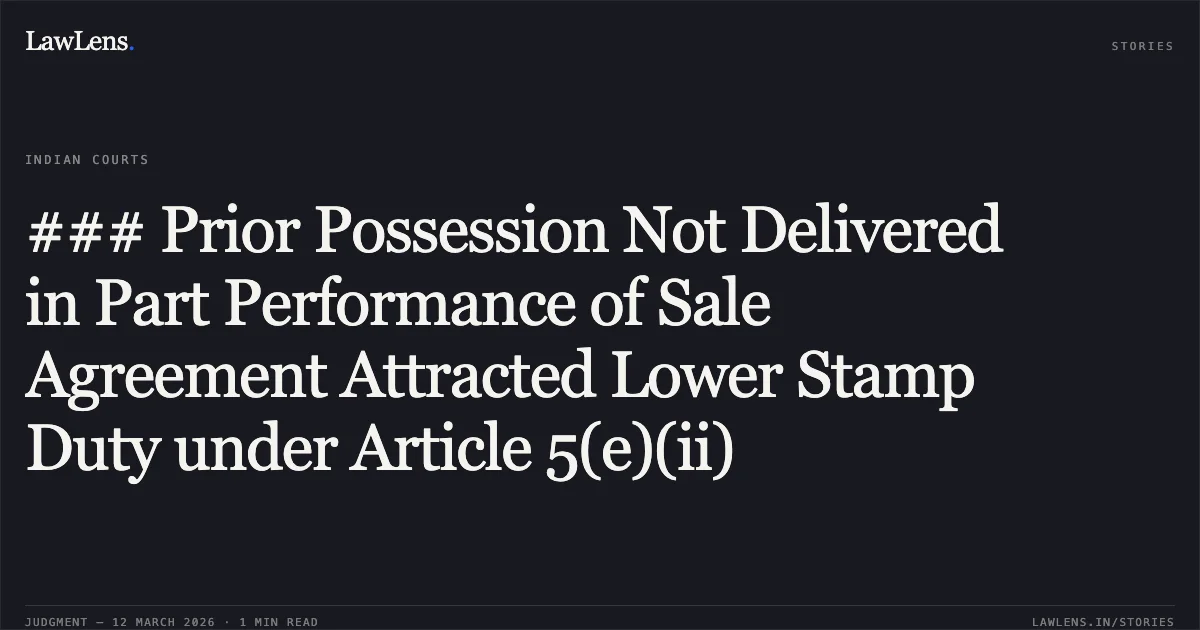
Whether an agreement of sale that recognizes possession delivered *prior* to the contract (and not in part performance of said contract) attracts stamp duty as a conveyance under Article 5(e)(i) of the Karnataka Stamp Act, 1957.
Source reference: para. 5, 9Law Applied
The Court applied Article 5(e) of the Karnataka Stamp Act, 1957.
Source reference: no citationArticle 5(e)(i) mandates stamp duty equivalent to a conveyance (Article 20) if possession is delivered or agreed to be delivered "in part performance of the contract".
Source reference: para. 8, 9Conversely, Article 5(e)(ii) applies if possession is not delivered under the instrument.
Source reference: para. 8The Court relied on *Danappagouda Fakkiragouda Patil v. Kamalawwa* and the Supreme Court decision in *Vijay Kumar Goyal v. Neena Rani*, establishing that for Article 5(e)(i) to apply, the delivery of possession must be a result of the agreement itself in part performance, rather than a mere recital of pre-existing possession.
Source reference: para. 10(a), 10(f)Reasoning
The Court examined the specific language of the agreement, which stated that the first party "gave possession to the second party about 2 years ago" and the second party "is already residing" there.
Source reference: para. 6The Court reasoned that Article 5(e)(i) requires two specific conditions: (a) delivery of possession under the agreement or (b) an agreement to deliver possession before the final conveyance, both specifically in "part performance" of the contract.
Source reference: para. 9, 11In this case, since the Plaintiff was already in physical possession years before the agreement was drafted, the possession was not transferred *by* or *in part performance of* the 2018 agreement.
Source reference: para. 11The Court distinguished cases cited by the Petitioner by noting that those agreements explicitly stated possession was being handed over "in part performance," whereas the present instrument merely acknowledged a historical fact of pre-existing possession.
Source reference: para. 12-15Therefore, the instrument did not fall under the higher tax bracket of Article 5(e)(i).
Source reference: para. 16Holding
The Court answered the issue in the negative, holding that pre-existing possession not delivered in part performance of the suit agreement does not attract duty under Article 5(e)(i).
The High Court upheld the Trial Court's order, confirming that the stamp duty and penalty paid under Article 5(e)(ii) were appropriate.
Source reference: para. 16The Writ Petition was rejected.
Source reference: para. 17Acts & Sections Cited
3 provisions across 2 statutes referred to in this judgment. Each provision opens on LawLens.
Registration Act, 19081
KARNATAKA STAMP ACT, 19572
Original Court PDF
Smt. Anitha Shanti Vaz v. Smt. Noothan Shetty & Ors. W.P. No. 2065/2024 (GM-CPC); NC: 2026:KHC:14464
Click to open original judgment
Original judgment, available to read, download and summarize on LawLens.in