Facts
Respondent Ramesh Chand claimed ownership via a chain of Wills: from original allottee Om Prakash to Munno Devi (1964), and Munno Devi to himself (1992)
Source reference: para. 2Appellant Uttam Pandit claimed ownership through an Agreement to Sell and GPA (1987/1988) executed by Suraj Prakash, whom he alleged was Om Prakash's adopted son
Source reference: para. 11, 21Ramesh Chand filed a suit for possession alleging Uttam Pandit was a trespasser who forcibly occupied a room in 1994
Source reference: para. 7Uttam Pandit filed a cross-suit for possession of another room
Source reference: para. 23The Trial Court dismissed both suits, finding neither party proved absolute title
Source reference: para. 19, 32On appeal, the District Judge reversed the dismissal of Ramesh Chand's suit, granting him possession on the basis of "better possessory title"
Source reference: para. 37Issues
1. Whether a party can be granted a decree of possession based on "better possessory title" in the absence of registered ownership documents
Source reference: para. 53, 712. Whether documents such as GPA, Agreement to Sell, and unregistered Wills create a transferable interest in immovable property
Source reference: para. 31, 35, 73Law Applied
The Court applied the doctrine of "Possessory Title" as distinguished from "Proprietary Title," noting that under Indian law, a person in peaceful possession has a good title against the entire world except the rightful owner
Source reference: para. 57, 62It relied on Articles 64 and 65 of the Limitation Act, 1963, which recognize suits based on previous possession
Source reference: para. 63Nair Service Society Ltd. v. K. C. Alexander, establishing that when neither party shows perfect title, possession decides
Source reference: para. 61Rame Gowda v. M. Varadappa Naidu, which held that prior peaceful settled possession is evidence of title
Source reference: para. 67-68The court also applied Suraj Lamp & Industries (P) Ltd. (2) v. State of Haryana, affirming that GPA/Agreement to Sell transactions do not confer legal title
Source reference: para. 31Reasoning
The Court noted that since both parties derived their claims from a common ancestor, Om Prakash, the case turned on who held the "better" right to possess
Source reference: para. 51, 54The Court found the Respondent's chain of documents (Wills and Revenue records) more credible than the Appellant's claims
Source reference: para. 75Critically, the Court observed that Munno Devi (Respondent's predecessor) had previously successfully litigated against Suraj Prakash (Appellant's predecessor) to recover possession, meaning the Appellant’s occupation was never "settled" or "acquiesced to" by the true owners
Source reference: para. 34, 74Conversely, the Appellant failed to prove Suraj Prakash’s status as an adopted son or his own status as a lawful purchaser under the Suraj Lamp dictates
Source reference: para. 31, 73Thus, the Respondent demonstrated a superior entitlement to remain in possession compared to the Appellant
Source reference: para. 70, 75Holding
The High Court held that while neither party proved absolute ownership through registered deeds, Ramesh Chand established a "better possessory title" through a consistent chain of testamentary succession and prior litigation
The High Court dismissed the Second Appeals, upholding the District Judge’s judgment
Source reference: para. 76-77Acts & Sections Cited
1 provisions across 1 statute referred to in this judgment. Each provision opens on LawLens.
Transfer of Property Act, 18821
Original Court PDF
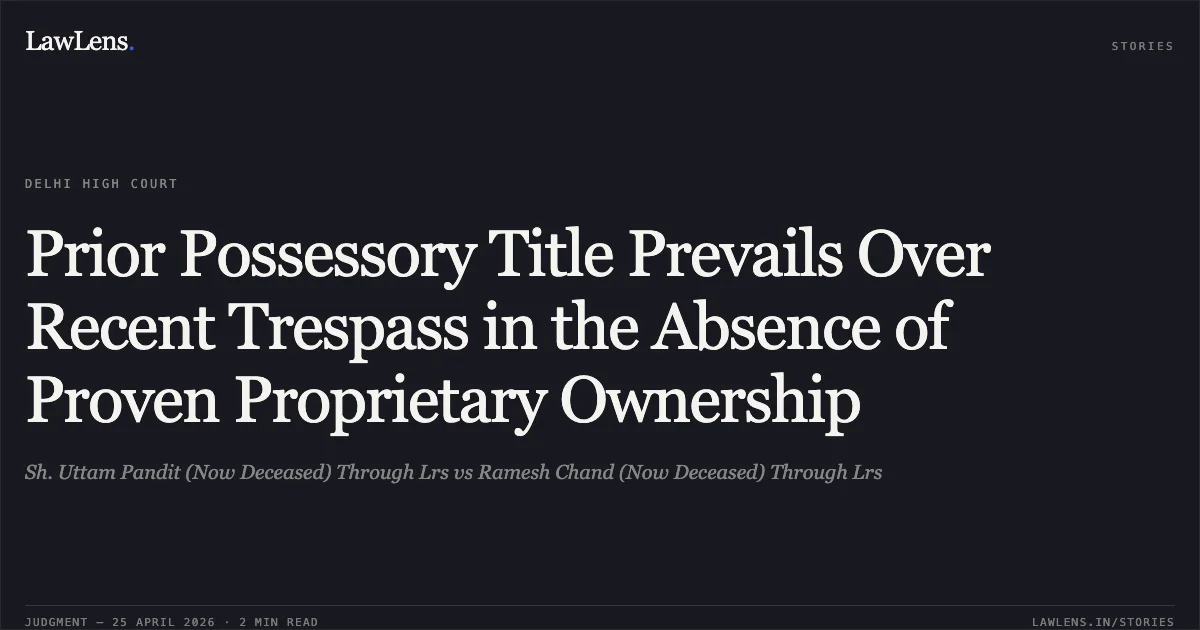
Sh. Uttam Pandit (Now Deceased) Through LrsvsRamesh Chand (Now Deceased) Through Lrs
Click to open original judgment
Original judgment, available to read, download and summarize on LawLens.in