01Facts
The Appellant, a convict lodged in Tihar Jail, filed a Writ Petition [W.P.(C) 2656/2025] seeking the implementation of revised minimum wages for prison labour in accordance with an order dated 20.04.2023 issued by the Office of the Commissioner (Labour), GNCTD
¶ 4, 6A learned Single Judge disposed of the petition on 17.04.2026, directing the Appellant to file a representation before a committee of the High Court instead of granting the relief directly
¶ 4-5The Appellant challenged this order via an intra-Court appeal, asserting that the revised wages should apply to prison labour engaged in Scheduled Employment from 01.04.2023
¶ 6-702Issues
i.1. Whether the learned Single Judge erred in directing the filing of a representation before a committee instead of adjudicating the prayer for payment of revised minimum wages
¶ 8ii.2. Whether convicts employed in Scheduled Employment within the prison are entitled to revised minimum wages as per the Commissioner (Labour) order dated 20.04.2023
¶ 7, 1003Law Applied
The Court primarily applied the Minimum Wages Act, 1948, which governs the revision and payment of rates for unskilled, semi-skilled, and skilled categories of workmen in Scheduled Employment
¶ 7The Court further relied on the judicial precedent established in W.P.(C) 8299/2023 (order dated 04.12.2023), which held that revised minimum wages must be implemented from the date they are increased by the GNCTD, rather than an arbitrary later date
¶ 9Provisions in the judgment · 1
Minimum Wages Act, 1948 Section 1
04Reasoning
The Division Bench reasoned that the order dated 20.04.2023, originating from the Minimum Wages Act, 1948, creates a statutory obligation to pay revised wages to all categories of workmen in Scheduled Employment; prisoners are not an exception to this mandate
¶ 7The Court found that the Single Judge’s direction to refer the matter to a committee was irrelevant to the adjudication of the legal right claimed by the Appellant
¶ 8Citing the precedent in W.P.(C) 8299/2023, the Court observed that parity must be maintained, and since the wages were increased by the GNCTD effective from 01.04.2023, the same benefit must accrue to prison inmates from that specific date
¶ 9-1105Holding
The Court allowed the appeal and set aside the Impugned Order dated 17.04.2026
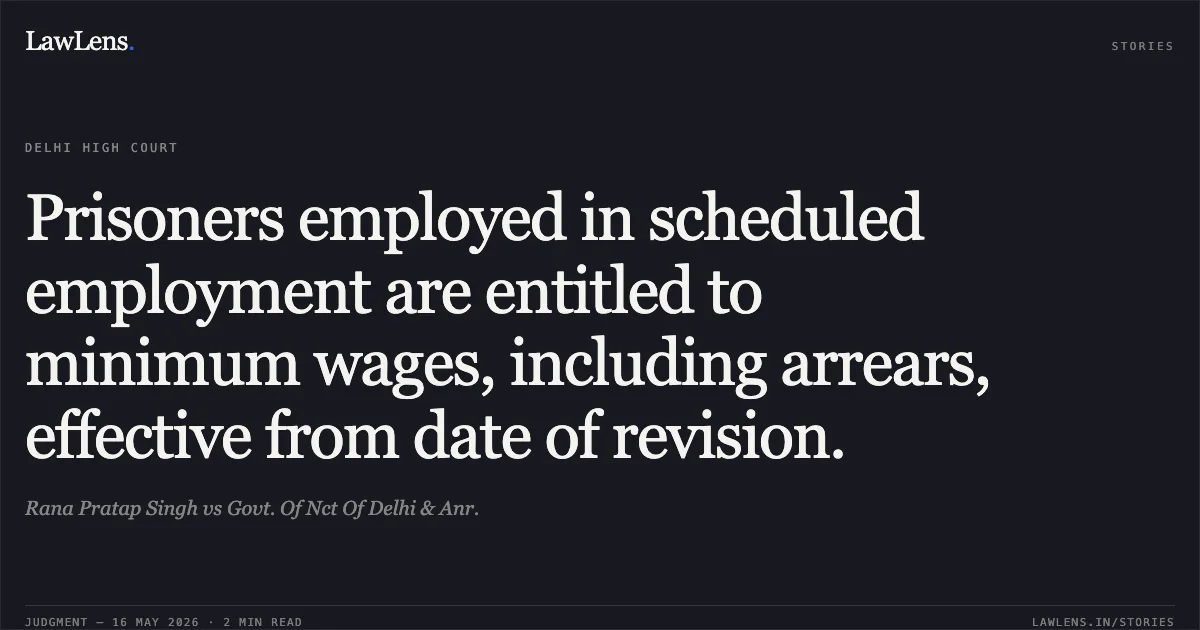
¶ 11It held that the Appellant and all similarly situated prisoners are entitled to the revised minimum wages effective from 01.04.2023
¶ 11, 13The Court directed the Respondents to: (i) commence payment of revised wages within two weeks; and (ii) pay all arrears to the Appellant and all other prisoners employed in Scheduled Employment within six weeks
¶ 13Original Court PDF
Rana Pratap SinghvsGovt. Of Nct Of Delhi & Anr.
Click to open original judgment
Original judgment, available to read, download and summarize on LawLens.in