Facts
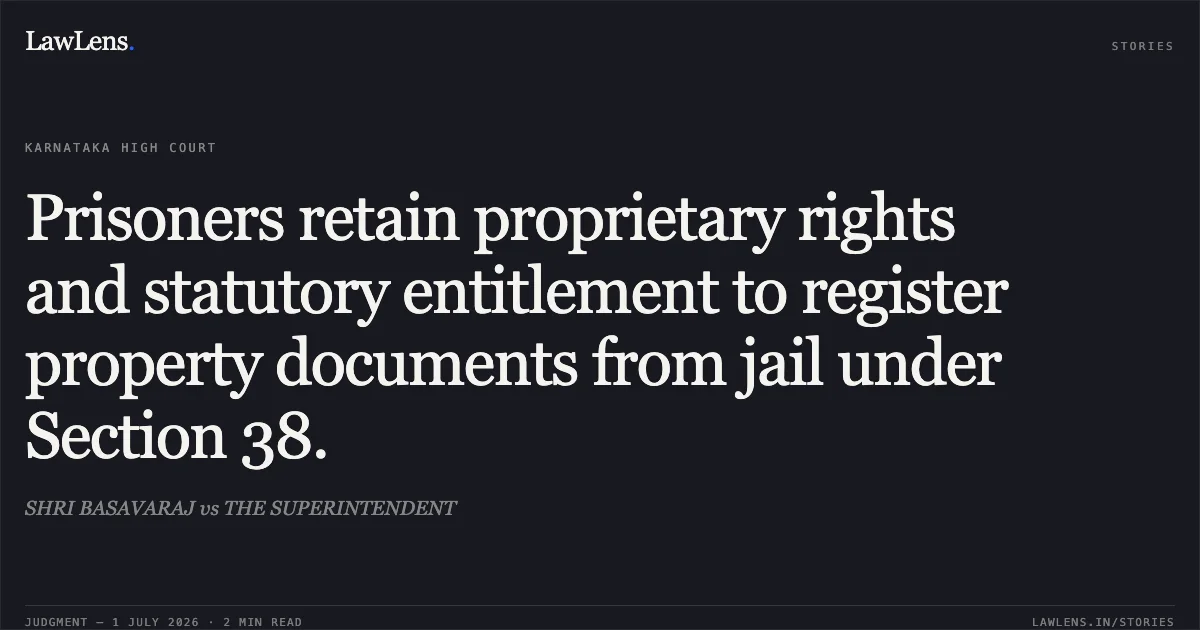
The petitioner, an under-trial prisoner lodged at Central Prison, Dharwad, sought to execute and register a sale deed for his immovable property (Sy. No. 29 Block Hissa No. 5 at Kamalapur Village)
Source reference: p. 1-2Due to his incarceration, he could not personally appear before the Sub-Registrar. Although the Sub-Registrar had communicated with the prison authorities to facilitate registration within the jail, the communication was allegedly never placed before the competent prison authority, resulting in inaction
Source reference: p. 3The petitioner approached the High Court seeking a writ of mandamus to compel the authorities to facilitate the registration process
Source reference: p. 2Issues
1. Whether a person confined in jail is exempt from personal appearance at the registration office and can execute/register property documents within the prison premises under the Registration Act, 1908?
Source reference: p. 4-52. Whether the incarceration of an under-trial prisoner divests them of their proprietary rights to alienate or deal with their property?
Source reference: p. 7Law Applied
Section 38 of the Registration Act, 1908, which expressly exempts persons in jail under civil or criminal process from attending the registration office and mandates that the Registering Officer shall either visit the person in jail or issue a commission for their examination
Source reference: p. 5-6The court further relied on the constitutional principle that an under-trial prisoner does not suffer "civil death"; they retain all proprietary and civil rights available to ordinary citizens, including the right to alienate property, subject only to necessary prison discipline and security regulations
Source reference: p. 7Reasoning
The court reasoned that Section 38 of the Act is couched in mandatory language to address the physical incapacity of prisoners to attend public offices
Source reference: p. 6It observed that the legislature intended to ensure that legal incapacity caused by confinement does not lead to the deprivation of lawful property rights
Source reference: p. 6The court rejected the notion that criminal prosecution extinguishes civil rights, noting that an under-trial prisoner remains "clothed with all proprietary rights"
Source reference: p. 7Applying this to the facts, the court found that since the Sub-Registrar was willing to visit the jail, the prison authorities had a public duty to facilitate this access
Source reference: p. 8Administrative inconvenience or internal communication failures between departments cannot be used as a ground to defeat a statutory right
Source reference: p. 8-9Holding
The court allowed the writ petition, holding that the petitioner possesses an enforceable statutory right under Section 38 of the Act
The court directed Respondent No. 1 (Superintendent of Central Prison) to permit Respondent No. 2 (Sub-Registrar) to enter the prison to complete the registration process, including obtaining signatures and conducting the required examination
Source reference: p. 9-10Respondent No. 2 was ordered to complete this exercise within four weeks, subject to compliance with prison security protocols
Source reference: p. 10Acts & Sections Cited
1 provisions across 1 statute referred to in this judgment. Each provision opens on LawLens.
Registration Act, 19081
Original Court PDF
SHRI BASAVARAJvsTHE SUPERINTENDENT
Click to open original judgment
Original judgment, available to read, download and summarize on LawLens.in