Facts
The Petitioner, a senior citizen and freelancer, maintained savings and current accounts with HDFC Bank (Respondent No. 3).
Source reference: para 4On July 14, 2021, unknown fraudsters added three beneficiaries to his accounts and enhanced the daily net-banking transfer limit from Rs. 4,00,000 to Rs. 40,00,000
Source reference: para 4On July 15, 2021, a sum of Rs. 38,04,000 was unauthorizedly withdrawn through eight transactions within 41 minutes
Source reference: para 1The Petitioner alleged that he never received One-Time Passwords (OTPs) for beneficiary addition or limit enhancement
Source reference: para 4HDFC Bank refused to reverse the debits, claiming the transactions were authenticated via OTPs and the Petitioner must have compromised his credentials
Source reference: para 5The Banking Ombudsman closed the Petitioner’s complaint, finding no deficiency in service
Source reference: para 8BSNL (Respondent No. 5) filed an affidavit revealing that the Petitioner’s SIM card had been "swapped" four times in four days between July 12 and 15, 2021, using forged documents and impersonation at various service centers
Source reference: para 74-75Issues
1. Whether a Writ Petition under Article 226 of the Constitution is maintainable against a private scheduled bank for the enforcement of Reserve Bank of India (RBI) guidelines
Source reference: para 31, 502. Whether the Petitioner is entitled to "Zero Liability" for unauthorized electronic transactions under the RBI Circular dated July 6, 2017
Source reference: para 9, 773. Whether the bank discharged its burden of proving customer negligence in cases of unauthorized electronic banking transactions
Source reference: para 67, 69Law Applied
Article 226 of the Constitution of India regarding the High Court's power to issue writs to any person or authority for the enforcement of rights
Source reference: para 31Section 35A of the Banking Regulation Act, 1949, which empowers the RBI to issue binding directions in the public interest
Source reference: para 47, 50RBI Circular “Customer Protection – Limiting Liability of Customers in Unauthorised Electronic Banking Transactions” (July 6, 2017), which establishes "Zero Liability" for customers in cases of third-party breaches where the customer notifies the bank within three working days
Source reference: para 9, 49the "function test" from S. Shobha v. Muthoot Finance Ltd.
Source reference: para 41principles from Federal Bank Ltd. v. Sagar Thomas, distinguishing between purely private contracts and duties involving a public law element
Source reference: para 34-36Reasoning
while HDFC is a private entity and not "State" under Article 12, it is a scheduled bank operating under the regulatory control of the RBI.
Source reference: para 50, 56, 60Since the RBI issued the 2017 Circular under Section 35A in the "public interest" to protect customers in the digital ecosystem, the enforcement of these mandatory guidelines involves a public law element, making the bank's refusal to comply amenable to writ jurisdiction
Source reference: para 50, 56, 60under the 2017 Circular, the burden of proof lies solely on the bank to establish customer negligence
Source reference: para 67The BSNL evidence of "SIM Swapping" confirmed that the Petitioner’s mobile signal was intercepted by fraudsters; thus, any OTPs sent by the bank were received by the cloned SIM, not the Petitioner
Source reference: para 76the bank's own internal logs showed that the transactions originated from IP addresses in Chennai, whereas the Petitioner’s genuine transactions originated from Pune
Source reference: para 78The court found that the bank failed to prove the Petitioner shared his password or acted negligently, and the fraud occurred due to a system breach elsewhere
Source reference: para 77, 79Holding
The court allowed the Writ Petition and quashed the Banking Ombudsman’s order
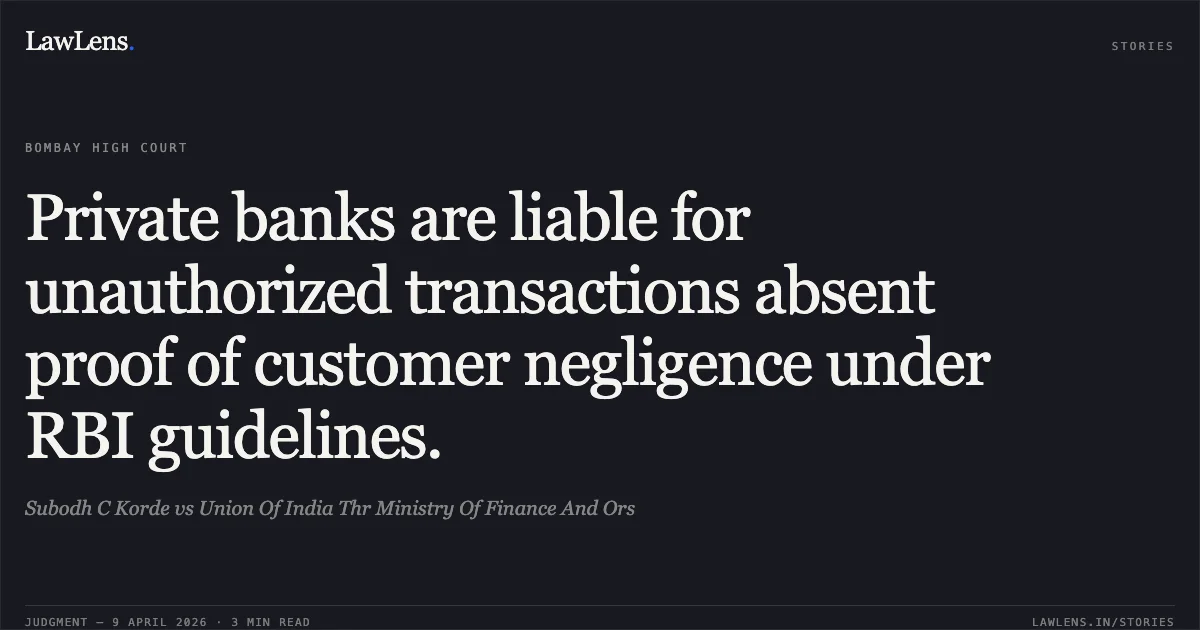
It held that the Petitioner was a victim of cyber fraud with "Zero Liability" under the RBI Circular dated July 6, 2017, as he reported the fraud promptly and no negligence was proven against him
Source reference: para 77, 80The High Court directed HDFC Bank to remit Rs. 38,04,000 to the Petitioner’s account within eight weeks, along with interest at 6% per annum from the date of the unauthorized transactions
Source reference: para 80Failure to remit within the stipulated time would attract an enhanced interest rate of 8% per annum
Source reference: para 80Acts & Sections Cited
13 provisions across 4 statutes referred to in this judgment. Each provision opens on LawLens.
Indian Penal Code, 18605
Information Technology Act, 20001
Reserve Bank of India Act, 19344
Banking Regulation Act, 19493
Original Court PDF
Subodh C KordevsUnion Of India Thr Ministry Of Finance And Ors
Click to open original judgment
Original judgment, available to read, download and summarize on LawLens.in