Facts
The petitioner, owner and operator of Devi Villa Homestay, was arrayed as Accused No.2 in Crime No.34/2026 of Kutta Police Station and C.C. No.575/2026 before the Civil Judge and JMFC, Ponnampet.
Source reference: paras. 2.3–2.7; pp. 4–7The complainant, a U.S. national holding a valid Indian tourist visa, alleged that she was sexually assaulted by the homestay’s cook/housekeeper during her stay from 12 to 18 April 2026.
Source reference: paras. 2.3–2.7; pp. 4–7The petitioner was not alleged to have been present when the incident occurred and, according to the complainant’s statement, she did not inform him of the alleged assault at the relevant time.
Source reference: paras. 2.3–2.7; pp. 4–7The FIR was registered on 18 April 2026 for offences under Sections 64(1), 351(2), 238 and 239 of the Bharatiya Nyaya Sanhita, 2023 (“BNS”), while Section 3(5) BNS was later introduced at the remand stage.
Source reference: paras. 2.8–2.9; pp. 7–8The charge sheet dated 7 June 2026 dropped the substantive sexual-offence allegations against the petitioner but charged him under Section 239 BNS and Sections 7 read with 14 of the Foreigners Act, 1946, alleging that he failed to report the offence and failed to furnish information regarding the foreign guest.
Source reference: para. 2.13; p. 9The petitioner invoked Section 528 of the Bharatiya Nagarik Suraksha Sanhita, 2023 (“BNSS”) to quash the charge sheet, cognizance order and consequential proceedings.
Source reference: p. 2Issues
Whether the petitioner could be prosecuted under Sections 7 read with 14 of the Foreigners Act, 1946 for an alleged omission occurring on 12 April 2026, after that enactment had been repealed with effect from 1 September 2025?
Source reference: paras. 9–17; pp. 20–31Whether the allegations and materials disclosed the ingredients of Section 239 BNS, particularly that the petitioner had knowledge of the offence, intentionally omitted to report it, and was legally bound to furnish such information?
Source reference: paras. 18–23, 30–33; pp. 31–42Whether the High Court could quash the charge sheet after its filing where the alleged offences were not made out in law?
Source reference: paras. 34–40; pp. 42–50Law Applied
The Court applied Section 528 BNSS, corresponding to the inherent jurisdiction under Section 482 of the Code of Criminal Procedure, 1973, to prevent abuse of process and secure the ends of justice.
Source reference: no citationSections 7 and 14 of the Foreigners Act, 1946 could not govern conduct occurring after that statute was repealed by Section 36(1) of the Immigration and Foreigners Act, 2025; the saving clauses in Section 36(2)–(3) and Section 6 of the General Clauses Act, 1897 preserve past actions and liabilities but do not revive a repealed penal provision for future conduct.
Source reference: paras. 10–16; pp. 20–31Article 20(1) of the Constitution prohibits conviction except for violation of a law in force at the time of the alleged act.
Source reference: para. 12; pp. 22–24Section 239 BNS requires proof of three cumulative ingredients: knowledge or reason to believe that an offence had been committed, intentional omission to provide information, and a legal obligation to provide that information.
Source reference: paras. 18–21; pp. 31–34Section 33 BNSS imposes a reporting duty only in respect of specifically enumerated offences; sexual offences are not included in that list.
Source reference: paras. 22–29; pp. 34–40The Court relied on Harishchandrasinh Sajjansinh Rathod v. State of Gujarat , (1979) 4 SCC 502, for the ingredients of the predecessor provision, Section 202 IPC; Kolhapur Canesugar Works Ltd. v. Union of India , (2000) 2 SCC 536, on the effect of repeal and saving provisions; Anand Kumar Mohatta v. State (NCT of Delhi) , (2019) 11 SCC 706, and Mahmood Ali v. State of U.P. , 2023 SCC OnLine SC 950, for the availability of inherent jurisdiction after filing of the charge sheet; and State of Haryana v. Bhajan Lal , 1992 Supp (1) SCC 335, particularly the categories where the allegations, even if accepted, do not constitute an offence.
Source reference: no citationReasoning
The Court held that the Foreigners Act, 1946 had ceased to exist before the alleged omission on 12 April 2026.
Source reference: paras. 10–17; pp. 20–31Consequently, Sections 7 and 14 of that Act could not provide the statutory basis for the petitioner’s prosecution; Section 36 of the Immigration and Foreigners Act, 2025 saved only actions or liabilities originating while the repealed statute was in force and did not create future liability under it.
Source reference: paras. 10–17; pp. 20–31As to Section 239 BNS, the Court treated the legal-duty requirement as foundational.
Source reference: paras. 18–23, 30–33; pp. 31–42Although the prosecution alleged that the petitioner knew of the incident and failed to report it, Section 33 BNSS did not impose a general duty on private citizens to report every offence and did not include the alleged sexual offence among the specified offences.
Source reference: paras. 18–23, 30–33; pp. 31–42The petitioner was a private homestay owner, not a person shown to be subject to any special statutory reporting obligation.
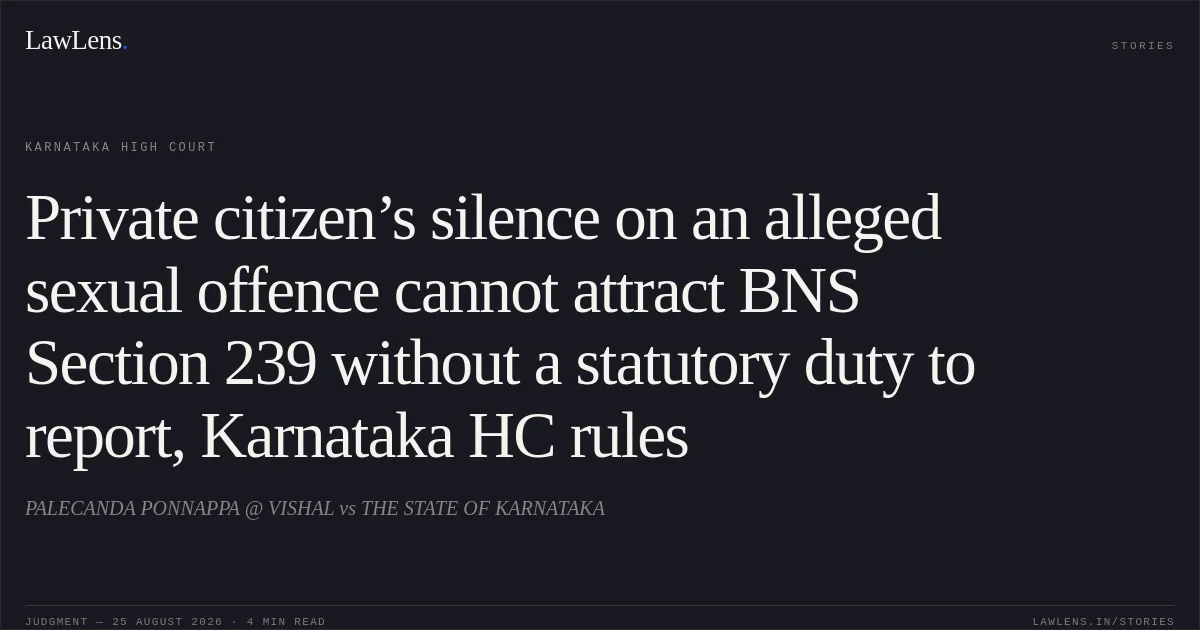
Source reference: no citationTherefore, the alleged silence could not amount to an intentional omission punishable under Section 239 BNS.
Source reference: no citationThe Court further held that the filing of the charge sheet did not bar scrutiny under Section 528 BNSS, particularly where the foundational ingredients of the offences were absent rather than merely unsupported by sufficient evidence.
Source reference: paras. 34–40; pp. 42–50Holding
The petition was allowed.
The charge sheet dated 7 June 2026 in Crime No.34/2026, pending in C.C. No.575/2026, together with the cognizance and consequential proceedings, was quashed insofar as they concerned the petitioner.
Source reference: para. 42(i)–(ii); pp. 50–51The Court held that the charges under Sections 7 read with 14 of the Foreigners Act, 1946 were legally untenable because the statute had been repealed before the alleged conduct, and the charge under Section 239 BNS failed for want of a statutory duty to report.
Source reference: no citationThe Court clarified that its observations were confined to the petitioner’s case and would not affect proceedings against the other accused.
Source reference: para. 42(iii); p. 51Acts & Sections Cited
66 provisions across 7 statutes referred to in this judgment. Each provision opens on LawLens.
Bharatiya Nagarik Suraksha Sanhita, 20234
Bharatiya Nyaya Sanhita, 2023
Code of Criminal Procedure, 19734
Immigration and Foreigners Act, 20252
General Clauses Act, 18971
Indian Penal Code, 18603
Protection of Children from Sexual Offences Act, 20122
Original Court PDF
PALECANDA PONNAPPA @ VISHALvsTHE STATE OF KARNATAKA
Click to open original judgment
Original judgment, available to read, download and summarize on LawLens.in
![Courts will not interfere with transfers absent mala fides or violation of statutory rules.. M Ramya vs EMPLOYEES STATE INSURANCE CORPORATION (ESIC). CAT - ['Chennai']. LawLens](/stories/thumbnails/courts-will-not-interfere-with-transfers-absent-mala-fides-or-violation-of-statutory-rules-a6845e9ca6f548fca284c51c8351957f.webp)
![Courts cannot direct one-time recruitment age relaxation absent authority in the governing rules or advertisement.. UT OF PUDUCHERRY vs M ANDAL. CAT - ['Chennai']. LawLens](/stories/thumbnails/courts-cannot-direct-one-time-recruitment-age-relaxation-absent-authority-in-the-governing-895d78fde47143e2a8ed0207c4b6a44f.webp)
![A review cannot correct an allegedly erroneous decision absent an error apparent on the record.. Ajit Kumar Jha vs RAILWAY BOARD. CAT - ['Delhi']. LawLens](/stories/thumbnails/a-review-cannot-correct-an-allegedly-erroneous-decision-absent-an-error-apparent-on-the-re-8ac952fd4eba470c92f7da20af72a220.webp)