Facts
Two batches of MBBS students (2013-14 and 2014-15) were admitted to Sardar Rajas Medical College, Hospital and Research Centre (SRMCH), managed by Selvam Educational and Charitable Trust.
Source reference: para. 7Due to severe infrastructure and faculty deficiencies, the Medical Council of India (MCI) denied renewal of recognition.
Source reference: para. 7, 27To protect the students' academic careers, the High Court of Orissa and subsequently the Supreme Court directed their relocation to recognized private medical colleges (KIMS, SUM Hospital, and Hi-Tech Medical College).
Source reference: para. 4, 11Under interim orders, these students paid fees at highly subsidized government rates (~Rs. 30,000/annum) instead of the private college rates they initially contracted for at SRMCH.
Source reference: para. 12, 14, 33The transferee colleges filed interlocutory applications seeking reimbursement for the education imparted and stipends paid, as a substantial portion of fees remained outstanding.
Source reference: para. 5, 20Issues
1. Whether the relocated students are liable to pay fees at government rates or at the rates applicable to private medical colleges for the duration of their course.
Source reference: para. 252. How the financial liability and differential fee amounts should be equitably apportioned between the students, the defaulting Selvam Trust, and regulatory bodies.
Source reference: para. 25Law Applied
The Court applied the equitable principle of Commodum ex injuria sua nemo habere debet (no one should derive a benefit from their own wrong) to prevent the defaulting Trust from escaping liability.
Source reference: para. 38It also considered Article 142 of the Constitution of India to pass directions for complete justice regarding financial adjustments.
Source reference: para. 30The Court referred to the precedent in Hind Charitable Trust Ors. v. Union of India, which initially mandated government-rate fees as an interim measure for non-compliant colleges.
Source reference: para. 29, 32Reasoning
The Court reasoned that although the students were moved to transferee colleges under an interim order to pay government fees, they had originally qualified and contracted for private/management seats at SRMCH.
Source reference: para. 33, 35Permitting them to complete their degrees at government rates—despite not qualifying for government medical colleges on merit—would constitute "unjust enrichment".
Source reference: para. 36Conversely, SRMCH (the "defaulting institution") could not benefit from its failure to maintain standards.
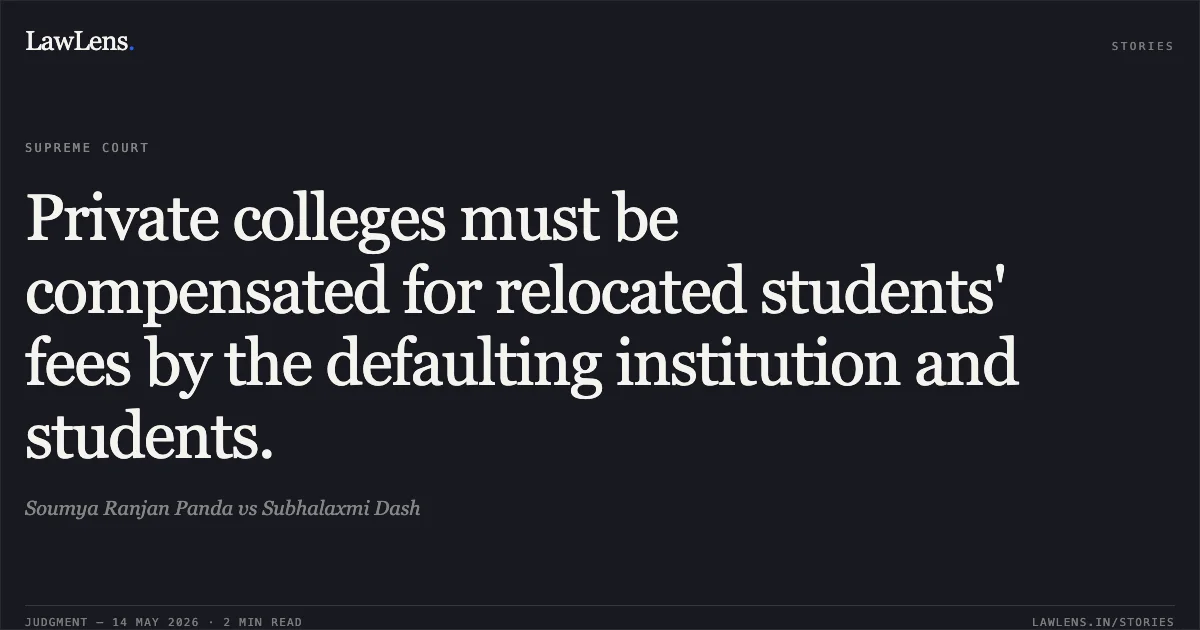
Source reference: para. 36-37The Court determined that since the transferee colleges provided high-quality education and infrastructure without receiving their entitled fees, the financial burden must primarily fall on the Selvam Trust because its deficiencies caused the crisis.
Source reference: para. 42However, the students also carry a secondary liability to pay the difference up to the SRMCH rate (which they had initially agreed to pay) to ensure the transferee colleges are not left with a shortfall.
Source reference: para. 52-53Holding
The Court held that the transferee colleges are entitled to be reimbursed at the fee rates originally chargeable by SRMCH.
The Rs. 10 Crores bank guarantee furnished by the Selvam Trust to the MCI/NMC, and the Rs. 2 Crores (plus interest) deposited with the Supreme Court, must be released and distributed equally among the three transferee colleges.
Source reference: para. 44-46The NMC is directed to facilitate the recovery of the remaining shortfall from the passed-out students by evaluating the difference between the government fees paid and the SRMCH rates.
Source reference: para. 53Students who clear these outstanding dues are entitled to receive all their academic and course-completion documents immediately.
Source reference: para. 54Original Court PDF
Soumya Ranjan PandavsSubhalaxmi Dash
Click to open original judgment
Original judgment, available to read, download and summarize on LawLens.in