01Facts
The deceased, Shalini @ Lavanya, died within six months of her marriage. This fact is not in dispute.
¶ 16The police registered a case and filed a charge-sheet only for offences under Section 498A IPC and Sections 3, 4 and 6 of the Dowry Prohibition Act, 1961. No charge-sheet was filed for Sections 302 or 304B IPC.
¶ 16The complainant (respondent) filed a private complaint (PCR No. 148/2017) alleging that the police investigation was defective. She contended that the post-mortem report (Ex.C29) and inquest report (Ex.C10) recorded external injuries, and that the police had ignored them.
¶ 3The Trial Court, on 18.02.2019, took cognizance of Sections 302 and 304B IPC along with the police-invoked offences. The complaint was numbered C.C. No. 177/2019.
¶ 2, 3The Trial Court relied on the doctor's evidence (CW-2) and the external injuries recorded in the inquest and post-mortem reports.
¶ 3, 16The petitioners, the accused, challenged that order under Section 482 CrPC. They contended that the private complaint was not maintainable once the police had filed a report.
¶ 402Issues
i.1. Whether the High Court can exercise its power under Section 482 CrPC to quash the cognizance taken on the private complaint for offences under Sections 302 and 304B IPC, in addition to the police-invoked offences under Section 498A IPC and the DP Act.
¶ 15(i)ii.2. Whether there is any bar to filing a private complaint after the police investigation has concluded.
¶ 15(ii)iii.3. Whether the Court can invoke Section 210 CrPC to direct the Trial Court to try the police case and the complaint case together.
¶ 15(iii)03Law Applied
The Court applied Section 304B IPC, which concerns dowry death, and the presumption under Section 113B of the Indian Evidence Act, which operates where death occurs within seven years of marriage. The prosecution must rule out natural or accidental death (Kamesh Panjiyar v. State of Bihar, (2005) 2 SCC 388).
¶ 14, 16The Court applied Section 302 IPC on murder, which the Trial Court invoked on the basis of external injuries.
¶ 16Section 210 CrPC governs a complaint case and a police investigation concerning the same offence. Where cognizance is taken against an accused in both, the Magistrate must try the two cases together as if both were instituted on a police report. Otherwise the complaint proceedings resume (Samaj Parivartan Samudaya v. State of Karnataka, (2012) 7 SCC 407; Kapil Agarwal v. Sanjay Sharma, (2021) 5 SCC 524; Pal alias Palla v. State of U.P., (2010) 10 SCC 123).
¶ 10, 11, 18Under Section 482 CrPC, the inherent power is exercised sparingly. Summoning must follow satisfaction that a real case exists (Pepsi Foods Ltd. v. Special Judicial Magistrate, (1998) 5 SCC 749).
¶ 5The bar against second complaints and the protection against double jeopardy under Article 20(2) of the Constitution and Section 300 CrPC apply where a second complaint is filed on the same facts (Subrata Choudhury v. State of Assam; Ranimol v. State of Kerala; Krishna Lal Chawla v. State of U.P., as distinguished at para. 19).
¶ 6, 7, 19Provisions in the judgment · 11 · Linked ones open on LawLens
Code of Criminal Procedure, 1973 Section 482Section 210Section 173Section 200Section 300
Indian Penal Code, 1860 Section 302Section 34Section 506
04Reasoning
The Court held that the death within six months of marriage attracted the Section 113B presumption, which the Investigating Officer had failed to address. The external injuries in Exs. C10 and C29 were unexplained in the police report.
¶ 16The petitioners' claim that the deceased suffered from epilepsy was unsubstantiated, since no supporting documents were produced and the police collected no such material. The Trial Court's reasons therefore showed a prima facie basis for Sections 302 and 304B IPC.
¶ 16, 17The petitioners' authorities were distinguished. Krishna Lal Chawla concerned the lower court's failure to scrutinise a complaint before issuing process. Subrata Choudhury and Ranimol concerned second complaints on the same facts. Here, no second complaint was filed; the private complaint was the only vehicle for challenging the police's omission to invoke the graver offences. Double jeopardy therefore did not arise.
¶ 19The Court relied on Kapil Agarwal, Samaj Parivartan and Amasasetty to hold that both proceedings must be tried together because the incident and the offences are the same.
¶ 20, 21The Court found no justification for quashing under Section 482 CrPC, because the lapses in investigation warranted a joint trial and not a termination of proceedings.
¶ 2105Holding
The Court answered Point (i) in the negative, holding that quashing under Section 482 CrPC is not warranted.
¶ 21The Court answered Point (ii) in the negative, holding that a private complaint is not barred merely because the police investigation has concluded, where the police have omitted grave offences.
¶ 19, 21The Court answered Point (iii) in the affirmative, holding that Section 210 CrPC applies to a case where both a complaint and a police report concern the same incident.
¶ 21The petition is dismissed.
¶ 22(i)The concerned Magistrates are directed to commit both the private complaint (Sections 302 and 304B IPC) and the police charge-sheet (Section 498A IPC and Sections 3, 4 and 6 DP Act) to the Sessions Court, which must dispose of both simultaneously in accordance with law.
¶ 22(ii)The Court's observations shall not influence the Trial Court on merits.
¶ 22(iii)Original Court PDF
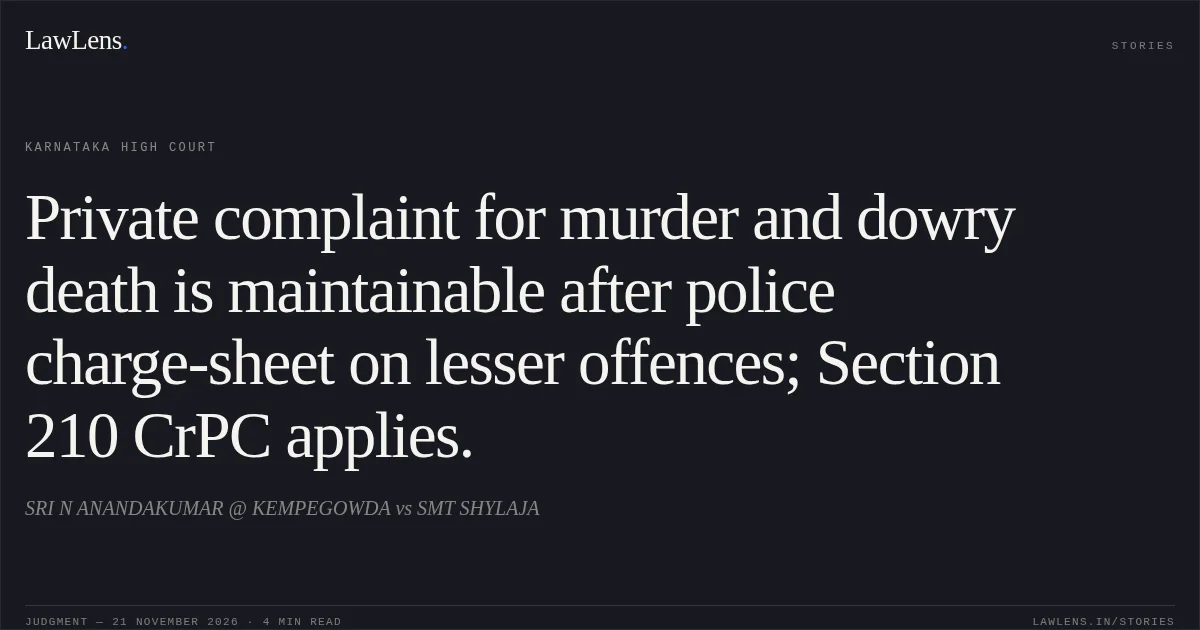
SRI N ANANDAKUMAR @ KEMPEGOWDAvsSMT SHYLAJA
Click to open original judgment
Original judgment, available to read, download and summarize on LawLens.in



