Facts
In 2000, Gautam Kumar, then District Social Welfare Officer, lodged an FIR against Akhileshwar Singh and another concerning alleged embezzlement of scholarship funds meant for Scheduled Caste/Scheduled Tribe students.
Source reference: paras. 4, 20–25; pp. 1–3, 9–13The FIR was based on an inquiry conducted by Vinod Kumar Singh, then Additional District Development Officer. The investigation resulted in a charge-sheet under Sections 409, 420, 467, 468 and 471 IPC and Section 3(2)(6) of the Scheduled Castes and Scheduled Tribes (Prevention of Atrocities) Act.
Source reference: paras. 20–25; pp. 9–13The accused were convicted by the Trial Court on 6 March 2014, but were subsequently acquitted by the Appellate Court on 16 November 2021, principally on the ground that the inquiry conducted by Vinod Kumar Singh was defective.
Source reference: paras. 20–25; pp. 9–13Following the appellate judgment, Akhileshwar Singh and another instituted Complaint Case No. 19897 of 2022 under Section 500 IPC against Gautam Kumar and Vinod Kumar Singh, alleging that the findings and conduct of the applicants had defamed them.
Source reference: paras. 3, 5–18; pp. 1, 3–9The Magistrate took cognizance and summoned the applicants on 14 October 2022.
Source reference: paras. 3, 5–18; pp. 1, 3–9Issues
Whether the complaint under Section 500 IPC disclosed the essential ingredients of defamation, including a specific imputation and the requisite intention, knowledge or reason to believe that the imputation would harm the complainants’ reputations?
Source reference: paras. 5–11Whether the alleged acts of the applicants, performed while conducting an official inquiry and lodging an FIR, were protected by the statutory exceptions to Section 499 IPC, particularly the Fifth Exception?
Source reference: paras. 12–14, 28–31Whether the complaint was maintainable in view of Section 199(2) Cr.P.C., since the alleged defamatory acts concerned public servants acting in the discharge of their official functions and the complaint was not filed by the Public Prosecutor before the Court of Session?
Source reference: paras. 15–18, 27–28Whether the proceedings, including the cognizance and summoning order, were liable to be quashed under Section 482 Cr.P.C.?
Source reference: paras. 5–8, 26, 32–33Law Applied
The Court applied Section 499 IPC, which defines defamation as making or publishing an imputation concerning a person with the intention, knowledge or reason to believe that it will harm that person’s reputation; Section 500 IPC prescribes the punishment for defamation.
Source reference: paras. 10, 13–14; pp. 4–7The Court particularly relied on the Fifth Exception to Section 499 IPC, under which a good-faith opinion regarding the merits of a case decided by a court or the conduct of a party, witness or agent in such proceedings does not constitute defamation.
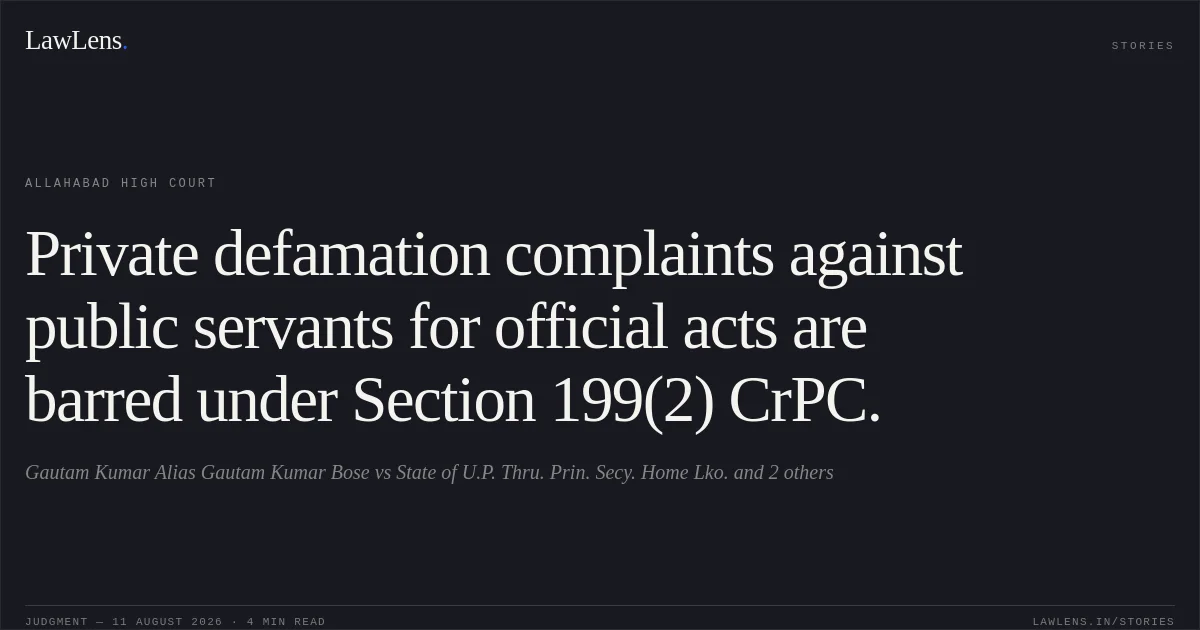
Source reference: paras. 10, 13–14; pp. 4–7The Court also applied Section 199(2) Cr.P.C., holding that where defamation is alleged against a public servant in respect of conduct in the discharge of official functions, cognizance may be taken by the Court of Session only upon a written complaint by the Public Prosecutor.
Source reference: paras. 15–17, 27–28; pp. 7–9The inherent jurisdiction under Section 482 Cr.P.C. may be exercised to prevent abuse of process and to quash criminal proceedings where the complaint, even if taken at face value, does not disclose the commission of an offence.
Source reference: paras. 5–8, 26, 32–33Reasoning
The Court found that the complaint did not identify any particular defamatory word, statement or publication allegedly made by either applicant, nor did the summoning order record a prima facie finding explaining how the ingredients of Section 499 IPC were satisfied.
Source reference: paras. 5–11The applicants’ conduct consisted of an official inquiry into alleged misappropriation of scholarship funds and the lodging of an FIR based on that inquiry. The Court treated these acts as having been performed in the discharge of official duties and in good faith.
Source reference: paras. 28–31It further held that the applicants’ conduct fell within the Fifth Exception to Section 499 IPC, since the alleged imputations arose from proceedings concerning the complainants’ conduct in a criminal case.
Source reference: paras. 28–31The Court additionally held that Section 199(2) Cr.P.C. created a statutory bar because the complaint had been filed by private individuals rather than by the Public Prosecutor before the Court of Session.
Source reference: paras. 27–31The subsequent acquittal of the complainants did not, in the Court’s view, render the applicants’ official acts defamatory or mala fide.
Source reference: paras. 27–31Holding
The Court answered the issues in favour of the applicants.
It held that the complaint under Section 500 IPC lacked the necessary factual foundation for defamation, that the applicants’ official acts were protected by the Fifth Exception to Section 499 IPC, and that the complaint was barred under Section 199(2) Cr.P.C.
Source reference: paras. 27–32Accordingly, both applications under Section 482 Cr.P.C. were allowed.
Source reference: paras. 32–33; p. 15The proceedings in Complaint Case No. 19897 of 2022, including the cognizance and summoning order dated 14 October 2022, were quashed and set aside insofar as they concerned Gautam Kumar alias Gautam Kumar Bose and Vinod Kumar Singh.
Source reference: paras. 32–33; p. 15Acts & Sections Cited
12 provisions across 3 statutes referred to in this judgment. Each provision opens on LawLens.
Code of Criminal Procedure, 19734
Indian Penal Code, 18607
Scheduled Castes and the Scheduled Tribes (Prevention of Atrocities) Act, 19891
Original Court PDF
Gautam Kumar Alias Gautam Kumar BosevsState of U.P. Thru. Prin. Secy. Home Lko. and 2 others
Click to open original judgment
Original judgment, available to read, download and summarize on LawLens.in