Facts
The petitioner filed a writ petition under Article 226 of the Constitution seeking directions to prohibit private educational institutions and private employers in Tamil Nadu from mandatorily collecting caste or community details in application forms, except where required by statute, and to require regulatory measures against discrimination in private institutions.
Source reference: p.2The petitioner relied on the State’s policy permitting persons who did not wish to disclose their religion or caste to leave the relevant columns blank or enter “No Religion” and “No Caste”.
Source reference: p.4The Court also considered the earlier decision in G. Balakrishnan v. State of Tamil Nadu, W.P.No.18488 of 2016, concerning implementation of G.O.Ms.No.205, School Education (C2) Department, dated 31 July 2000.
Source reference: p.3Issues
1. Whether private educational institutions and private employers in Tamil Nadu can mandatorily collect caste or community details from applicants.
Source reference: pp.2, 72. Whether the respondents should be directed to issue regulatory measures ensuring that persons who do not wish to disclose caste or religion are not compelled to do so and are protected against discrimination.
Source reference: pp.2–3, 7Law Applied
The Court applied Article 226 of the Constitution as the jurisdictional basis for issuing a writ of mandamus.
Source reference: p.2It relied on G.O.Ms.No.205, School Education (C2) Department, dated 31 July 2000, which recognises that persons who do not wish, or are unable, to disclose their religion or caste at the time of admission or otherwise need not be compelled to provide such details, and may use “No Religion” and “No Caste” or leave the columns blank.
Source reference: pp.4–6The Court further relied on G. Balakrishnan v. State of Tamil Nadu, W.P.No.18488 of 2016, where the Division Bench directed circulation and publicity of the Government Order and held that caste need not be disclosed in a transfer certificate where the individual does not wish it to be disclosed.
Source reference: pp.3–6Reasoning
The Court found that the substance of the petitioner’s grievance was already covered by G.O.Ms.No.205 and the principles affirmed in G. Balakrishnan.
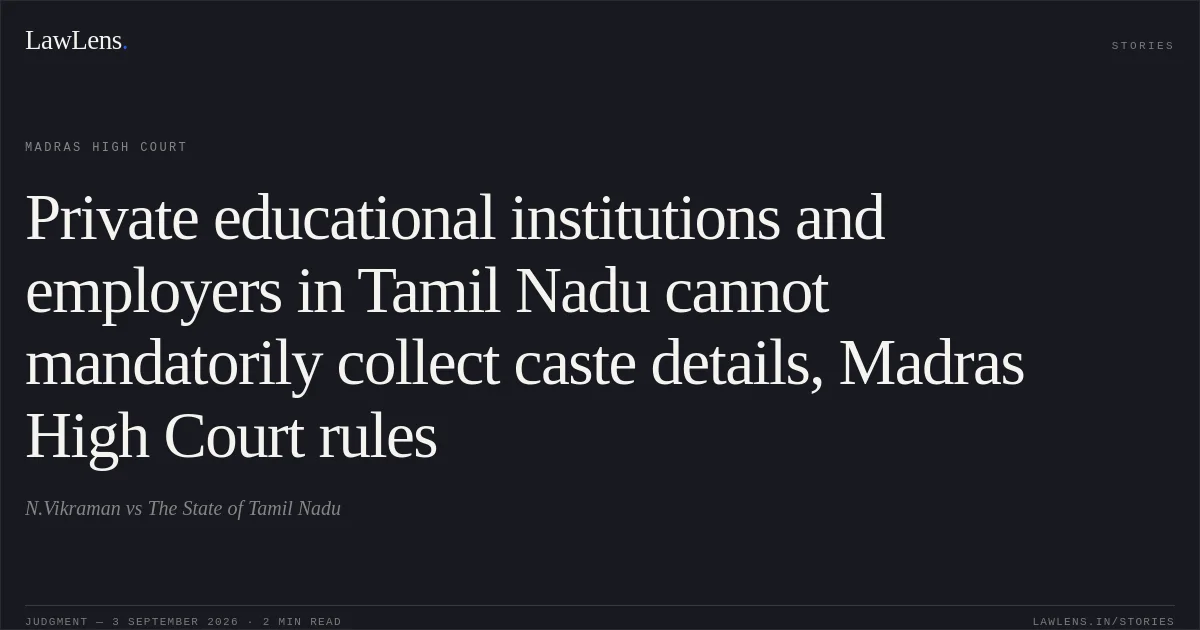
Source reference: pp.3–6Recognising the right of individuals not to disclose caste details, the Court extended the protection in express terms to private educational institutions and private employers within Tamil Nadu, holding that they could not mandatorily collect caste details.
Source reference: p.7Although the petitioner expressed concern that non-disclosure might result in discrimination or adverse action, the Court considered the prohibition against compulsory collection sufficient for disposing of the petition and declined to issue any further regulatory directions.
Source reference: pp.6–7Holding
The Court held that no private educational institution or private employer within Tamil Nadu may mandatorily collect caste details from an individual.
The writ petition was disposed of with this direction alone; no further directions were issued, and there was no order as to costs.
Source reference: p.7Original Court PDF
N.VikramanvsThe State of Tamil Nadu
Click to open original judgment
Original judgment, available to read, download and summarize on LawLens.in