Facts
In July 2025, the petitioner, an elected councillor, and others submitted a representation to the District Collector alleging financial irregularities and corruption in road construction by the Municipal Council, Shivpuri.
Source reference: para. 2Following an inquiry by the SDM, an FIR was registered against a contractor and municipal engineers under the Bharatiya Nyaya Sanhita (BNS) and the Prevention of Corruption Act.
Source reference: para. 2At the stage of framing charges, the petitioner filed an application (I.A. No. 2/2026) under Section 338(2) of the Bharatiya Nagarik Suraksha Sanhita (BNSS), seeking permission to assist the prosecution.
Source reference: para. 2The Special Court rejected the application on February 10, 2026, on the grounds that the petitioner did not qualify as a "victim".
Source reference: para. 3The petitioner challenged this order via the present revision.
Source reference: para. 1Issues
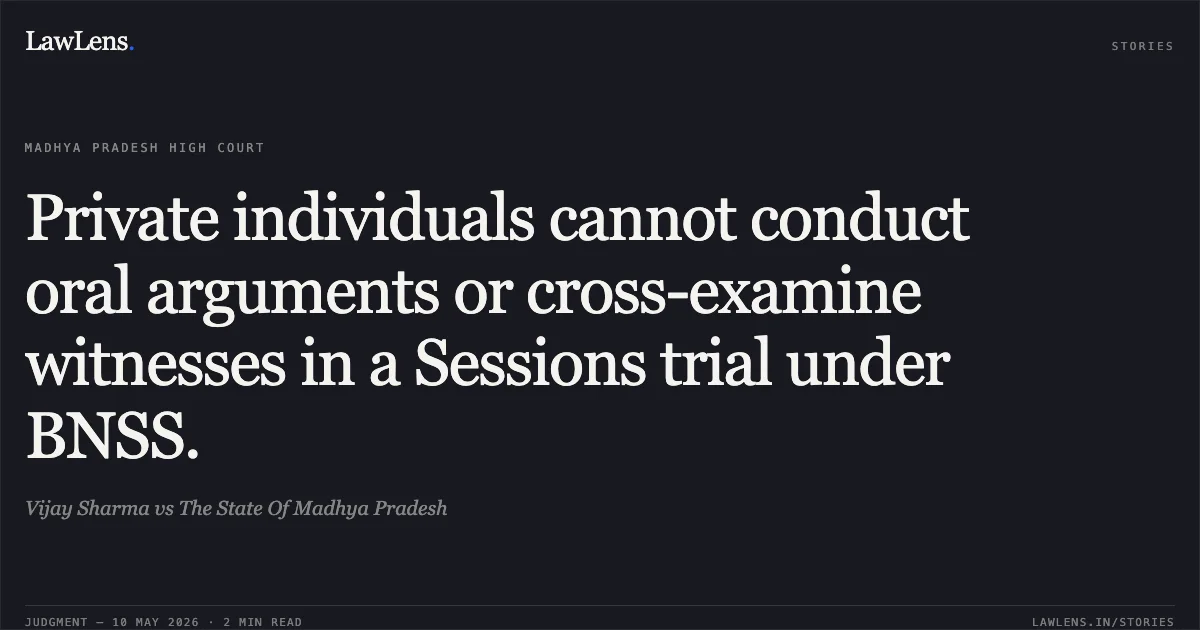
1. Whether a private person or the original complainant has the right to conduct oral arguments or cross-examine witnesses in a sessions trial under the provisions of the BNSS.
Source reference: para. 7-82. Whether the trial court erred in refusing the petitioner's assistance at the stage of framing of charges.
Source reference: para. 8Law Applied
Section 248 of the BNSS, which mandates that a Public Prosecutor must conduct every trial before a Court of Session.
Source reference: para. 6Section 338(2) of the BNSS, which stipulates that while a private person may instruct an advocate, such advocate must act under the directions of the Public Prosecutor and can only submit written arguments after the evidence is closed, with the court's permission.
Source reference: para. 6-7The principle established in Rekha Murarka v. The State of West Bengal, (2020) 2 SCC 474, which limits the role of a victim’s counsel to ensure the Public Prosecutor retains control over the proceedings.
Source reference: para. 9Reasoning
The court reasoned that the statutory language of Sections 248 and 338(2) of the BNSS is unambiguous: the Public Prosecutor is entrusted with the primary responsibility of conducting the case.
Source reference: para. 7The role of an advocate engaged by a private party is strictly supplementary and restricted to assisting the Public Prosecutor.
Source reference: para. 7The court observed that the law does not permit a private advocate to make oral arguments or cross-examine witnesses; their participation is limited to filing written arguments only after the conclusion of evidence.
Source reference: para. 8Since the petitioner sought to intervene at the preliminary stage of framing charges, the court found his application premature and legally unsustainable under the BNSS framework.
Source reference: para. 8The court distinguished the precedents cited by the petitioner regarding bail cancellation, noting they were inapplicable to the conduct of a sessions trial.
Source reference: para. 10Holding
The High Court affirmed the trial court's order, holding that a private person's right to participate in a sessions trial is restricted and subject to the control of the Public Prosecutor.
The court concluded there was no illegality or perversity in the impugned order as the BNSS does not permit the requested level of private intervention at the charge-framing stage.
Source reference: para. 11The criminal revision was dismissed.
Source reference: para. 11Acts & Sections Cited
17 provisions across 4 statutes referred to in this judgment. Each provision opens on LawLens.
Bharatiya Nagarik Suraksha Sanhita, 20234
Bharatiya Nyaya Sanhita, 20237
Prevention of Corruption Act, 19883
Code of Criminal Procedure, 19733
Original Court PDF
Vijay SharmavsThe State Of Madhya Pradesh
Click to open original judgment
Original judgment, available to read, download and summarize on LawLens.in


