Facts
K.S. College of Professional Education, a private non-aided institution offering the Diploma in Elementary Education (D.El.Ed.) course, approached the Patna High Court through its Chief Administrative Officer seeking a direction to the Bihar School Examination Board to conduct a second round of spot admission for the 2025–27 session.
Source reference: p. 2–3The Board had conducted a common admission test between 25 August and 27 September 2025, followed by multiple admission rounds for Government and private institutions.
Source reference: p. 2After three admission rounds and one spot-admission round for private institutions, the petitioner claimed that 57 seats remained vacant and that approximately 76 students were willing to seek admission.
Source reference: p. 3The petitioner contended that a second spot-admission round had been permitted for Government Colleges but not for private institutions, which allegedly violated Article 14 of the Constitution.
Source reference: p. 3–6The Board opposed the petition, stating that the petitioner had received four opportunities, including the spot-admission round, but had admitted only 43 students against its sanctioned intake of 100.
Source reference: p. 5–7According to the Board, the admission process had concluded in accordance with the notified schedule, and a further round would disrupt the academic calendar and teaching process.
Source reference: p. 5–7The Board further submitted that the first and second semester examinations had already commenced.
Source reference: p. 7Issues
Whether the petitioner, a private non-aided D.El.Ed. institution, was entitled to a direction for a second round of spot admission to fill its vacant seats for the 2025–27 session?
Source reference: para. 2–6, 10–13Whether permitting a second spot-admission round only for Government Colleges, and not for the petitioner’s private institution, was arbitrary or discriminatory under Article 14 of the Constitution?
Source reference: para. 4, 6, 10–12Whether such a direction could be issued after the admission timetable and the date fixed for commencement of the academic session, in light of the Supreme Court’s prescribed timelines?
Source reference: para. 8–9, 12–13Law Applied
The Court relied principally on Maa Vaishno Devi Mahavidyalaya v. State of U.P., (2013) 2 SCC 617, which prescribed a strict timetable for admission and affiliation in teaching and training institutions, including commencement of the academic session on 1 July and completion of counselling by 25 June.
Source reference: para. 8, 12–13It also considered College of Professional Education v. State of U.P., (2013) 2 SCC 721, which emphasised that seats should be filled through counselling pursuant to an entrance examination before commencement of the academic session.
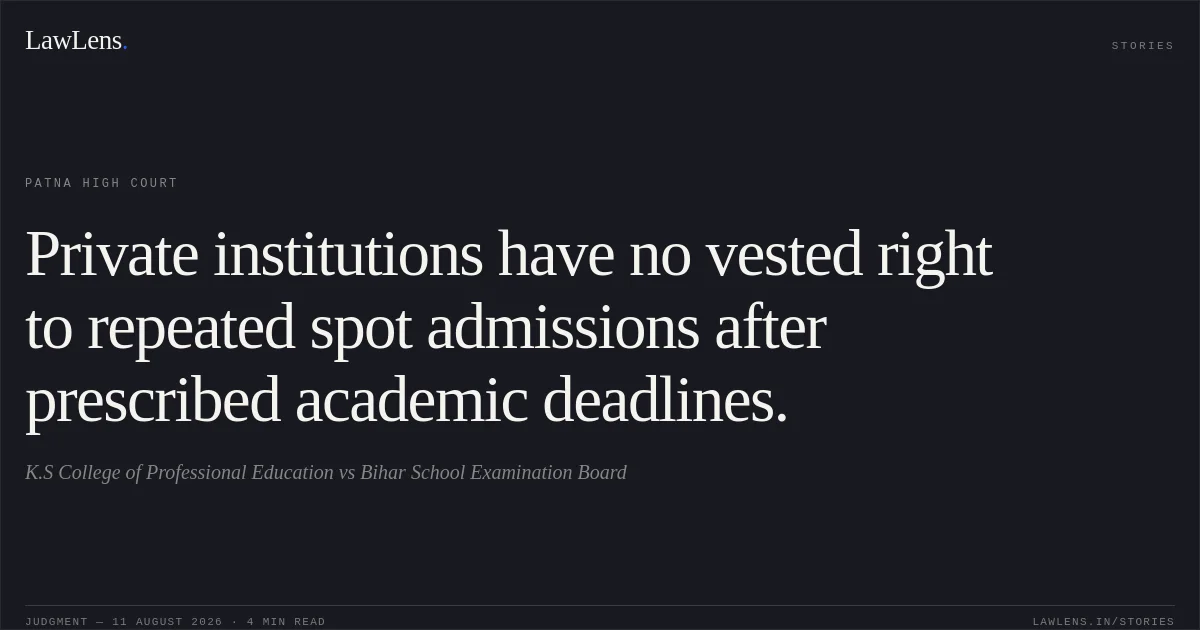
Source reference: para. 6, 14The Court further applied the principle that a private institution has no vested or fundamental right to compel the examining authority to conduct repeated admission rounds merely to fill all sanctioned seats.
Source reference: para. 7It held that Government Colleges, being State-funded institutions established to serve economically weaker and rural students, may legitimately be treated differently from self-financed private institutions, provided the classification is rational and connected with the object sought to be achieved.
Source reference: para. 11Reasoning
The Court found that the petitioner had already been permitted to participate in three regular admission rounds and one spot-admission round for private institutions.
Source reference: para. 10, 12The petitioner’s admission of only 43 students against an intake of 100 was therefore not attributable to any demonstrated act or omission of the Board.
Source reference: para. 12The Court accepted the Board’s distinction between Government Colleges and private self-financing institutions: Government Colleges are publicly funded and intended, inter alia, to provide affordable teacher training to economically weaker and rural candidates, whereas private institutions operate on a self-financing basis.
Source reference: para. 11This distinction was held sufficient to repel the Article 14 challenge.
Source reference: para. 11Further, granting a second spot-admission round after the Supreme Court’s prescribed timeline, particularly after the date fixed for commencement of the academic session and when examinations had commenced, would interfere with the academic calendar and the binding admission schedule.
Source reference: para. 8–9, 12Although the Supreme Court precedents favour filling seats through counselling, that principle operates within the prescribed admission timetable and did not confer an entitlement to repeated admissions after the process had concluded.
Source reference: para. 12–14Holding
The Court held that the petitioner had no enforceable right to a second round of spot admission and that the differential treatment between Government Colleges and private institutions was not shown to be arbitrary or discriminatory.
The prayer for directing the Board to conduct a second spot-admission round for the petitioner’s D.El.Ed. institution was rejected.
Source reference: para. 13The writ petition was accordingly closed.
Source reference: no citationHowever, the Court observed that the State and the Board should formulate guidelines for future sessions, consistent with the Supreme Court’s directions, so that seats are filled through counselling pursuant to the entrance examination before commencement of the academic session.
Source reference: para. 14–15Original Court PDF
K.S College of Professional EducationvsBihar School Examination Board
Click to open original judgment
Original judgment, available to read, download and summarize on LawLens.in