Facts
The dispute involves two factions of the erstwhile royal family of Kapurthala regarding the character and succession of properties held by the Brigadier (Respondent No. 1), the eldest descendant of Maharaja Paramjit Singh.
Source reference: para. 2The Brigadier claimed absolute ownership of all properties, whether public or private, under the customary rule of primogeniture.
Source reference: para. 4Conversely, his estranged wife (Smt. Gita Devi) and children (Appellants) sought partition, asserting the properties were ancestral coparcenary assets under Hindu Law.
Source reference: para. 3Following a merger agreement in 1948, the then Maharaja Jagatjit Singh surrendered sovereignty but declared specific assets as "private properties".
Source reference: paras. 16-19The Trial Court and High Court initially favored the Brigadier, holding that the rule of primogeniture applied to both the throne and private properties.
Source reference: paras. 6-8Issues
1. Whether the private properties of an erstwhile Ruler, declared under a merger covenant, are subject to the customary rule of primogeniture or the personal law of succession.
Source reference: para. 242. Whether the concepts of joint Hindu family and coparcenary apply to properties held by a former Ruler after the cessation of sovereignty and the enactment of the Hindu Succession Act, 1956.
Source reference: paras. 24, 79Law Applied
The Court primarily applied Articles XII and XIV of the Covenant of Merger (1948), which distinguished between State properties and the Ruler's "private properties".
Source reference: para. 38It relied on the Three-Judge Bench precedents in Revathinnal Balagopala Varma v. Padmanabha Dasa, Talat Fatima Hasan v. Syed Murtaza Ali Khan, and Maharani Deepinder Kaur v. Rajkumari Amrit Kaur, which established that while succession to the Gaddi (throne) follows custom, private properties follow personal law.
Source reference: paras. 51, 52, 57The Court also interpreted Section 5(ii) of the Hindu Succession Act, 1956, noting it exempts estates descending to a "single heir" only if dictated by a covenant, but does not apply to private ancestral property once sovereignty is lost.
Source reference: paras. 77-79Reasoning
The Court reasoned that upon signing the merger agreement, the Ruler ceased to be a sovereign and became an ordinary citizen, retaining "full ownership" of private properties as an individual, not as a monarch.
Source reference: paras. 47-48It observed that Article XIV of the Covenant guaranteed primogeniture only for the Gaddi and titles, not for private assets.
Source reference: paras. 48, 62The Court scrutinized the Maharaja’s 1948/1949 declarations, noting he used the plural "heirs and successors," indicating an intent for distribution among all descendants rather than a single heir.
Source reference: paras. 49-50It distinguished the Division Bench ruling in Trijugi Narain v. Sankoo, clarifying that later Three-Judge Bench decisions in Talat Fatima and Deepinder Kaur (Faridkot case) settled that personal law overrides primogeniture for private estates.
Source reference: paras. 73-76Finally, the Court noted that assets purchased in joint names from the sale proceeds of ancestral property (Delhi and Kapurthala villas) were inherently subject to partition regardless of royal custom.
Source reference: paras. 83-88Holding
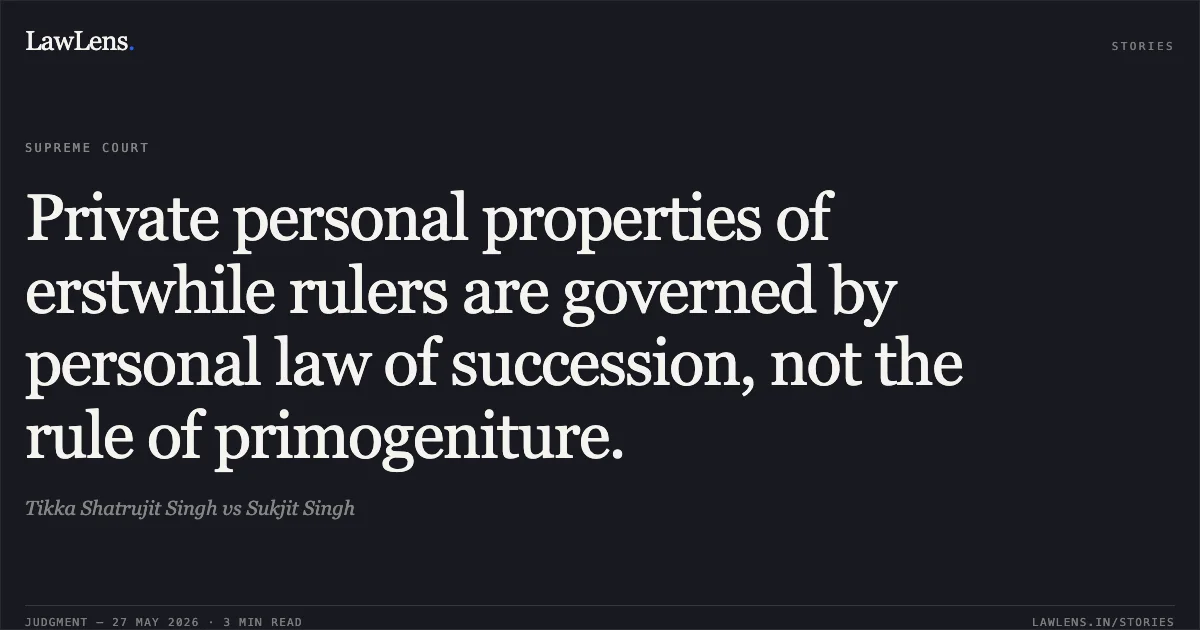
The Court held that the rule of primogeniture does not apply to personal private properties.
The Court partially allowed the appeal, setting aside the High Court's judgment and ordering a preliminary decree of partition: (i) the Mussoorie property to be divided equally (1/4th each) among the Brigadier and the three surviving children; (ii) the Delhi properties belong 5/8th to the Brigadier and 1/8th to each child; (iii) the Villa Bouna Vista belongs 5/8th to the surviving son and 1/8th each to the Brigadier and daughters.
Source reference: paras. 92, 93, 95Acts & Sections Cited
6 provisions across 2 statutes referred to in this judgment. Each provision opens on LawLens.
Code of Civil Procedure, 19081
Hindu Succession Act, 19565
Original Court PDF
Tikka Shatrujit SinghvsSukjit Singh
Click to open original judgment
Original judgment, available to read, download and summarize on LawLens.in