Facts
The petitioners, comprising 137 private unaided recognized schools in Delhi, challenged various orders and circulars issued by the Directorate of Education (DoE) that rejected their fee-hike proposals.
Source reference: paras 4-5The DoE asserted that schools situate on land allotted by government agencies (governed by a ‘land-clause’) must obtain prior approval before increasing fees.
Source reference: para 45.1In processing these proposals, the DoE empaneled Chartered Accountants to audit school accounts, frequently disallowing various accounting heads (e.g., Development Funds, Depreciation Reserves) and treating them as "available funds" to meet revenue expenditures like salaries.
Source reference: paras 11.2, 16-22The petitioner schools alleged these actions violated their fundamental right under Article 19(1)(g) and transgressed the statutory framework of the Delhi School Education Act, 1973 (DSE Act).
Source reference: paras 6.1-6.2Issues
1. Whether the DoE’s orders are ultra vires the DSE Act and contravene the law laid down by the Supreme Court regarding the autonomy of private unaided schools.
Source reference: paras 5, 642. Whether the DoE’s regulatory powers differ between schools governed by a ‘land-clause’ and those that are not.
Source reference: paras 5, 853. Whether the DoE violated principles of natural justice by rejecting fee proposals without affording a personal hearing or sharing the audit reports relied upon.
Source reference: paras 5, 1014. Whether school accounts must be maintained on an accrual/mercantile system and if the DoE can dictate the utilization of specific funds for revenue expenditure.
Source reference: paras 5, 111Law Applied
Section 17(3) of the DSE Act, which mandates schools to file a statement of fees before an academic session but requires "prior approval" only for mid-session hikes.
Source reference: paras 60, 77.1T.M.A. Pai Foundation v. State of Karnataka, establishing the "maximum autonomy" of unaided institutions in fee fixation.
Source reference: para 66Modern School v. Union of India, which balanced such autonomy against the DoE’s power to prevent "profiteering/commercialization" through Fund-Based Accounting.
Source reference: paras 68, 72The ICAI Guidance Note (2005) and GAAP, emphasizing that "accrual basis" accounting is scientifically superior and mandatory for not-for-profit entities.
Source reference: paras 112-113The principle of audi alteram partem as applied per Gullapalli Nageswara Rao v. APSRTC, holding that he who hears must decide.
Source reference: para 108Reasoning
The court reasoned that the DoE fundamentally misinterpreted its regulatory role, mistakenly assuming that the "land-clause" grants it power to override Section 17(3) of the DSE Act; the court clarified that a contractual lease condition cannot supplant a statute.
Source reference: paras 93-94Regarding accounting, the court found the DoE’s practice of adding capital reserves (like Depreciation or Development Funds) to "funds available" for revenue expenses was legally untenable and commercially imprudent, as it forced schools to violate Rule 176 of the DSE Rules, which prohibits diversion of earmarked funds.
Source reference: paras 117-119The court held that the DoE’s rejection of fee hikes based on the mere existence of a surplus was flawed, as Islamic Academy allows a "reasonable surplus" (6-15%) for growth.
Source reference: paras 82, 126.1Procedurally, the DoE as a quasi-judicial authority failed to provide show-cause notices or personal hearings before the Director, rendering the orders void for violating natural justice.
Source reference: para 110Holding
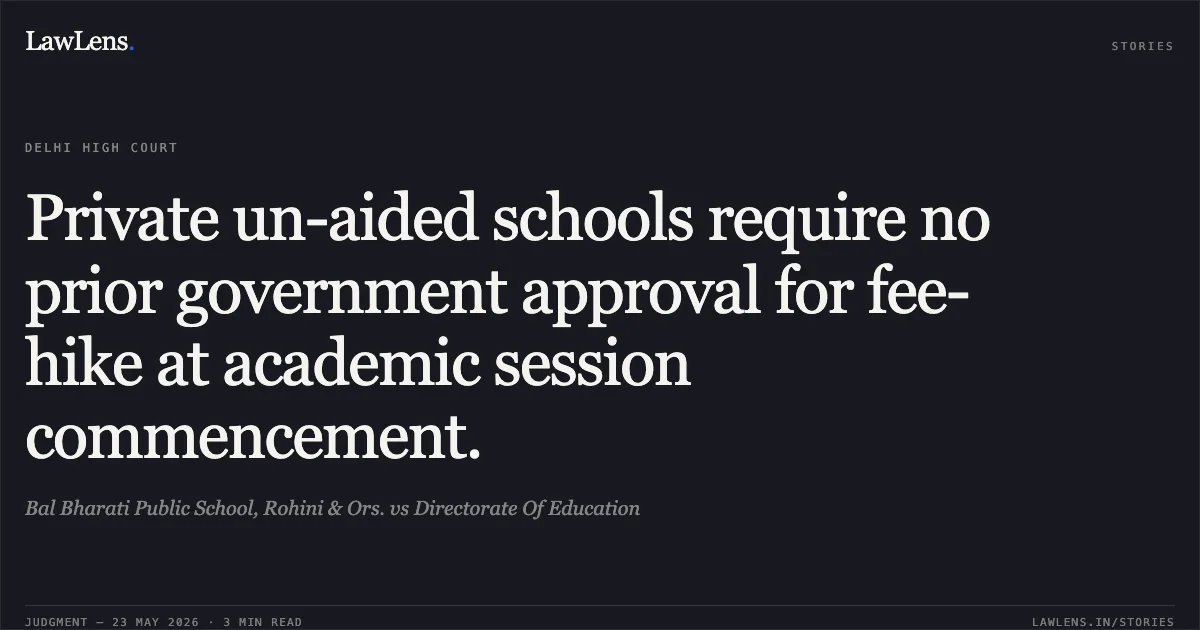
The court quashed the impugned orders, holding that no prior approval is required for fee hikes at the commencement of a session for any private unaided school, regardless of a "land-clause".
The DoE may only intervene if it determines "profiteering" through a formal audit under Section 18(5) after the session begins.
Source reference: para 77.7The court directed that: (i) schools must maintain accounts on an accrual basis per ICAI/GAAP norms; and (ii) for mid-session hikes, the DoE must decide within two months or it shall be deemed approved.
Source reference: paras 144.4, 142To protect parents from retroactive burdens, the court ordered that proposed fee increases shall only apply prospectively from the April 2027 academic session, with no recovery of past arrears allowed.
Source reference: para 150Acts & Sections Cited
9 provisions across 2 statutes referred to in this judgment. Each provision opens on LawLens.
Delhi School Education Act, 19736
Right of Children to Free and Compulsory Education Act, 20093
Original Court PDF
Bal Bharati Public School, Rohini & Ors.vsDirectorate Of Education
Click to open original judgment
Original judgment, available to read, download and summarize on LawLens.in


