Facts
The petitioner’s minor son was studying in Class IX, Section I, at Don Bosco Academy, Patna, an unaided school affiliated with the ICSE Board. He was suspended and prevented from attending classes, and was subsequently allegedly expelled on 17 October 2025 for repeated indiscipline, bunking classes, altercations with students and failure to comply with the School’s directions.
Source reference: paras. 2, 5–6The School relied on the admission agreement and Clause 66 of its Rules and Regulations, which empowered the Principal to impose disciplinary punishment, including expulsion.
Source reference: para. 7The petitioner contended that the expulsion order was cryptic, non-speaking and passed without any show-cause notice or opportunity of hearing. During the pendency of the writ petition, the Court directed the School on 12 February 2026 to permit the student to appear in the Final Term Examination, subject to the final outcome of the proceedings.
Source reference: para. 3The School challenged the maintainability of the writ petition on the ground that it was a private unaided institution and that the dispute arose from a contractual relationship.
Source reference: paras. 4, 7–8Issues
Whether a writ petition under Article 226 of the Constitution is maintainable against a private unaided school in relation to the expulsion of a student?
Source reference: paras. 17–20, 34–35Whether the School’s order expelling the petitioner’s minor son was vitiated by violation of natural justice, non-application of mind, absence of adequate reasons and disproportionality?
Source reference: paras. 36–38, 46–52Whether the petitioner’s son was entitled to resume classes and receive protective directions against academic prejudice caused by the expulsion?
Source reference: paras. 53–57Law Applied
Article 226 empowers the High Court to issue writs not only against the State but also against a private person or body performing public duties or functions, provided the impugned action contains a public-law element.
Source reference: paras. 18–20, 32Under St. Mary’s Education Society & Anr. v. Rajendra Prasad Bhargava & Ors., (2023) 4 SCC 498, an educational institution may be amenable to writ jurisdiction because imparting education is a public function; however, every action of such institution is not reviewable, and the impugned action must have a direct nexus with that public function and must not merely involve enforcement of a private contract.
Source reference: paras. 24–29The Court also applied the principles of fairness, natural justice, reasoned decision-making and proportionality under Article 14.
Source reference: paras. 34, 37, 45, 48Relying on Mohinder Singh Gill v. Chief Election Commissioner, (1978) 1 SCC 405, the Court held that an order must stand or fall on the reasons contained in it and cannot be subsequently supplemented by reasons in a counter-affidavit.
Source reference: para. 10The Court further considered Jayshree Vijay Mundaware v. Principal/Head Mistress of Ashoka Universal School, 2015 SCC OnLine Bom 3929, Apoorva YK v. South Asian University, 2024 SCC OnLine Del 335, and Roychan Abraham v. State of U.P., 2019 SCC OnLine All 3935, in recognising that private educational institutions perform public functions and must act fairly when taking disciplinary action against students.
Source reference: paras. 30–33Clause 66 of the School Rules authorised disciplinary punishment, including expulsion, but such power remained subject to the governing rules, natural justice and proportionality.
Source reference: paras. 37–38Reasoning
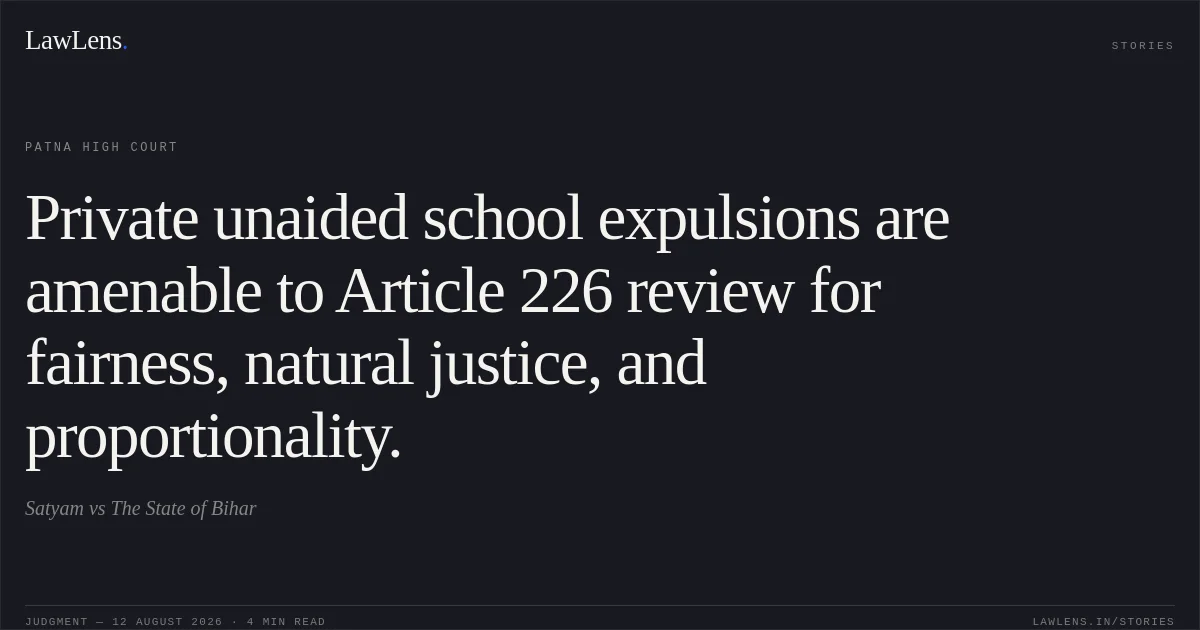
The Court held that imparting education by an unaided school involves a public function and that the expulsion of a student directly affects the student’s access to education; consequently, the impugned action contained a sufficient public-law element to attract Article 226 jurisdiction.
Source reference: paras. 32–35On merits, although the School possessed disciplinary authority and the record contained allegations of class-bunking, altercations and inappropriate conduct, the expulsion order merely referred generally to indiscipline and fighting and did not disclose proper consideration of the supporting material or the student’s explanation.
Source reference: paras. 36–37, 47–48The Court noted that class-bunking was not specifically included among the offences in Clause 66, and that every student altercation could not automatically justify the extreme penalty of expulsion without examining its seriousness and circumstances.
Source reference: paras. 38–40Since no adequate opportunity of hearing was afforded, the order was non-speaking, suffered from non-application of mind, and was disproportionate, particularly in the case of a minor student for whom a corrective and reformative approach was ordinarily preferable.
Source reference: paras. 41–45, 49–52The School’s detailed allegations in its counter-affidavit could not cure the defects in the original order.
Source reference: para. 10Holding
The Court overruled the School’s preliminary objection and held that the writ petition was maintainable under Article 226.
It quashed and set aside the order of expulsion dated 17 October 2025 as arbitrary, non-speaking, procedurally unfair and disproportionate.
Source reference: paras. 52–54The School was directed to permit the petitioner’s son to resume classes and participate in academic activities and examinations for which he was otherwise eligible.
Source reference: para. 55If he had missed any mandatory term examination solely because of the expulsion, the School was directed to provide an appropriate supplementary or special examination so that he suffered no academic prejudice.
Source reference: para. 56The student was directed to comply with the School’s rules and maintain discipline and decorum.
Source reference: para. 57Original Court PDF
SatyamvsThe State of Bihar
Click to open original judgment
Original judgment, available to read, download and summarize on LawLens.in