Facts
The petitioners, 137 private unaided recognized schools, challenged several orders and circulars issued by the Directorate of Education (DoE) that rejected their fee-hike proposals.
Source reference: p. 8, 80The DoE had mandated that schools situate on land allotted by government agencies (governed by a ‘land-clause’) must seek prior approval before increasing fees.
Source reference: p. 28Upon scrutiny by chartered accountants and a Project Management Unit (PMU), the DoE rejected these hikes, claiming schools possessed sufficient surplus funds and that certain expenditures (e.g., salaries for Chairmen, higher-than-government pay scales, and capital asset reserves) amounted to profiteering.
Source reference: p. 30-32, 43The schools contended these rejections were arbitrary, violated principles of natural justice due to lack of hearings, and impinged upon their financial autonomy.
Source reference: p. 9, 12Issues
1. Whether private unaided schools require prior approval from the DoE for fee hikes at the commencement of an academic session under Section 17(3) of the DSE Act.
Source reference: p. 5, Question 2.12. Whether the DoE’s regulatory power varies between schools with and without a ‘land-clause’ in their allotment letters.
Source reference: p. 6, Question 43. Whether the DoE’s practice of adding specific reserve funds (Contingency, Depreciation, Development) to "available funds" to deny fee hikes is legally sustainable.
Source reference: p. 7, Question 54. Whether the impugned orders were passed in violation of the principles of natural justice.
Source reference: p. 5, Question 1Law Applied
Section 17(3) of the Delhi School Education (DSE) Act, 1973, which requires schools to file a statement of fees before the session but mandates prior approval only for mid-session hikes.
Source reference: p. 45Rule 177 of the DSE Rules regarding the utilization of fees and the maintenance of a "reasonable surplus".
Source reference: p. 48-49Modern School v. Union of India, establishing that DoE's role is limited to preventing "profiteering" and "commercialization" while respecting institutional autonomy.
Source reference: p. 56ICAI Guidance Note (2005), requiring schools to follow the "accrual system" of accounting as not-for-profit entities.
Source reference: p. 93-96The principle from Gullapalli Nageswara Rao v. APSRTC that "he who hears must decide" regarding natural justice.
Source reference: p. 91Reasoning
The court reasoned that Section 17(3) of the DSE Act provides a "balancing" mechanism: schools have the autonomy to fix fees at the start of a session but are restrained from mid-session increases without approval.
Source reference: p. 73The DoE’s attempt to enforce prior approval for all hikes was deemed ultra vires the statute.
Source reference: p. 74Regarding the "land-clause," the court held that contractual terms between a school and a land agency cannot override statutory autonomy; the land-clause must be read in harmony with Section 17(3).
Source reference: p. 84The court found the DoE's accounting logic fundamentally flawed; by treating restricted funds (like Depreciation and Gratuity reserves) as "available cash" for salaries, the DoE was forcing schools to violate Rule 176 (misapplication of specific funds) and established accounting standards.
Source reference: p. 101-102Furthermore, the court noted a gross violation of natural justice as the DoE relied on internal reports and PMU recommendations without sharing them with the schools or providing a personal hearing before the Director.
Source reference: p. 86-91Holding
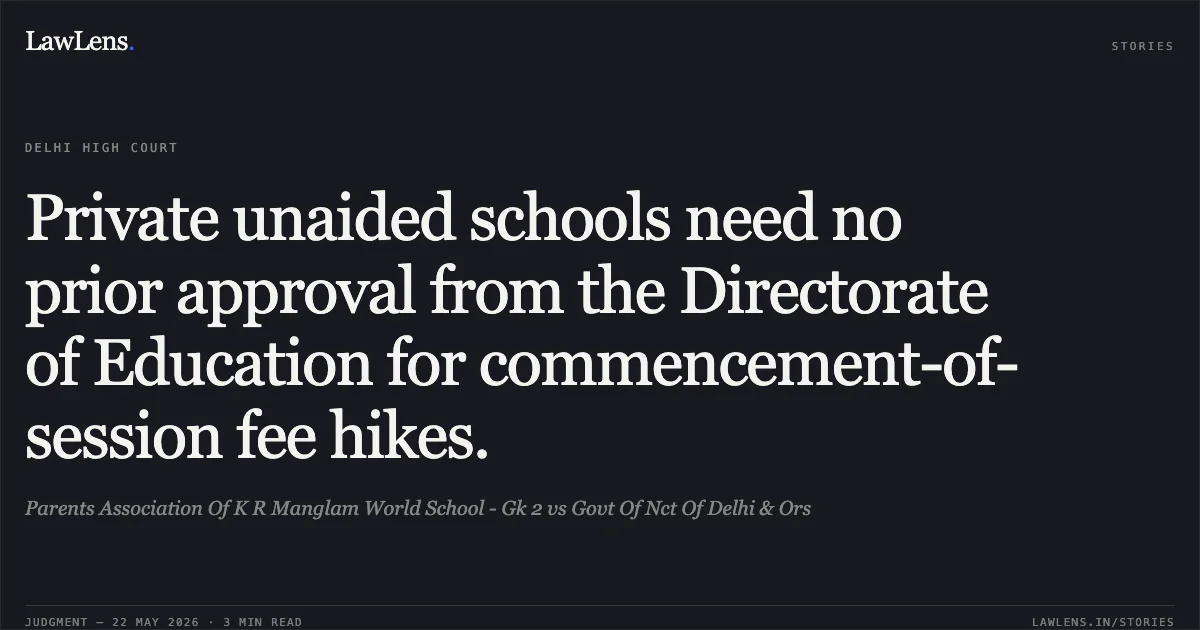
The court quashed the impugned orders, holding that no prior DoE approval is required for fee-hikes at the start of a session.
Unaided schools only need to file a fee statement; prior sanction is restricted to mid-session increases.
Source reference: p. 117There is no distinction in DoE's statutory regulatory powers between schools with or without a land-clause.
Source reference: p. 118Schools must follow the accrual system and ICAI Guidance Note; DoE cannot micro-manage fiscal affairs or treat reserves as operational income.
Source reference: p. 118-119To avoid "inordinate burden" on parents from retrospective hikes dating back to 2016, the court directed that proposed fee increases shall only apply prospectively from the April 2027 session, with no recovery of arrears.
Source reference: p. 119-120Acts & Sections Cited
9 provisions across 2 statutes referred to in this judgment. Each provision opens on LawLens.
Delhi School Education Act, 19736
Right of Children to Free and Compulsory Education Act, 20093
Original Court PDF
Parents Association Of K R Manglam World School - Gk 2vsGovt Of Nct Of Delhi & Ors
Click to open original judgment
Original judgment, available to read, download and summarize on LawLens.in