Facts
The appellant/complainant alleged that the respondent borrowed ₹3,50,000 as a hand loan on 13 October 2017 and issued Cheque No. Ex.P1 dated 12 March 2018 towards repayment.
Source reference: p.2The cheque was presented on 14 March 2018 and dishonoured on account of the respondent’s stop-payment instructions. After issuing a statutory notice, which was acknowledged by the respondent, the appellant filed a complaint under Section 138 of the Negotiable Instruments Act, 1881 (“NI Act”).
Source reference: p.5The complainant relied on the cheque, return memo, notice, acknowledgment and promissory note.
Source reference: no citationThe respondent admitted his signature on the cheque but disputed the underlying liability.
Source reference: no citationHe established through cross-examination, his own evidence and certified copies of related complaints that the complainant had advanced a single loan transaction involving the respondent, his sister and brother-in-law, while obtaining separate cheques, promissory notes and property documents from them.
Source reference: pp.10–12The trial Court acquitted the respondent, holding that the cheque was not proved to be supported by consideration.
Source reference: no citationThe complainant challenged the acquittal under Section 378(4) of the Code of Criminal Procedure, 1973.
Source reference: p.1Issues
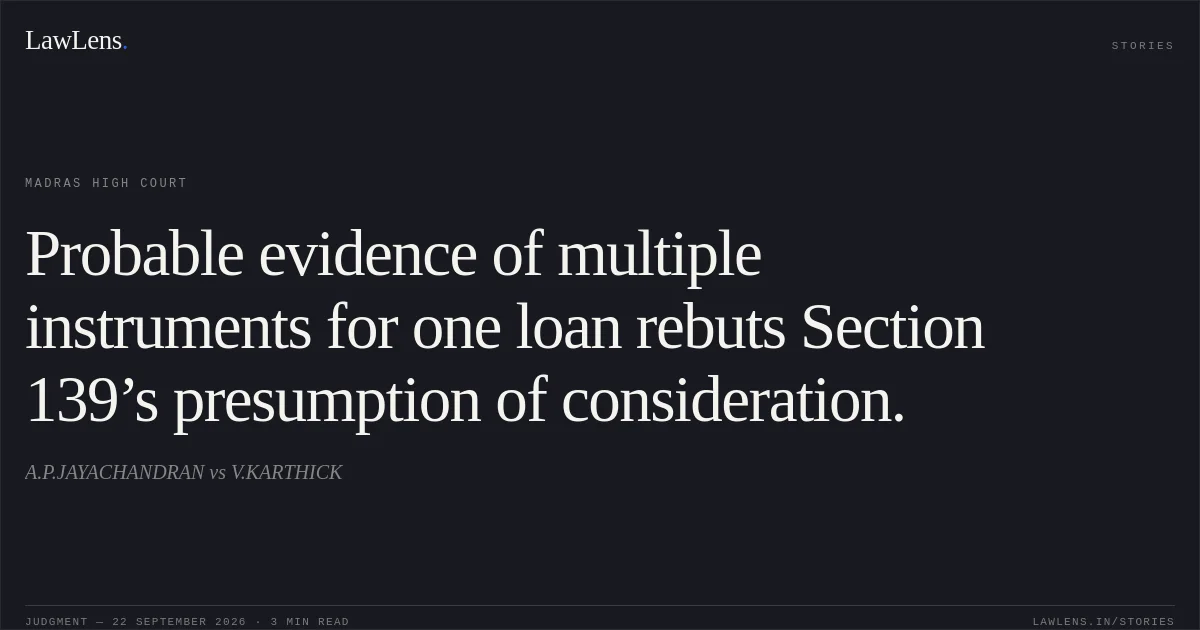
Whether the respondent successfully rebutted the statutory presumptions under Sections 118 and 139 of the NI Act by raising a probable defence that the cheque was not supported by consideration or a legally enforceable debt.
Source reference: pp.6–9, 12Whether, after rebuttal of the statutory presumptions, the complainant proved that consideration had in fact passed under the cheque in question.
Source reference: pp.12–14Whether the trial Court’s acquittal suffered from illegality or perversity warranting appellate interference.
Source reference: p.14Law Applied
Section 138 of the NI Act penalises dishonour of a cheque issued towards discharge of a legally enforceable debt or liability.
Source reference: no citationOnce the accused admits the signature on the cheque, the presumptions under Sections 118 and 139 arise in favour of the holder, shifting the evidentiary burden to the accused.
Source reference: p.6However, the accused need not rebut the presumptions beyond reasonable doubt; a probable defence established on the preponderance of probabilities is sufficient.
Source reference: pp.6–8The accused may rely on direct evidence, circumstantial evidence, the complainant’s own materials or cross-examination to show that consideration or debt did not exist, as held in Bharat Barrel and Drum Manufacturing Co. v. Amin Chand Payrelal , (1999) 3 SCC 35, and Kumar Exports v. Sharma Carpets , (2009) 2 SCC 513.
Source reference: pp.6–8Tedhi Singh v. Narayan Dass Mahant , (2022) 6 SCC 735, further recognises that whether a probable defence has been established depends on the totality of the facts and circumstances.
Source reference: pp.8–10Reasoning
Although the respondent admitted his signature, thereby triggering the statutory presumptions, the evidence disclosed material inconsistencies in the complainant’s case.
Source reference: no citationThe legal notice and complaint described only a hand loan to the respondent and omitted the promissory note, interest obligation and the alleged involvement of the respondent’s sister and brother-in-law.
Source reference: pp.4–5In cross-examination, the complainant admitted that all three persons had approached him together in relation to the same financial transaction and that he had obtained separate cheques and promissory notes from each of them, besides property documents from the respondent’s sister.
Source reference: pp.10–12He had also filed separate Section 138 complaints against the sister and brother-in-law for the same amount.
Source reference: pp.11–12These admissions, supported by the certified copies of the related complaints, constituted a probable defence that multiple instruments had been obtained for a single transaction.
Source reference: pp.12–14The burden therefore shifted back to the complainant, who failed to satisfactorily explain the multiple proceedings or prove that the cheque represented a distinct legally enforceable liability of ₹3,50,000.
Source reference: pp.12–14The alleged admission in the later reply notice did not alter the result, particularly as its authenticity and timing were disputed and it was issued after filing of the complaint.
Source reference: p.13Holding
The High Court held that the respondent had rebutted the presumptions under Sections 118 and 139 of the NI Act on the preponderance of probabilities.
The complainant failed to re-establish that the cheque was supported by consideration or represented a legally enforceable debt.
Source reference: pp.14–16Finding no illegality or perversity in the trial Court’s acquittal, the High Court dismissed the criminal appeal and affirmed the judgment dated 7 August 2021 in C.C. No. 5013 of 2018.
Source reference: pp.14–16Acts & Sections Cited
4 provisions across 2 statutes referred to in this judgment. Each provision opens on LawLens.
Code of Criminal Procedure, 19731
Negotiable Instruments Act, 18813
Original Court PDF
A.P.JAYACHANDRANvsV.KARTHICK
Click to open original judgment
Original judgment, available to read, download and summarize on LawLens.in