Facts
Respondent No. 1 filed a petition under Section 268 of the Indian Succession Act, 1925, seeking Letters of Administration for a Will dated 02.03.2016 (the "Propounded Will") executed by Late Sh. Govind Singh
Source reference: p. 1-2The appellants moved an application (I.A. 13262/2023) seeking a direction for Respondent No. 1 to produce the original of a second alleged Will of the same date, claiming the Propounded Will was forged and forensic comparison of both originals was necessary
Source reference: p. 2Respondent No. 1 claimed the second original was lost
Source reference: p. 2The learned Single Judge dismissed the application on 08.01.2026, holding production was unnecessary at the preliminary stage as both documents bequeathed the property to Respondent No.1 and the appellants held a certified copy
Source reference: p. 2, 5The appellants challenged this dismissal
Source reference: p. 3Issues
1. Whether the production of a second alleged original Will is essential at the preliminary stage of probate/Letters of Administration proceedings to determine the genuineness of the propounded Will.
Source reference: p. 3 / para. 7-102. Whether the limited jurisdiction of a Probate Court permits an inquiry into comparative forensics of non-testamentary documents before the trial stage.
Source reference: p. 4-5 / para. 11-13Law Applied
The court primarily applied Sections 268, 299, and 300 of the Indian Succession Act, 1925, regarding the grant of Letters of Administration and the right to appeal
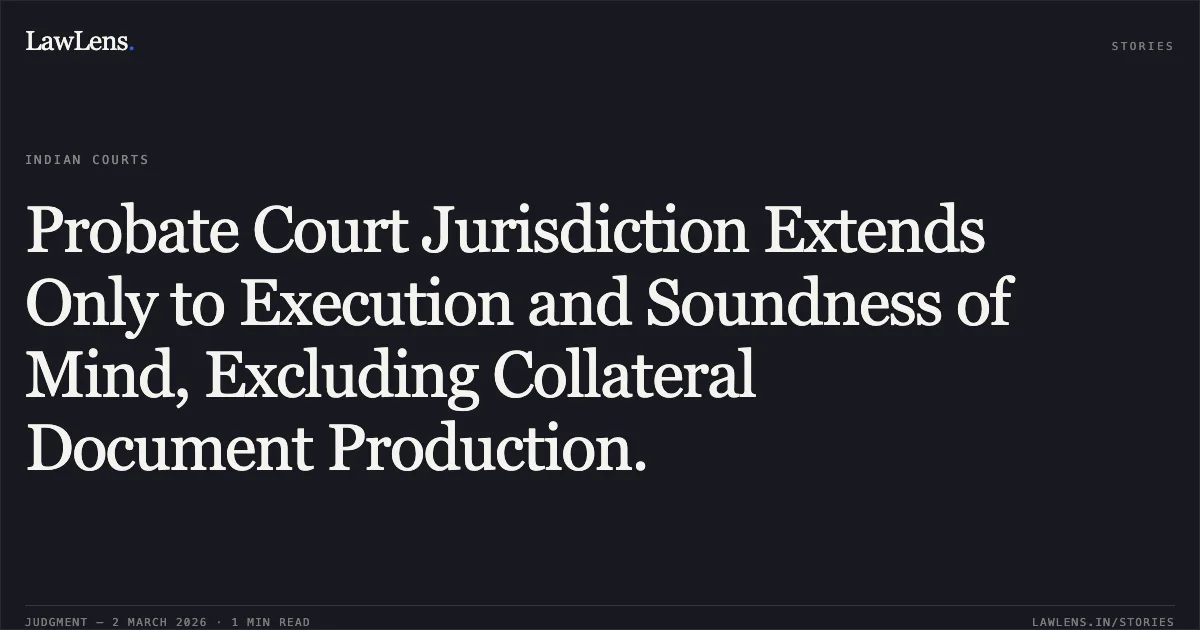
Source reference: p. 1-2It relied heavily on the precedent of Ishwardeo Narain Singh v. Kamta Devi & Ors. (1953), which established that the jurisdiction of a Probate Court is limited to determining if the propounded document was duly executed/attested by a testator of sound mind, and is not concerned with the validity of bequests or title
Source reference: p. 4, para. 11Furthermore, it observed the principle of adverse inference under Section 114 illustration (g) of the Indian Evidence Act, 1872, as argued by the appellants
Source reference: p. 3, para. 8Reasoning
The Court reasoned that in testamentary proceedings, the court’s focus is strictly limited to the due execution of the specific Will propounded—not the validity of bequests or collateral issues
Source reference: p. 4Applying Ishwardeo Narain Singh, the Court found that since Respondent No. 1 had already produced the original Propounded Will dated 02.03.2016 and the appellants possessed a certified copy of the alleged second Will, the trial could proceed without the second original at this "preliminary stage"
Source reference: p. 4-5The Court noted that issues had not yet been framed and the appellants retained the liberty to confront respondents with the certified copy during trial
Source reference: p. 5It further highlighted that since both versions of the Will bequeathed the property to the same person, the non-production did not immediately impede the Court’s ability to examine the execution of the Propounded Will
Source reference: p. 5Consequently, the Single Judge’s exercise of discretion was deemed appropriate as it did not preclude the appellants from raising objections later
Source reference: p. 6Holding
The Court answered the issues in the negative, holding that the production of the second original Will was not mandatory at this preliminary stage
The appeal was dismissed as devoid of merit, with the Court clarifying that the appellants may raise all permissible objections regarding the genuineness of the Propounded Will during the trial
Source reference: p. 6, para. 14-17The Court affirmed the Single Judge's order and granted liberty to the appellants to move a fresh application at a later stage if the need for the original document arises during the progress of the case
Source reference: p. 6Acts & Sections Cited
3 provisions across 1 statute referred to in this judgment. Each provision opens on LawLens.
Indian Succession Act, 19253
Original Court PDF
Gurbani Singh & Anr. v. Deepak Singh & Anr. FAO(OS) 23/2026
Click to open original judgment
Original judgment, available to read, download and summarize on LawLens.in