Facts
The respondent no. 2 sought deletion of Issue No. 1 framed by the Delhi High Court on 20.09.2017, contending that the issue concerned whether the consideration for acquiring the subject property was derived from partition compensation and, consequently, whether the property was joint family property in which the testator held only the position of Karta.
Source reference: p. 1, paras. 1–2An earlier application seeking to summon witnesses from the Land & Development Office and the Settlement Commissioner of Evacuee Properties to establish this contention had been dismissed on 02.02.2023, on the ground that questions concerning the testator’s title or authority to dispose of the property could not be adjudicated in probate proceedings.
Source reference: p. 2, paras. 2–4The challenge to that order before the Division Bench and the Supreme Court was also unsuccessful.
Source reference: p. 3, para. 5The parties informed the Court that evidence had already been recorded.
Source reference: p. 4, para. 11Issues
Whether Issue No. 1, concerning the testator’s authority or title to dispose of the subject property, should be struck off as falling outside the jurisdiction of a probate court.
Source reference: p. 1, para. 1; p. 3, paras. 7–9Whether a probate court can determine whether the property covered by the Will was joint family property or whether the testator had authority to bequeath it.
Source reference: p. 2, paras. 3–4Law Applied
Under Order XIV Rule 5(2) of the Code of Civil Procedure, 1908, the Court may, at any time before passing a decree, strike out an issue that appears to have been wrongly framed or introduced.
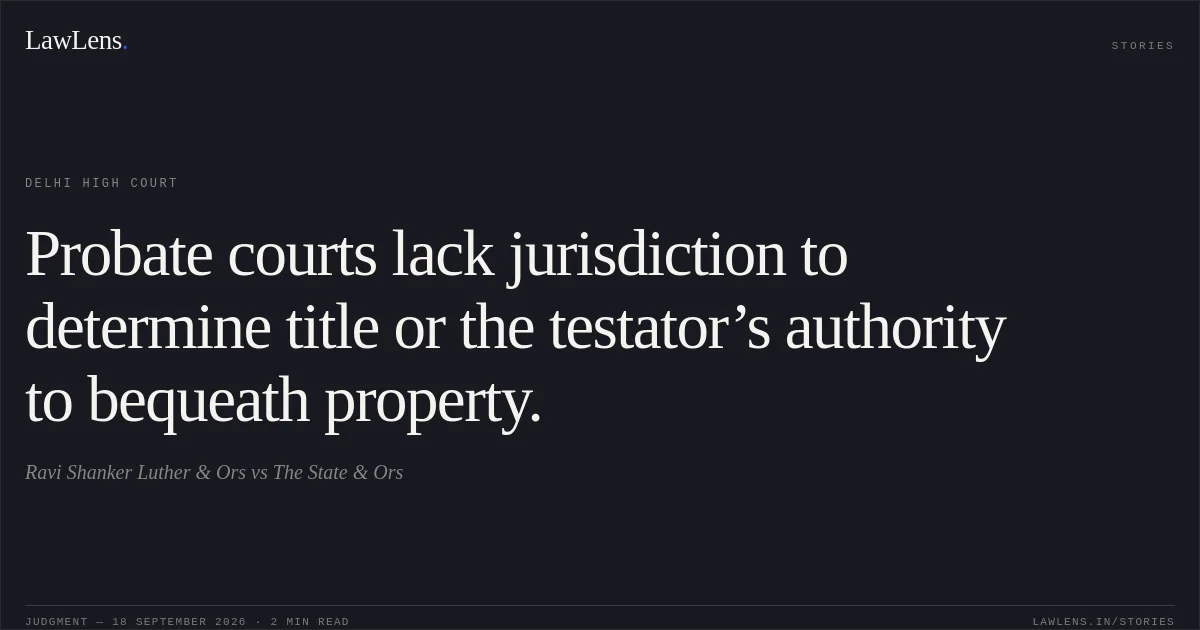
Source reference: p. 3, para. 7The jurisdiction of a probate court is confined to determining whether the Will was executed by the testator in a sound and disposing state of mind, without coercion or undue influence, and whether it was duly attested. It cannot determine the testator’s title to the property, his authority to dispose of it, or whether the property was joint ancestral or independently acquired. The Court relied on Kanwarjit Singh Dhillon v. Hardyal Singh Dhillon & Ors., (2007) 11 SCC 357.
Source reference: p. 2, paras. 3–4Reasoning
The Court held that Issue No. 1 required determination of matters relating to the testator’s title and authority to bequeath the subject property, including whether it was joint family property. Those questions were beyond the limited jurisdiction of the probate court under the rule stated in Kanwarjit Singh Dhillon.
Source reference: p. 2, paras. 3–4Since the Court could neither adjudicate the issue nor properly return a finding on it in the probate proceedings, retaining it would require the Court either to decide a question outside its jurisdiction or leave the issue unanswered. Accordingly, the issue was wrongly introduced and was liable to be struck out under Order XIV Rule 5(2) CPC.
Source reference: p. 3, paras. 7–9Holding
The Court allowed the application and struck off Issue No. 1 on the ground that it fell outside the jurisdiction of the probate court.
As evidence had already been recorded, the matter was listed for final hearing on 07.12.2026, and the parties were directed to file short synopses of submissions, not exceeding three pages, within four weeks.
Source reference: p. 4, paras. 11–13Acts & Sections Cited
1 provisions across 1 statute referred to in this judgment. Each provision opens on LawLens.
Code of Civil Procedure, 19081
Original Court PDF
Ravi Shanker Luther & OrsvsThe State & Ors
Click to open original judgment
Original judgment, available to read, download and summarize on LawLens.in