Facts
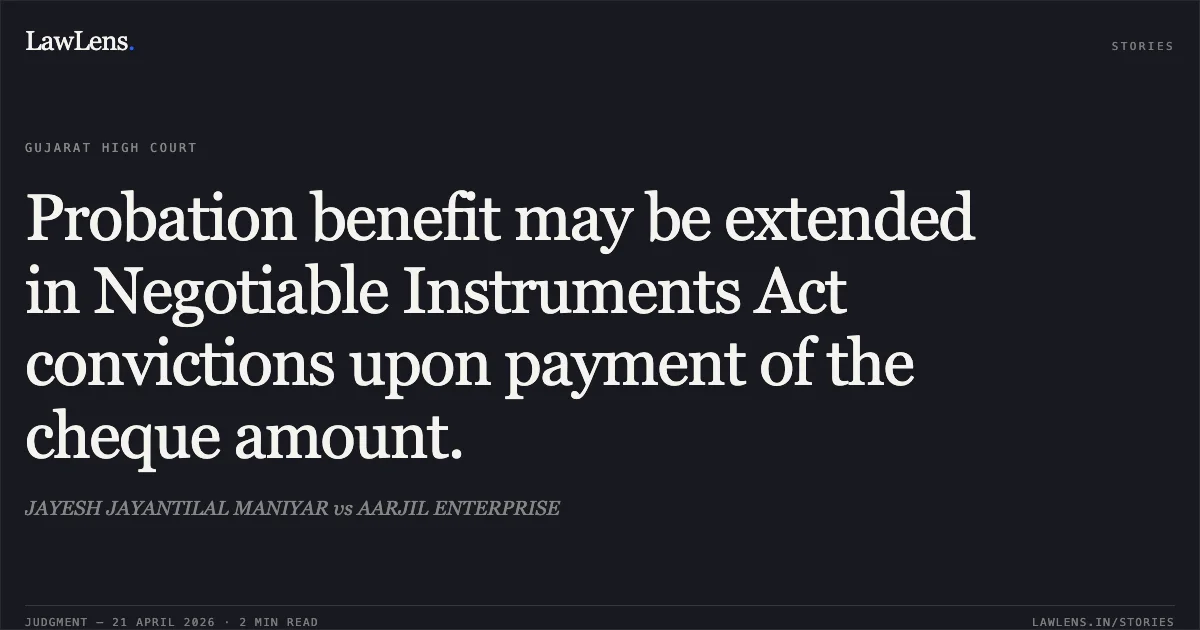
The applicant was originally convicted by the Chief Judicial Magistrate, Surendranagar, in Criminal Case No. 209 of 2002 for an offence under Section 138 of the Negotiable Instruments (NI) Act
Source reference: p. 1-2The trial court sentenced the applicant to one year of simple imprisonment and a fine of Rs. 10,000
Source reference: p. 2This order was challenged in Criminal Appeal No. 53 of 2010, where the Additional Sessions Judge, Surendranagar, reduced the sentence to six months of simple imprisonment while maintaining the fine
Source reference: p. 2During the pendency of the present revision application, the applicant deposited the cheque amount via Demand Draft on 18.04.2026
Source reference: p. 2Issues
1. Whether the concurrent findings of conviction by the lower courts warrant interference under revisional jurisdiction after the applicant has deposited the cheque amount
Source reference: p. 2-32. Whether the applicant can be granted the benefit of the Probation of Offenders Act, 1958, while maintaining the conviction for an offence under Section 138 of the NI Act
Source reference: p. 3Law Applied
The court primarily applied Section 138 of the Negotiable Instruments Act, 1881, noting that the offence is quasi-criminal and compoundable, designed to ensure the credibility of cheques rather than seek retribution
Source reference: p. 2Revisional powers were exercised under Sections 397 and 401 of the Code of Criminal Procedure, 1973, which restrict the court from re-analyzing evidence unless perversity is shown
Source reference: p. 2-3Furthermore, the court relied on the Supreme Court precedent Sanjabij Tari v. Kishore S. Borcar, 2025 INSC 1158, regarding the application of Section 4 of the Probation of Offenders Act, 1958, for such offences
Source reference: p. 3Reasoning
The court reasoned that as the applicant had deposited the full cheque amount, the primary objective of the NI Act—payment of money—was satisfied
Source reference: p. 2It observed that in the absence of perversity, a revisional court should not re-interpret evidence to upset concurrent findings of lower courts
Source reference: p. 2-3However, acknowledging the quasi-criminal nature of the offence and the subsequent payment, the court determined that while the conviction should stand, the punitive element could be mitigated
Source reference: p. 3Following the rationale in Sanjabij Tari, the court decided to extend the benefit of probation to the applicant, substituting active imprisonment with a bond of good conduct
Source reference: p. 3Holding
The High Court maintained the conviction but modified the sentence.
The applicant was directed to be released on probation of good conduct under Section 4 of the Probation of Offenders Act for a period of six months, upon execution of a bond of Rs. 20,000 with one surety
Source reference: p. 3The court ordered the applicant to maintain peace during this period and appear for sentencing if called upon
Source reference: p. 3The Registry was directed to release the deposited amount to the complainant after due verification
Source reference: p. 4The revision application was disposed of accordingly
Source reference: p. 4Acts & Sections Cited
4 provisions across 3 statutes referred to in this judgment. Each provision opens on LawLens.
Code of Criminal Procedure, 19732
Negotiable Instruments Act, 18811
Probation of Offenders Act, 19581
Original Court PDF
JAYESH JAYANTILAL MANIYARvsAARJIL ENTERPRISE
Click to open original judgment
Original judgment, available to read, download and summarize on LawLens.in