Facts
On 2 July 1998, while the informant and his family were returning from a marriage ceremony, the petitioner allegedly struck the informant with a lathi and participated with others in taking the victim to a co-accused’s house.
Source reference: p. 2–6, para. 1–5The petitioner was tried and convicted under Sections 323 and 363 of the IPC; the Trial Court imposed six months’ rigorous imprisonment for Section 323 and four years’ rigorous imprisonment and a fine of ₹2,000 for Section 363, with the sentences to run concurrently.
Source reference: p. 2–6, para. 1–5The Appellate Court affirmed the conviction and sentence. The petitioner challenged those decisions in revision under Sections 397 and 401 CrPC.
Source reference: p. 2–6, para. 1–5Issues
1. Whether the courts below’ findings of guilt under Sections 323 and 363 IPC were perverse, particularly in relation to identification of the petitioner.
Source reference: p. 6–8, para. 6–102. Whether, despite maintaining the convictions, the petitioner should be released on probation under Section 4 of the Probation of Offenders Act, 1958, and whether the fine should remain payable.
Source reference: p. 8–10, para. 11–14-ALaw Applied
Sections 323 and 363 IPC formed the basis of the petitioner’s convictions. Sections 397 and 401 CrPC empowered the High Court to examine the challenged judgments in revision.
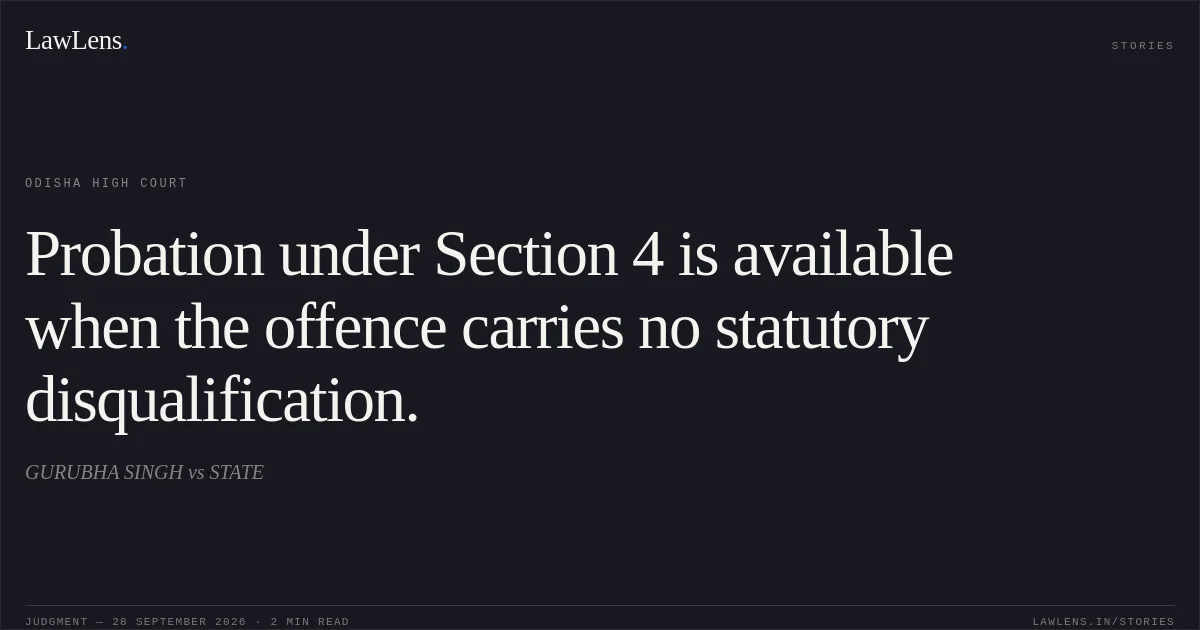
Source reference: p. 2, para. 1The Court applied Section 4 of the Probation of Offenders Act, 1958, concluding that the offences did not attract the disqualification under Section 4(1) and that probation could be granted on conditions fixed by the Trial Court.
Source reference: p. 8–10, para. 11–14The Court relied on Chellammal and Another v. State represented by the Inspector of Police, 2025 SCC OnLine SC 870, in considering probation in the circumstances.
Source reference: p. 9, para. 13It also considered, but found unhelpful to the petitioner on the identity issue, Balu Singh Munda v. State of Odisha, (1997) 12 OCR 208, and Pradeep Giri and others v. State of Orissa, (1994) 1 OLR 118.
Source reference: p. 7, para. 8Reasoning
The Court considered the evidence of the occurrence witness, P.W.4, alongside the investigating officer’s evidence and found no basis to disregard their evidence identifying the accused.
Source reference: p. 7–8, para. 8–10It also assessed the victim’s testimony, the other eyewitness evidence and the prosecution account that the victim was recovered from the co-accused’s house; it found no perversity in the Trial Court’s assessment or the Appellate Court’s approach.
Source reference: p. 7–8, para. 8–10On sentence, the Court took account of the petitioner’s age of about 63, his well-being report, the passage of time since the 1998 occurrence and the absence of any reported further offending since his release on bail in 2000.
Source reference: p. 8–10, para. 11–14In light of those circumstances and Chellammal, it considered probation appropriate.
Source reference: p. 8–10, para. 11–14Holding
The High Court declined to interfere with the convictions under Sections 323 and 363 IPC.
It nevertheless directed the petitioner’s release on probation under Section 4 of the Probation of Offenders Act, on conditions to be settled by the Trial Court, and set aside the fine.
Source reference: p. 10, para. 14–15The criminal revision and pending interlocutory applications were disposed of.
Source reference: p. 10, para. 14–15Acts & Sections Cited
10 provisions across 3 statutes referred to in this judgment. Each provision opens on LawLens.
Code of Criminal Procedure, 19732
Indian Penal Code, 18607
Probation of Offenders Act, 19581
Original Court PDF
GURUBHA SINGHvsSTATE
Click to open original judgment
Original judgment, available to read, download and summarize on LawLens.in