Facts
The Petitioner, a 72-year-old retired police officer and heart patient, sought the eviction of his daughter-in-law (Respondent No. 2) and son (Respondent No. 3) from his self-owned property
Source reference: p. 2He alleged that the daughter-in-law was quarrelsome and had locked him out of the upper floors of the premises
Source reference: p. 2The District Magistrate (DM) dismissed the eviction petition, finding it to be a result of matrimonial discord rather than elder abuse
Source reference: p. 3This was affirmed by the Appellate Authority, which observed the case was a "classic case of collusion" between the father and son to oust the daughter-in-law
Source reference: p. 3The Petitioner challenged these orders via a writ of mandamus
Source reference: p. 1-2Issues
1. Whether the summary eviction procedure under the Senior Citizens Act, 2007 can be invoked to evict a daughter-in-law in the context of matrimonial discord
Source reference: para. 13-152. Whether the Petitioner is entitled to reside in his property despite the denial of the eviction prayer
Source reference: para. 16-17Law Applied
The court relied on the Maintenance and Welfare of Parents and Senior Citizens Act, 2007 and the Delhi Rules, 2009, which must be liberally construed to protect the elderly
Source reference: para. 11the Protection of Women from Domestic Violence Act, 2005 (PWDVA), specifically the right to a "shared household" under Section 2(s), 17, and 19
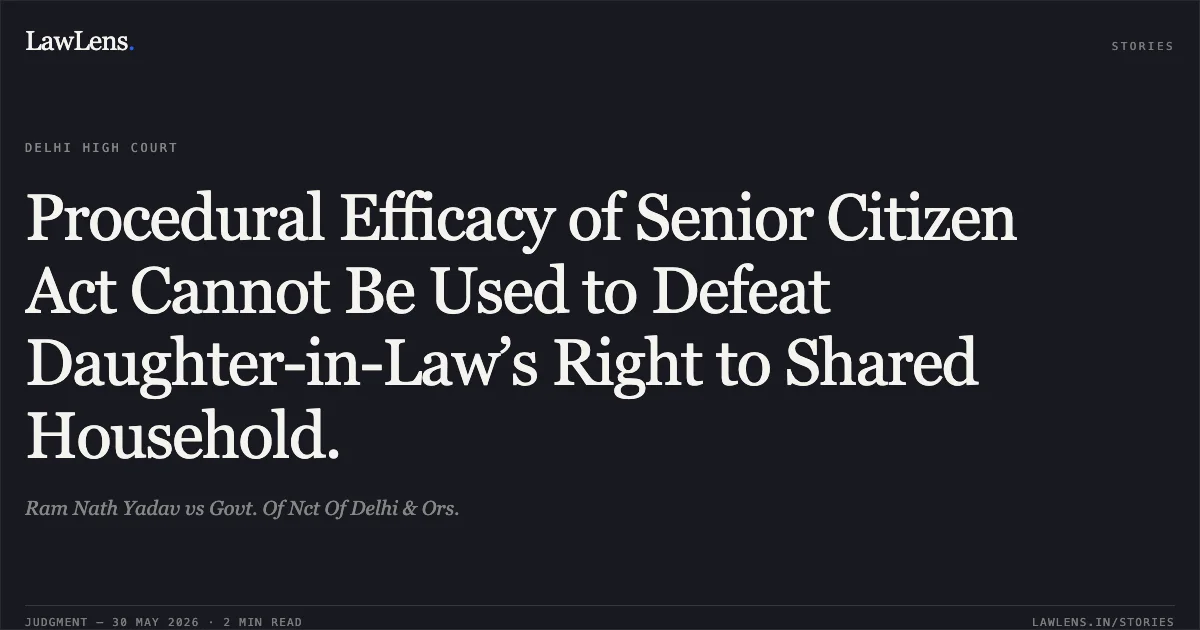
Source reference: para. 12The core doctrine applied was from S. Vanitha v. Deputy Commissioner, Bengaluru Urban District & Ors., which mandates a harmonious construction of both statutes, holding that the Senior Citizens Act cannot be used as a tool to override a woman's right to residency in a shared household through summary proceedings
Source reference: para. 13-14Reasoning
The Court observed that both the District Magistrate and the Appellate Authority concurrenty found no evidence of actual ill-treatment or harassment directed at the Petitioner by the daughter-in-law
Source reference: para. 7-8the authorities concluded that the Senior Citizens Act was being misused in collusion with the son to resolve matrimonial disputes
Source reference: para. 8Applying the ratio in S. Vanitha, the Court reasoned that while the Act protects senior citizens, it cannot be used to circumvent the PWDVA protections
Source reference: para. 13the Court noted that since the Respondents only occupied the ground floor and the Petitioner had access to the first and second floors, total eviction was not a proportionate or necessary remedy to ensure the Petitioner’s welfare
Source reference: para. 10, 16Holding
The Court dismissed the challenge to the impugned orders, holding that interference with the lower authorities' findings was not warranted
The Court ordered that the Petitioner is at liberty to stay in the upper floors and directed the concerned Station House Officer (SHO) to ensure his peaceful residence without any obstruction from the Respondents
Source reference: para. 17-18The petition was disposed of with these protections
Source reference: para. 19Acts & Sections Cited
4 provisions across 2 statutes referred to in this judgment. Each provision opens on LawLens.
Maintenance and Welfare of Parents and Senior Citizens Act, 20071
Protection of Women from Domestic Violence Act, 20053
Original Court PDF
Ram Nath YadavvsGovt. Of Nct Of Delhi & Ors.
Click to open original judgment
Original judgment, available to read, download and summarize on LawLens.in