Facts
The Appellants were appointed in 2014 as Clerk-cum-Salesmen and Peon-cum-Chowkidars in the Thanesar Cooperative Marketing-cum-Processing Society Ltd.
Source reference: p.2-3The recruitment followed a public advertisement and approval from the Registrar, Cooperative Societies.
Source reference: p.4In 2015, two Society members (Respondents 6 and 7) challenged the appointments under Section 27 of the Haryana Cooperative Societies Act, 1984, alleging procedural violations.
Source reference: p.8Specifically, it was argued that Rule 3 of the Service Rules, 2003 (as amended in 2011) was violated because the mandatory presence and concurrence of the Assistant Registrar, Inspector, and District Manager (HAFED) were missing during the appointment meeting on 13.08.2014.
Source reference: p.10Statutory authorities and the High Court (Single and Division Benches) invalidated the appointments, holding Rule 3 to be mandatory and the defect fatal.
Source reference: p.11-18The Appellants, having served for over a decade, appealed to the Supreme Court.
Source reference: p.18-19Issues
1. Whether amended Rule 3 of the Staff Service Rules, 2003, is mandatory or directory, and whether its violation renders appointments void ab initio.
Source reference: p.24, para. 25(i)2. Whether procedural irregularities in the final appointment stage (absence of official members) outweigh the legal validity of the prior selection phases (advertisement and interview).
Source reference: p.25, para. 25(iii)3. Whether Section 36 of the 1984 Act and the doctrine of proportionality protect employees from being penalized for institutional lapses.
Source reference: p.25, para. 25(iv-v)Law Applied
Rule 3 of the Staff Service Rules, 2003, which mandates the "presence and concurrence" of specific official members for appointments.
Source reference: p.27Rule 15 regarding recruitment transparency and Rule 35 concerning meeting quorums.
Source reference: p.29, 30Section 36 of the Haryana Cooperative Societies Act, 1984, which provides that acts of a cooperative society shall not be invalidated merely by procedural defects or vacancies in the committee.
Source reference: p.32The principle of curability of procedural irregularities and the constitutional obligation of fairness in public employment.
Source reference: p.1-2, 19Reasoning
The Court divided the recruitment process into three distinct stages: (1) Notification/Advertisement, (2) Interview/Selection, and (3) Final Appointment by the Board of Directors (BOD).
Source reference: p.45-46The Court found that the first two stages were fundamentally sound, ensuring public notice and merit-based selection.
Source reference: p.34, 43The Court characterized Rule 3 as "salutary" and "supervisory" rather than a rule that creates a fundamental nullity; its purpose is to provide technical oversight by non-elected officials to ensure rules were followed.
Source reference: p.46-47Applying Section 36 of the 1984 Act, the Court held that the absence of officials in the final meeting was a "curable irregularity" rather than a "fatal illegality".
Source reference: p.41-42, 48Because the Appellants had no role in the procedural lapse and had rendered a decade of unblemished service, the Court determined that the third stage of recruitment was "severable" from the valid earlier stages.
Source reference: p.48-49Holding
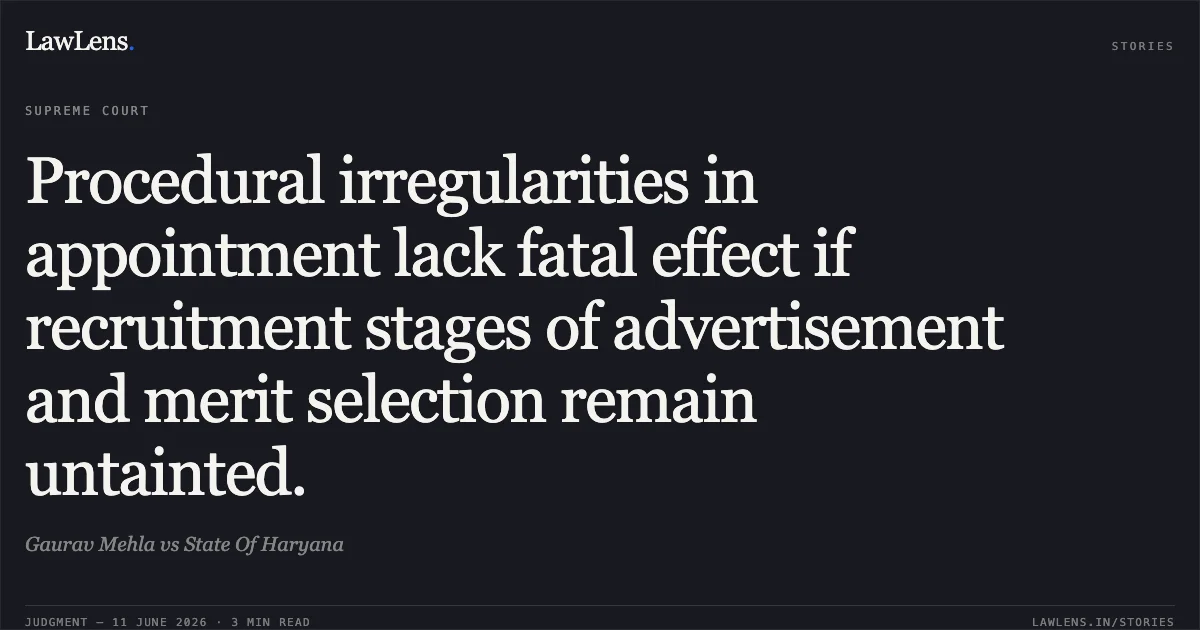
The Supreme Court set aside the High Court judgment and the orders of the statutory authorities, holding that the defect in the appointment resolution was curable and did not vitiate the entire selection process.
The Court directed the Cooperative Society to reconvene a meeting of the BOD within one month, with the mandatory presence of the Assistant Registrar, Inspector, and District Manager (HAFED), to verify the Appellants' eligibility and merit based on existing 2014 records; if found eligible, they must be re-appointed with continuity of service but without arrears of pay.
Source reference: p.50-52Acts & Sections Cited
2 provisions across 1 statute referred to in this judgment. Each provision opens on LawLens.
Haryana Co-operative Societies Act, 19842
Original Court PDF
Gaurav MehlavsState Of Haryana
Click to open original judgment
Original judgment, available to read, download and summarize on LawLens.in


