Facts
The petitioner, formerly District Sub-Registrar at Bihar Sharif, was accused of demanding a bribe of ₹20,000 for the registration of a plot of land
Source reference: p. 2Following a written complaint by one Rakesh Kumar on 14.07.2017 and subsequent verification, a trap was conducted on 21.07.2017, leading to the petitioner’s arrest and the recovery of tainted currency
Source reference: p. 2This petition sought to quash the fresh cognizance order dated 12.11.2020 passed by the Special Judge (Vigilance) after a previous order had been remitted by the High Court for lack of reasoned application of mind
Source reference: p. 3The petitioner challenged the order on grounds of the complainant’s lack of locus standi, as he was not a party to the sale deed, and alleged procedural violations during arrest
Source reference: p. 4Issues
1. Whether the order taking cognizance under Sections 7, 8, and 13 of the Prevention of Corruption Act, 1988 warrants quashing under Section 482 Cr.P.C. due to the complainant's alleged lack of locus standi or procedural irregularities in the arrest
Source reference: p. 5/11Law Applied
The court applied the jurisdictional limits of Section 482 Cr.P.C. as established in State of Haryana v. Bhajan Lal [1992 Supp (1) SCC 335] and Neeharika Infrastructure Pvt. Ltd. v. State of Maharashtra [(2021) 19 SCC 401], which mandate that inherent powers be exercised sparingly only when no cognizable offence is disclosed or the process is abused
Source reference: p. 5It further referenced Arnesh Kumar v. State of Bihar regarding arrest procedures and Bhim Singh v. State of J&K [(1985) 4 SCC 677], holding that illegal arrest does not vitiate a trial or quash an FIR
Source reference: p. 7The substantive law applied was Section 7 of the Prevention of Corruption Act, 1988, which penalizes a public servant's acceptance of "undue advantage" for performing official duties
Source reference: p. 8-10Reasoning
The Court rejected the petitioner’s argument regarding the complainant's locus standi, noting that neither the Prevention of Corruption Act nor the Cr.P.C. restricts the right to lodge a complaint to only parties involved in the transaction; furthermore, the presence of the complainant is a triable question of fact
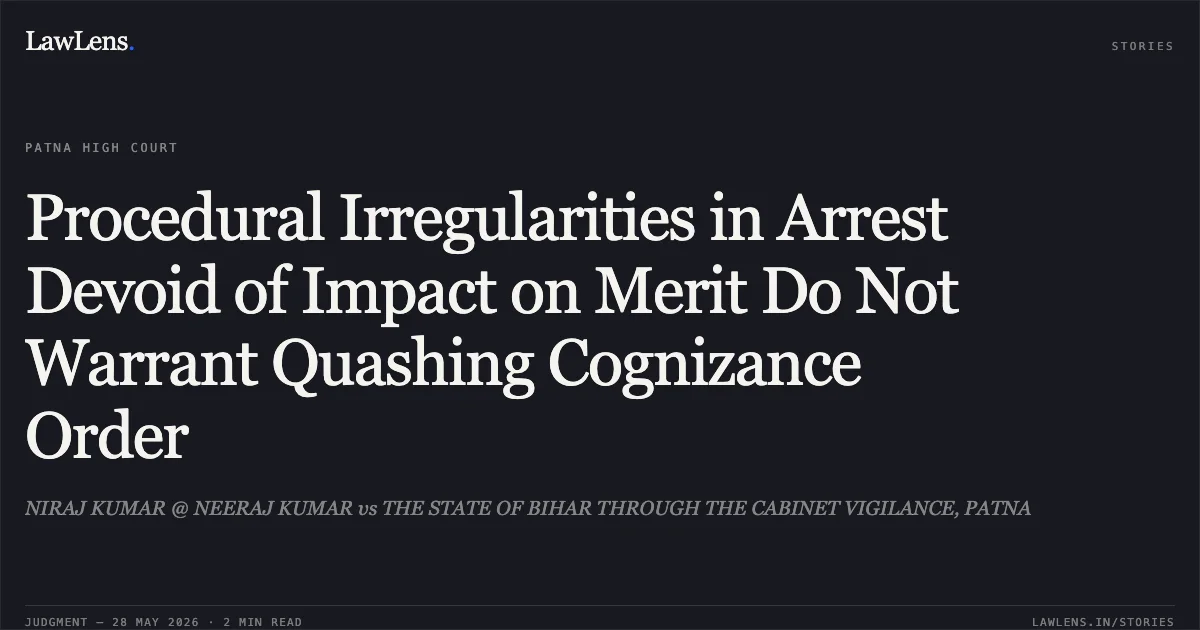
Source reference: p. 5-6Regarding the alleged non-compliance with Sections 41, 41B, and the D.K. Basu guidelines during arrest, the Court held that while such irregularities impact individual liberty, they do not render the entire prosecution bad if independent incriminating materials—such as the Post Trap Memorandum and recovery of tainted currency—exist
Source reference: p. 6-7The Court emphasized that at the cognizance stage, it only requires prima facie satisfaction that an offence occurred, rather than proof beyond reasonable doubt
Source reference: p. 7-8Holding
The Court answered the issue in the negative, holding that the materials on record (complaint, verification report, and trap recovery) clearly established the ingredients of the offences under Sections 7, 8, and 13 of the Act
The Court found no exceptional circumstances or manifest injustice to justify quashing the proceedings. Consequently, the petition was dismissed, and the prayer to quash the cognizance order dated 12.11.2020 was rejected
Source reference: p. 11-12Acts & Sections Cited
7 provisions across 2 statutes referred to in this judgment. Each provision opens on LawLens.
Prevention of Corruption Act, 19884
Code of Criminal Procedure, 19733
Original Court PDF
NIRAJ KUMAR @ NEERAJ KUMARvsTHE STATE OF BIHAR THROUGH THE CABINET VIGILANCE, PATNA
Click to open original judgment
Original judgment, available to read, download and summarize on LawLens.in