Facts
The applicants sought bail under Section 483 of the BNSS regarding Crime No. 201/2025 involving the murder of Sanju Lodhi, whose decomposed body was found in the Govindpura forest on July 15, 2025
Source reference: para. 2-3The deceased was last seen with the applicants on July 12, 2025, riding a motorcycle
Source reference: para. 16Following the applicants' arrest, a weapon (knife) was recovered based on their disclosure statements
Source reference: para. 18The applicants challenged their detention on grounds that "grounds of arrest" were not provided in writing, the "last seen" theory was weak due to lack of CCTV footage, and forensic reports were inconclusive regarding the cause of death
Source reference: para. 7, 11-14Issues
1. Whether the failure to communicate the grounds of arrest in writing, as mandated by Articles 21 and 22 of the Constitution, necessitates the mandatory release of the accused on bail in a murder case
Source reference: para. 8-92. Whether discrepancies in forensic evidence and the "last seen" theory at the prima facie stage are sufficient to grant bail in a grave offense under Section 103(1) of the BNS
Source reference: para. 11-15Law Applied
The court primarily applied Section 103(1) (Murder), 238(A), and 61(2)(a) of the BNS
Source reference: para. 2It analyzed Article 22(1) of the Constitution and Section 50 of the Cr.P.C. (now Section 47 of BNSS) regarding procedural mandates for arrest
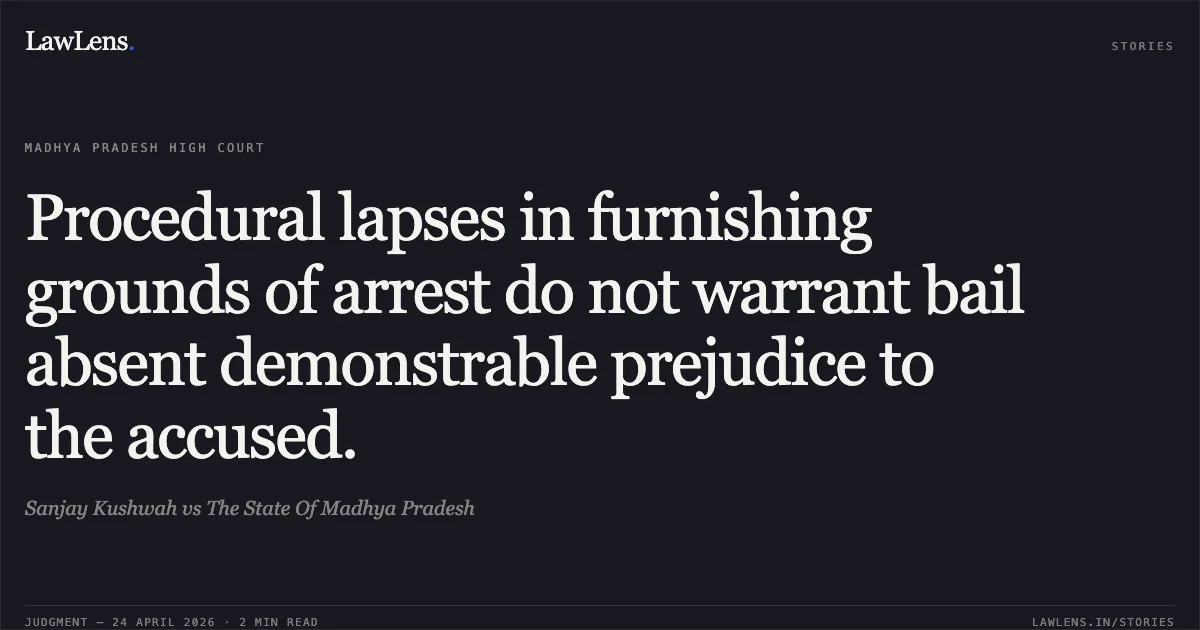
Source reference: para. 20.1.2It relied on State of Karnataka v. Sri Darshan, which held that delay/failure to furnish written grounds of arrest does not ipso facto render custody illegal or entitle the accused to bail unless demonstrable prejudice is shown
Source reference: para. 18, 20.1.7It further noted Ishwarji Nagaji Mali v. State of Gujarat, stating that the reliance on circumstantial evidence is not a valid ground for bail if a prima facie chain of events is established
Source reference: para. 22Reasoning
The court reasoned that although the applicants cited procedural lapses regarding the arrest memo, they were produced before a Magistrate and legally represented, which indicated an informed understanding of the charges, thus negating "demonstrable prejudice"
Source reference: para. 24Regarding the merits, the court noted that the testimony of the deceased's brother, Sonu Lodhi, placed the applicants with the deceased shortly before his disappearance, and a weapon was recovered based on their statements
Source reference: para. 25The court held that a "mini-trial" to weigh forensic discrepancies against oral evidence is impermissible at the bail stage
Source reference: para. 12, 25The court prioritized the heinous nature of the crime and the existence of a prima facie case over the technical and evidentiary gaps highlighted by the defense
Source reference: para. 26Holding
The court answered that procedural lapses in arrest do not automatically warrant bail in the absence of prejudice and that the "last seen" evidence coupled with recovery of a weapon established a sufficient prima facie case.
The High Court dismissed the first bail application of Dheeraj Kushwaha and the second bail application of Sanjay Kushwaha
Source reference: para. 26Acts & Sections Cited
4 provisions across 4 statutes referred to in this judgment. Linked provisions open on LawLens.
Bharatiya Nagarik Suraksha Sanhita, 20231
Bharatiya Nyaya Sanhita, 20231
Code of Criminal Procedure1
Indian Penal Code, 18601
Original Court PDF
Sanjay KushwahvsThe State Of Madhya Pradesh
Click to open original judgment
Original judgment, available to read, download and summarize on LawLens.in