Facts
The petitioner (Jeet Kaur) filed a civil suit for declaration and permanent injunction seeking to annul a registered sale deed dated 02.06.2010 executed by Respondent No. 1 in favor of Respondent No. 2
Source reference: p. 2The petitioner claimed possession of 17 Bigha 10 Biswa of land on the basis of a Will executed by the original allottee, Smt. Janaki
Source reference: p. 2Respondent No. 2 contested the suit, claiming lawful possession via the sale deed and denying the petitioner's possession
Source reference: p. 3During the trial, the petitioner moved an application on 27.04.2026 under Order XVI Rule 1(3) and Section 151 of the CPC to summon the Halka Patwari and revenue records to prove her actual possession
Source reference: p. 4The Trial Court rejected the application and closed the petitioner’s evidence on 04.05.2026, citing the failure to file a witness list within the prescribed time and characterizing the request as a "collection of evidence"
Source reference: p. 4-5Issues
1. Whether the procedural requirement of filing a witness list under Order XVI CPC is an absolute embargo that justifies the rejection of a material witness application and the closure of evidence
Source reference: p. 6 / para. 5-62. Whether the testimony of the Halka Patwari and associated revenue records were necessary for the just adjudication of the dispute regarding possession
Source reference: p. 7 / para. 7Law Applied
The Court applied Order XVI Rule 1(3) of the Code of Civil Procedure (CPC), which governs the summoning of witnesses not included in the original list, read with the inherent powers under Section 151 CPC
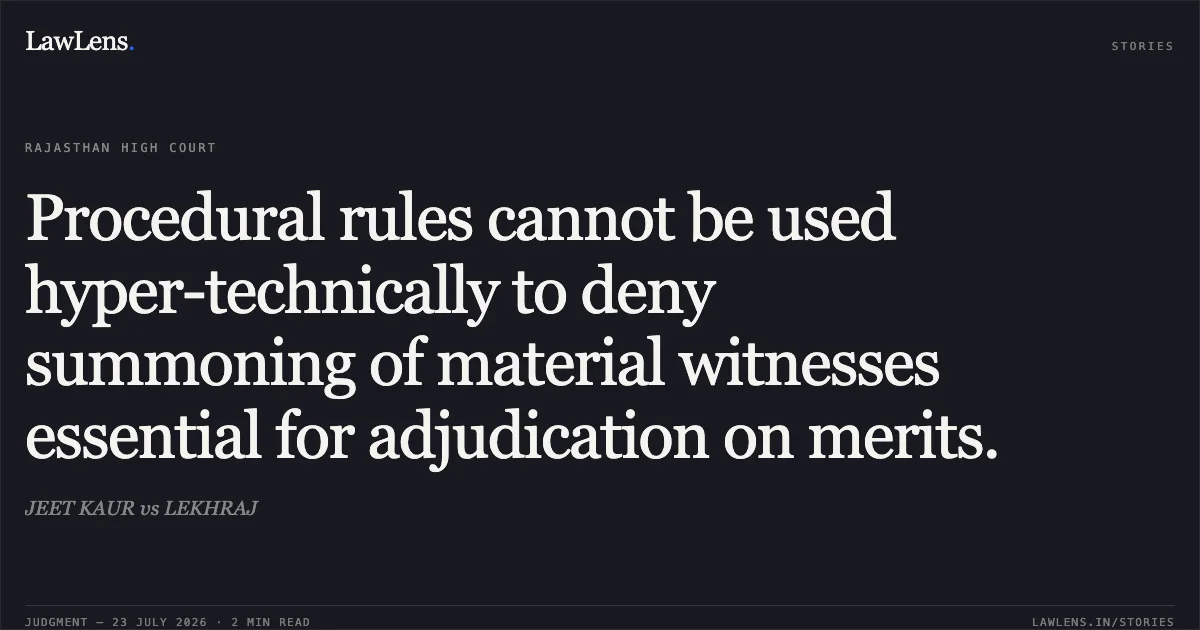
Source reference: p. 1, 4It relied on the foundational principle that "rules of procedure are handmaids of justice and not its mistress," emphasizing that procedural prescriptions are designed to facilitate adjudication on merits rather than defeat substantive rights through hyper-technical interpretations
Source reference: p. 6 / para. 6Reasoning
The Court reasoned that while Order XVI CPC ensures orderly trials and prevents delay, a rigid application that non-suits a litigant for curable procedural lapses (like late filing of a witness list) is inconsistent with the administration of justice
Source reference: p. 6 / para. 5-6The Court observed that the controversy over possession was a "principal issue" in the case; therefore, the Halka Patwari’s testimony and revenue records were material and relevant evidence
Source reference: p. 7 / para. 7Denying the petitioner the opportunity to lead this evidence would cause serious prejudice and deprive the Court of facts essential to resolving the dispute on its intrinsic merits
Source reference: p. 7 / para. 7The Court acknowledged the need for procedural discipline, noting that the petitioner had already received previous opportunities and should not be allowed to prolong the trial indefinitely
Source reference: p. 7-8 / para. 8Holding
The High Court allowed the writ petition and set aside the Trial Court's order dated 04.05.2026
The Court held that the petitioner must be granted a "final and effective opportunity" to summon the Halka Patwari and produce revenue records
Source reference: p. 8 / para. 10The petitioner was directed to ensure the witness's presence on the next date fixed by the Trial Court without seeking further adjournments, with the caveat that failure to conclude evidence on that date would allow the Trial Court to proceed in accordance with law
Source reference: p. 8 / para. 10Acts & Sections Cited
1 provisions across 1 statute referred to in this judgment. Each provision opens on LawLens.
Code of Civil Procedure, 19081
Original Court PDF
JEET KAURvsLEKHRAJ
Click to open original judgment
Original judgment, available to read, download and summarize on LawLens.in