Facts
The parties were married on 25.02.2006 and later separated due to disputes
Source reference: p. 1-2The respondent/husband filed a divorce petition under Section 13(1)(ia) of the Hindu Marriage Act, 1955
Source reference: p. 2Summons were served on the appellant/wife on 29.03.2024
Source reference: p. 2On 04.05.2024, the Family Court directed her to file a written statement within four weeks; however, she filed it on 02.09.2024
Source reference: p. 2By an order dated 03.09.2024, the Family Court struck off her defence, ruling the filing was beyond the 120-day permissible period reckoned from the date of service
Source reference: p. 2The appellant challenged this, citing financial hardship, her father’s hospitalization, and a bona fide misunderstanding of the limitation period
Source reference: p. 2-3, 7-8Issues
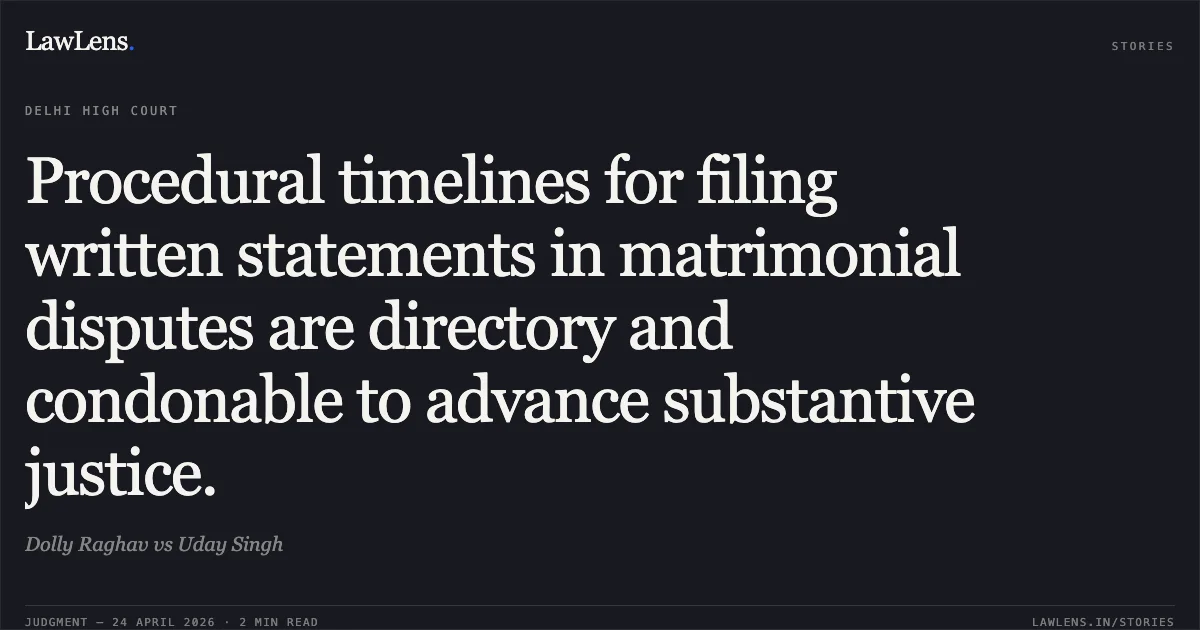
1. Whether the timeline for filing a written statement under Order VIII Rule 1 of the CPC is mandatory or directory in the context of matrimonial disputes before a Family Court.
Source reference: p. 3-52. Whether the appellant demonstrated "exceptional circumstances" or "sufficient cause" to condone the delay in filing the written statement.
Source reference: p. 7-8Law Applied
The Court applied Order VIII Rule 1 of the Code of Civil Procedure (CPC), 1908, governing the timeline for written statements, while noting that Section 10 of the Family Courts Act, 1984, allows Family Courts to adopt their own procedures to arrive at the truth
Source reference: p. 4, 6It relied on Kailash v. Nanhku and Ors. (2005) 4 SCC 480, which established that Order VIII Rule 1 is "directory" and "procedural" in nature, intended to be a "handmaid of justice" rather than a mistress
Source reference: p. 3-5The precedent dictates that while timelines should be honored, extensions may be granted in exceptional circumstances to prevent grave injustice
Source reference: p. 4Reasoning
The Court observed that while the written statement was filed beyond the statutory 120-day limit from the date of service, procedural law should not be interpreted so rigidly as to defeat substantive justice, especially in matrimonial rights
Source reference: p. 5, 7The Court analyzed the appellant's specific circumstances: she was unemployed, dependent on her father for rent, and her father was dealing with hospitalization and medical expenses
Source reference: p. 7-8It found that these financial constraints and domestic hardships constituted "sufficient cause"
Source reference: p. 8The Bench reasoned that the Family Court has a duty under Section 10(3) of the Family Courts Act to adopt a facilitative procedure
Source reference: p. 6Balancing the delay against the prejudice of losing a right to defense, the Court determined that the delay could be mitigated through compensatory costs rather than the irreversible striking off of her defense
Source reference: p. 8Holding
The High Court allowed the appeal and set aside the order dated 03.09.2024
It held that closure of the right to file a written statement in matrimonial matters should be a last resort
Source reference: p. 7The Court directed that the written statement be taken on record, subject to the appellant paying costs of Rs. 25,000 to the respondent within four weeks
Source reference: p. 8The parties were directed to appear before the Family Court on 18.05.2026
Source reference: p. 8Acts & Sections Cited
4 provisions across 2 statutes referred to in this judgment. Each provision opens on LawLens.
Family Courts Act, 19843
Hindu Marriage Act, 19551
Original Court PDF
Dolly RaghavvsUday Singh
Click to open original judgment
Original judgment, available to read, download and summarize on LawLens.in