Facts
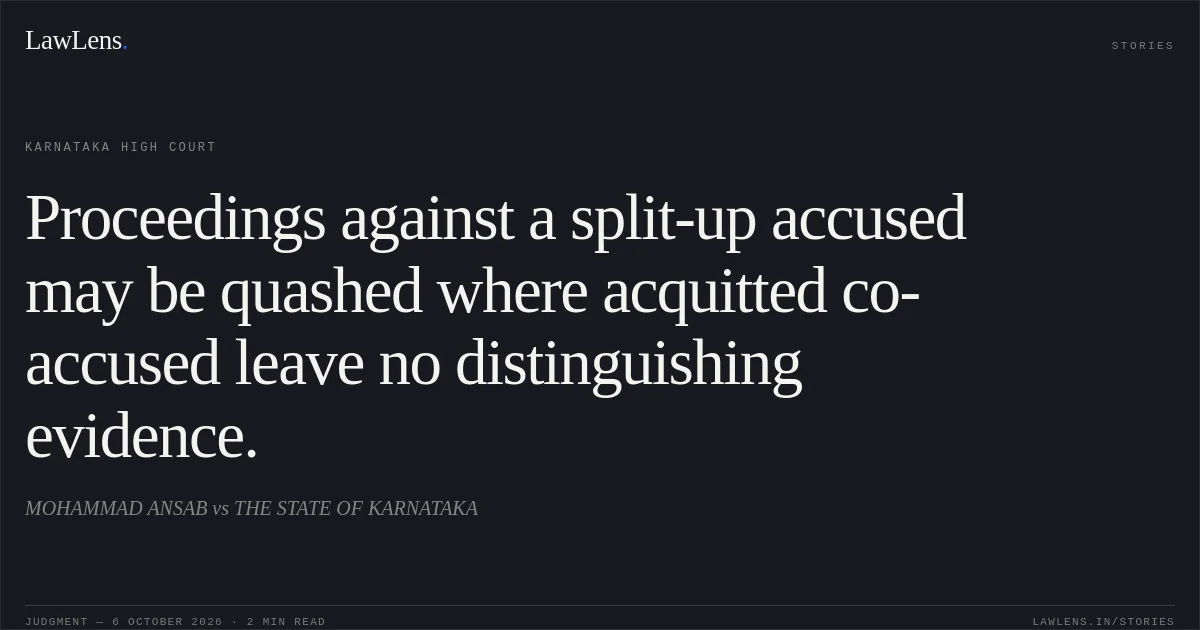
The petitioner was Accused No. 10 in the original proceedings in C.C. No. 1247/2021. After non-bailable warrants could not be served, his case was split up and registered as C.C. No. 367/2024.
Source reference: para. 2–3The other accused were tried and acquitted on 31 January 2026 after the prosecution witnesses failed to support the case.
Source reference: para. 4–5, 14The petitioner sought to quash the split-up proceedings, arguing that the allegations and evidence against him were the same. The High Court was informed by the prosecution that no additional material or distinguishing circumstance existed against him.
Source reference: para. 6–10Issues
1. Whether continuation of the split-up proceedings would serve any useful purpose where the co-accused had been acquitted on the same prosecution evidence and no additional or distinguishing material existed against the petitioner.
Source reference: para. 122. Whether, in those circumstances, continuing the proceedings would amount to an abuse of the process of law warranting exercise of the High Court’s inherent jurisdiction.
Source reference: para. 25–28Law Applied
The Court considered its inherent jurisdiction under Section 482 of the Code of Criminal Procedure, invoked in the petition under Section 528 of the Bharatiya Nagarik Suraksha Sanhita, to prevent abuse of the process of the court and secure the ends of justice.
Source reference: para. 25An acquittal of co-accused does not automatically terminate proceedings against an absconding or split-up accused; the court must assess the facts and determine whether any material distinguishes that accused’s case.
Source reference: para. 20Reasoning
The petitioner’s case arose from the same occurrence and allegations as those against the acquitted co-accused, and the prosecution proposed to rely on the same witnesses and material.
Source reference: para. 13–15, 22Those witnesses had not supported the prosecution in the original trial, and the prosecution identified no additional evidence or circumstance against the petitioner.
Source reference: para. 17–19In the absence of any distinguishing material, a further trial would require consideration of evidence already found insufficient to establish the prosecution case, with no meaningful purpose served.
Source reference: para. 23–28The Court therefore found that continuation of the proceedings would amount to an abuse of process.
Source reference: para. 28Holding
The High Court answered the issues in the petitioner’s favour and allowed the petition.
It quashed the proceedings against him in C.C. No. 367/2024 for offences under Sections 143, 147, 341, 504, 353, 506, 75 and 149 of the IPC, pending before the Additional Senior Civil Judge and JMFC, Putturu.
Source reference: para. 29Acts & Sections Cited
10 provisions across 3 statutes referred to in this judgment. Each provision opens on LawLens.
Code of Criminal Procedure, 19731
Bharatiya Nagarik Suraksha Sanhita, 20231
Indian Penal Code, 18608
Original Court PDF
MOHAMMAD ANSABvsTHE STATE OF KARNATAKA
Click to open original judgment
Original judgment, available to read, download and summarize on LawLens.in