Facts
The complainant alleged that he and a friend were abducted and confined by the petitioner and his brother-in-law over unpaid wages, subjected to caste-based abuse, and released after their families paid ₹1,50,000.
Source reference: para. 3The complaint was referred for registration of an FIR under Section 156(3) CrPC.
Source reference: no citationThe Magistrate took cognizance under Sections 342, 343, 344 and 365 IPC and Section 3(1)(x) of the SC/ST Act.
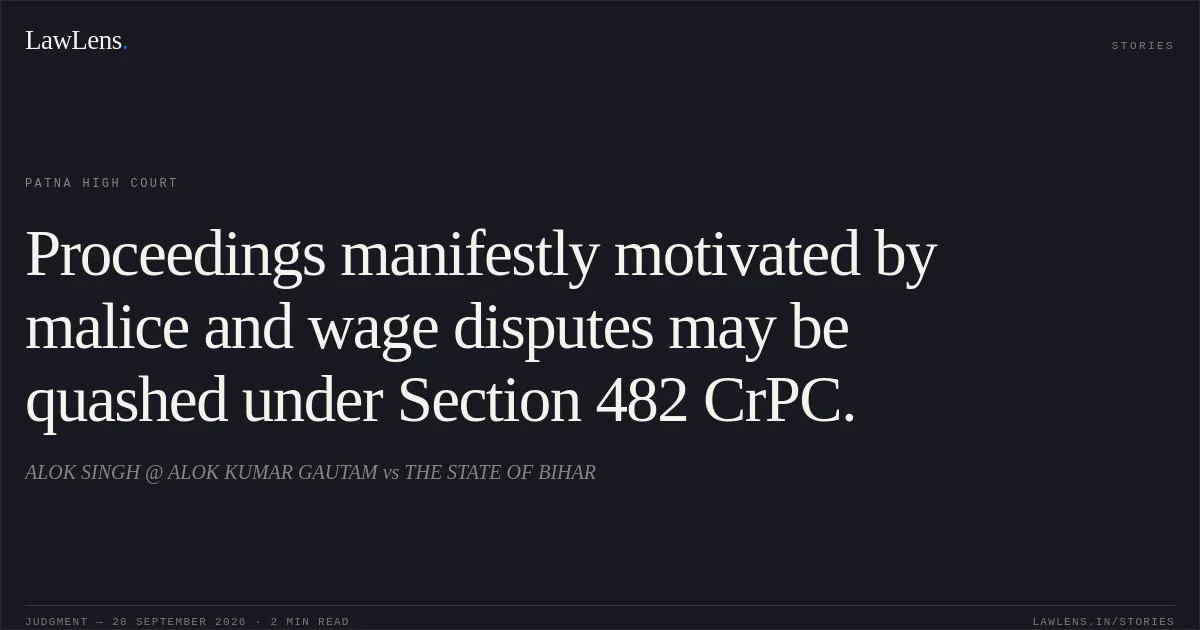
Source reference: p. 2, para. 2The petitioner sought quashing, arguing, among other things, that he was implicated because of his relationship with the principal accused, the case arose from a wage dispute, and the alleged incident occurred outside the court’s territorial jurisdiction.
Source reference: pp. 2–3, paras. 4–5A co-ordinate Bench had already quashed proceedings against the principal accused.
Source reference: p. 3, para. 6Issues
Whether the cognizance order and resulting prosecution against the petitioner should be quashed under the High Court’s inherent powers as a mala fide prosecution arising from a wage dispute.
Source reference: pp. 3–5, paras. 6–11Whether the caste-abuse allegation attracted Section 3(1)(x) of the SC/ST Act where the alleged abuse occurred in a closed room rather than in public view.
Source reference: p. 4, para. 9Whether the asserted lack of territorial jurisdiction warranted quashing; this contention was recorded but not separately determined in the Court’s reasoning.
Source reference: p. 3, para. 5Law Applied
Section 482 CrPC empowers the High Court to quash criminal proceedings to prevent abuse of process.
Source reference: no citationRelying on State of Haryana v. Bhajan Lal, 1992 Supp (1) SCC 335, the Court applied the principle that proceedings manifestly attended by mala fides or instituted with an ulterior motive to wreak vengeance may be quashed, corresponding to category 7 of the Bhajan Lal categories.
Source reference: p. 5, paras. 10–11The Court also considered the public-place/public-view requirement it treated as necessary for the alleged offence under Section 3(1)(x) of the SC/ST Act.
Source reference: p. 4, para. 9Reasoning
The Court regarded the prosecution as an attempt to exert pressure in a wage-related dispute, noting that the petitioner’s alleged connection to the incident rested principally on his relationship with the main accused.
Source reference: pp. 3–4, paras. 7–8It found the account of the complainant being forcibly taken away from the brick kiln unconvincing and considered the caste-abuse allegation insufficient because it was said to have occurred in a closed room, not in public view.
Source reference: p. 4, paras. 8–9Applying Bhajan Lal, the Court concluded that the prosecution was mala fide and its continuation would abuse the process of law.
Source reference: p. 5, para. 11It also relied on parity and judicial discipline because the cognizance order against the similarly situated co-accused had been quashed.
Source reference: p. 5, para. 12Holding
The Court held that the prosecution against the petitioner fell within category 7 of Bhajan Lal and should not continue.
It quashed the Magistrate’s order dated 12 June 2015 and all prosecution arising from Maranchi P.S. Case No. 11 of 2014; the application was allowed.
Source reference: pp. 5–6, paras. 13–14Acts & Sections Cited
7 provisions across 3 statutes referred to in this judgment. Each provision opens on LawLens.
Indian Penal Code, 18604
Scheduled Castes and the Scheduled Tribes (Prevention of Atrocities) Act, 19891
Code of Criminal Procedure, 19732
Original Court PDF
ALOK SINGH @ ALOK KUMAR GAUTAMvsTHE STATE OF BIHAR
Click to open original judgment
Original judgment, available to read, download and summarize on LawLens.in