Facts
The petitioner, a practising Advocate, was arrayed as Accused No.4 in Crime No.162/2026 registered by R.T. Nagar Police Station for offences under Sections 318(4) and 351(2) of the Bharatiya Nyaya Sanhita, 2023 (“BNS”)
Source reference: para. 1Respondent No.2 alleged that, when he visited Accused No.1, Gaurav, to recover money allegedly advanced in connection with an online trading arrangement, Gaurav called several persons, including the petitioner, who allegedly threatened the complainant over the telephone
Source reference: para. 2.1The petitioner’s case was that Gaurav had contacted him in his professional capacity for legal assistance and that the complainant and his associates had abused and threatened Gaurav, following which the petitioner advised him to contact the police
Source reference: para. 2.2A separate Crime No.35/2026 had earlier been registered against the complainant and others concerning an alleged assault on Gaurav
Source reference: para. 2.3Crime No.162/2026 was registered on 12 May 2026, approximately three months after the alleged telephonic incident, and the petitioner sought quashing of the FIR insofar as it concerned him
Source reference: para. 2.4The complainant, though served, remained unrepresented
Source reference: paras. 3, 6Issues
1. Whether the allegations against the petitioner disclosed the essential ingredients of cheating punishable under Section 318(4) of the BNS
Source reference: paras. 8–8.12. Whether the allegation that the petitioner threatened the complainant over a telephone call disclosed the offence of criminal intimidation under Section 351(2) of the BNS
Source reference: para. 93. Whether continuation of the criminal proceedings against the petitioner constituted an abuse of the process of law, warranting exercise of jurisdiction under Article 226 of the Constitution and Section 528 of the BNSS
Source reference: paras. 10–14Law Applied
The Court applied Sections 318(1) and 318(4) of the BNS, holding that aggravated cheating under Section 318(4) necessarily requires the foundational elements of cheating under Section 318(1), including deception, dishonest inducement, and a transaction resulting in delivery or retention of property
Source reference: para. 8It applied Sections 351(1) and 351(2) of the BNS concerning criminal intimidation, substantially corresponding to Sections 503 and 506 of the IPC, requiring a threat of injury accompanied by an intention to cause alarm or to compel or prevent a legally permissible act
Source reference: para. 9Relying on Naresh Aneja v. State of Uttar Pradesh , (2025) 2 SCC 604, and Manik Taneja v. State of Karnataka , (2015) 7 SCC 423, the Court held that mere utterance of words is insufficient; intention to cause alarm must be demonstrated
Source reference: para. 9.1It further relied on Mohd. Wajid v. State of Uttar Pradesh , 2023 SCC OnLine SC 951, for the principle that, while examining allegations of frivolous or vexatious prosecution, the Court may scrutinise the FIR along with the surrounding circumstances and read between the lines
Source reference: para. 9.2The Court also relied on Surendra Khawse v. State of Madhya Pradesh , 2025 SCC OnLine SC 2043, and the Bhajan Lal principle that proceedings instituted mala fide or with an ulterior motive to wreak vengeance may be quashed
Source reference: para. 10Reasoning
The Court found that the allegation of cheating was wholly inapplicable to the petitioner because there was no transaction, deception, dishonest inducement, or delivery of property between the petitioner and the complainant; the only allegation against him was that he made a threatening telephone call
Source reference: para. 8The allegation of criminal intimidation was likewise unsupported by particulars identifying the words allegedly used, the injury threatened, or any material demonstrating an intention to cause alarm
Source reference: paras. 9–9.2The Court considered the unexplained delay of nearly three months in lodging the complaint, the petitioner’s professional relationship with Accused No.1, the prior criminal case involving the complainant, and the sparse nature of the allegations as circumstances indicating embellishment and possible retaliatory prosecution
Source reference: paras. 10–12It further held that merely providing legal assistance or representing a client could not, without an independent criminal act, expose an Advocate to prosecution, and that permitting such proceedings to continue would amount to abuse of process
Source reference: paras. 12–14Holding
The Court answered the issues in favour of the petitioner.
It held that the FIR did not disclose the ingredients of either cheating under Section 318(4) or criminal intimidation under Section 351(2) of the BNS against him and that continuation of the proceedings would constitute an abuse of process
Source reference: paras. 8–14The writ petition was allowed, and Crime No.162/2026 pending before the VIII Additional Chief Metropolitan Magistrate, Bengaluru, was quashed insofar as it related to the petitioner, Accused No.4
Source reference: para. 15, order clauses (i)–(ii)The Court clarified that its findings and reasons were confined to the petitioner and would not apply to the other accused in the case
Source reference: para. 15, order clause (iii)Acts & Sections Cited
10 provisions across 4 statutes referred to in this judgment. Each provision opens on LawLens.
Bharatiya Nagarik Suraksha Sanhita, 20231
Bharatiya Nyaya Sanhita, 20235
Indian Penal Code, 18603
Code of Criminal Procedure, 19731
Original Court PDF
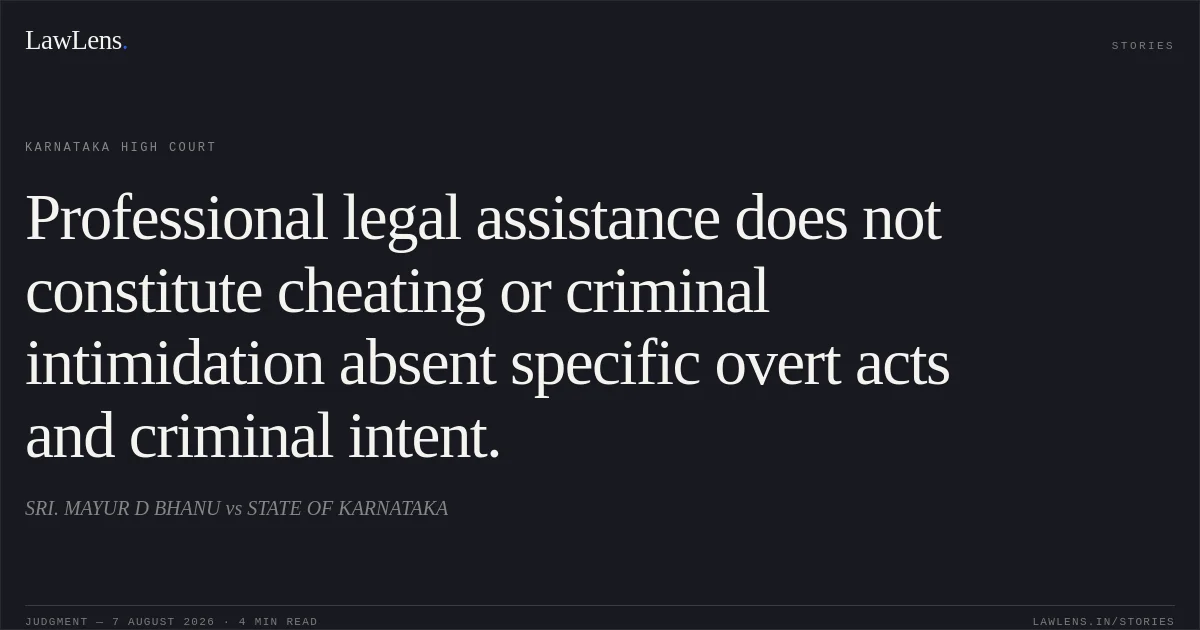
SRI. MAYUR D BHANUvsSTATE OF KARNATAKA
Click to open original judgment
Original judgment, available to read, download and summarize on LawLens.in