Facts
The Appellants (Sellers) entered into Agreements to Sell property in Amar Colony with the Respondents (Purchasers) in 2010 and 2011.
Source reference: p. 3-4Following a Suit for Specific Performance, an ex-parte judgment and decree were passed against the Appellants on 30.07.2016.
Source reference: p. 3-4Execution petitions were filed in 2017.
Source reference: p. 8-9During execution proceedings on 08.08.2018, Appellant Rakesh Kapoor (also acting as POA for Veena Khanna) appeared in person and stated he was willing to execute the sale deeds upon receipt of the balance consideration, subsequently withdrawing an application filed under Order IX Rule 13 CPC to set aside the ex-parte decree.
Source reference: p. 8-9After years of further litigation in the execution stage—including the dismissal of objections in 2022 and the withdrawal of two CM(Main) petitions in 2023—the Appellants filed these Regular First Appeals (RFAs) with a delay of 6 years and 9 months.
Source reference: p. 5-7, 13Issues
1. Whether the Appellants have shown "sufficient cause" under Section 5 of the Limitation Act to condone the delay of 6 years and 9 months in filing the appeals
Source reference: p. 32. Whether the alleged professional negligence of previous counsels constitutes a valid ground for condonation of delay in light of the Appellants' conduct
Source reference: p. 123. Whether the impugned ex-parte judgment dated 30.07.2016 is a nullity for failing to specify a timeframe for the payment of balance consideration under Order XX Rule 12A CPC
Source reference: p. 14Law Applied
Section 5 of the Limitation Act, 1963, which requires the applicant to demonstrate "sufficient cause" for delay.
Source reference: p. 3Lala Mata Din v. A. Narayanan, establishing that while a counsel’s mistake can sometimes be sufficient cause, it is not an absolute rule.
Source reference: p. 7Order XX Rule 12A of the CPC and Section 28 of the Specific Relief Act, 1963, regarding the mandatory inclusion of payment timelines in specific performance decrees.
Source reference: p. 14Balvant N. Viswamitra v. Yadav Sadashiv Mule to distinguish between "void" and "wrongful" decrees, holding that only a lack of inherent jurisdiction renders a decree a non-est nullity.
Source reference: p. 16Reasoning
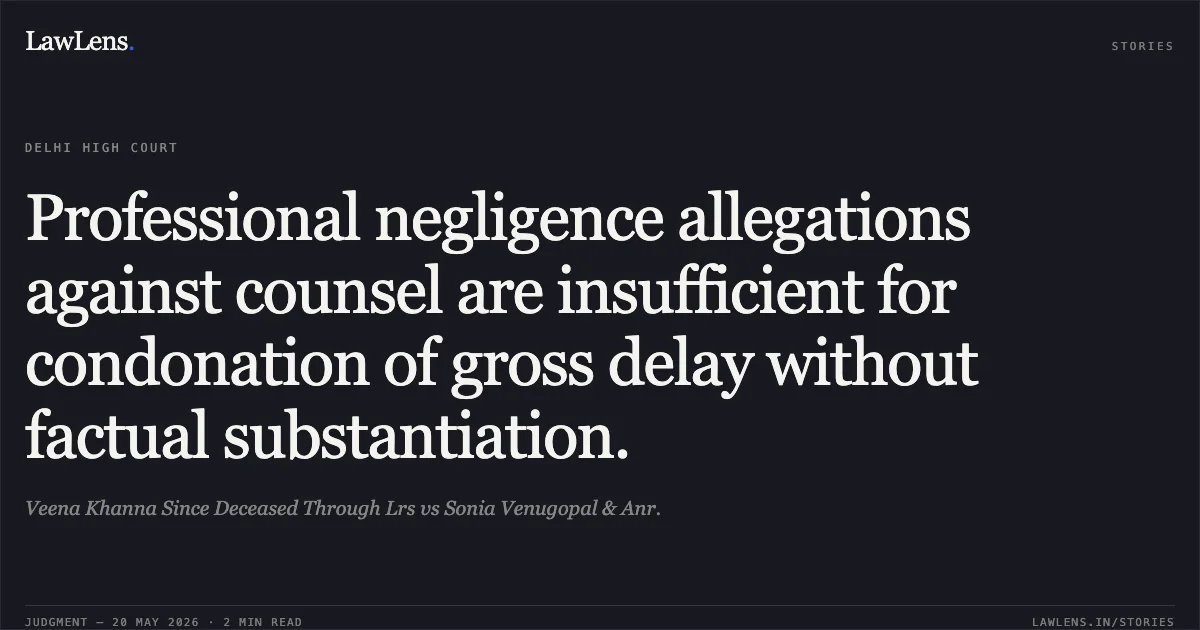
The Court rejected the Appellants' plea that the delay was due to the negligence of Advocate Vivek Sharma, noting that the Appellants were represented by multiple counsels (including Mr. S.S. Tyagi) since 2017.
Source reference: p. 12-13The record revealed that Rakesh Kapoor voluntarily withdrew his application to set aside the ex-parte decree in 2018 and expressed willingness to execute the sale deed, indicating a "conscious decision" not to challenge the judgment at that time.
Source reference: p. 12-14The Court observed that the Appellants suppressed the fact that they had filed and withdrawn CM(Main) petitions through their current counsel before filing these RFAs.
Source reference: p. 11, 13Regarding the "nullity" argument, the Court found that the 2016 judgment did specify a two-month period for execution, which inherently required the payment of the balance consideration.
Source reference: p. 15Since the Trial Court had competent jurisdiction, the decree was not void ab-initio.
Source reference: p. 16Holding
The Court held that the Appellants failed to provide "sufficient explanation" for the 81-month delay, characterizing the appeals as dilatory tactics and an afterthought.
The Court dismissed CM APPL. 33374/2023 and CM APPL. 35537/2023 (Condonation of Delay). Consequently, RFA 488/2023 and RFA 545/2023 were dismissed as time-barred.
Source reference: p. 16-17Acts & Sections Cited
8 provisions across 3 statutes referred to in this judgment. Each provision opens on LawLens.
Code of Civil Procedure, 19086
Limitation Act, 19631
Specific Relief Act, 19631
Original Court PDF
Veena Khanna Since Deceased Through LrsvsSonia Venugopal & Anr.
Click to open original judgment
Original judgment, available to read, download and summarize on LawLens.in