Facts
The Respondent filed T.S. 05 of 2022 against the Appellant seeking a declaration of right over 'Schedule-A' land and recovery of 'Schedule-B' land through eviction and demolition of structures.
Source reference: p. 1The suit was decreed on 29.07.2024.
Source reference: p. 1The Appellant applied for a certified copy on 29.05.2025 and secured it on 17.06.2025.
Source reference: p. 2He subsequently filed the first appeal (T.A. 01 of 2025) before the District Judge, Kailashahar, with a delay of 119 days.
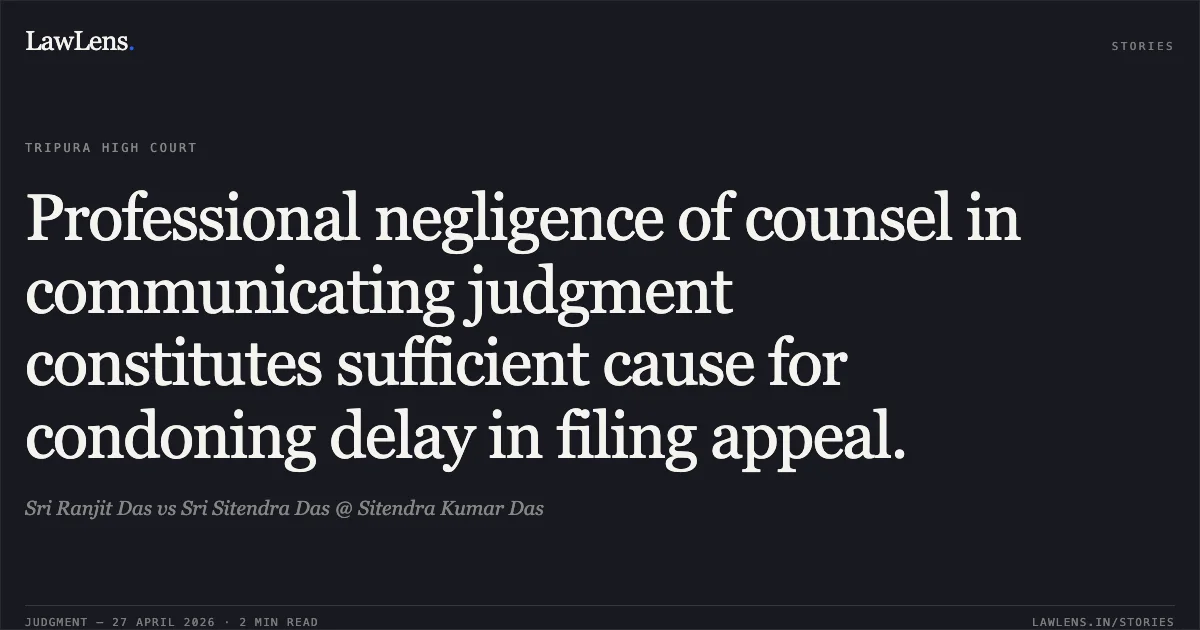
Source reference: p. 2The Appellant contended the delay occurred because his previous advocate failed to inform him of the judgment until summons were received in the execution case.
Source reference: p. 2The District Judge dismissed the condonation application (Civil Misc. 01 of 2025) and consequently the appeal, on the grounds that the Appellant was aware of a concurrent judgment in a different suit (T.S. 17 of 2022) delivered on the same day.
Source reference: p. 2-3The Appellant challenged these dismissals via CRP 25 of 2026 and RSA 47 of 2025.
Source reference: p. 3Issues
1. Whether the District Judge erred in dismissing the application for condonation of delay by citing the party's presumed knowledge of the judgment based on a concurrent case.
Source reference: p. 32. Whether a liberal approach should be adopted in condoning delay when substantial stakes like title and recovery of possession are involved.
Source reference: p. 3Law Applied
Section 5 of the Limitation Act, 1963, regarding the condonation of delay upon showing "sufficient cause".
Source reference: p. 2Legal principle that a party in a trial court typically depends on their counsel for information regarding the pronouncement of judgments, and a counsel's professional lapse constitutes a valid ground for relief.
Source reference: p. 3Doctrine of "liberal approach," which mandates that procedural delays should be condoned to allow for the adjudication of cases involving substantial property rights, such as declaration of title and recovery of possession.
Source reference: p. 3Reasoning
The High Court observed that the date of pronouncement is not automatically known to a party as they are not always present in court.
Source reference: p. 3The Court reasoned that if a counsel fails in their professional duty to inform the client of a judgment, the litigant cannot be blamed for being ignorant of the decree.
Source reference: p. 3The Court rejected the District Judge’s reasoning that knowledge of one judgment (T.S. 17 of 2022) automatically implies knowledge of another (T.S. 05 of 2022), even if delivered on the same day.
Source reference: p. 2-3It was determined that where substantial stakes—specifically land title and eviction—are involved, the judiciary must prioritize merit over technical timelines.
Source reference: p. 3The Court found that the District Judge committed a reversible error by not condoning the 119-day delay.
Source reference: p. 3Holding
The High Court allowed both CRP 25 of 2026 and RSA 47 of 2025.
The Court condoned the 119-day delay in filing T.A. 01 of 2025, set aside the District Judge’s orders dated 22.05.2025, and restored the first appeal to the file.
Source reference: p. 3-4The District Judge, Unakoti, was directed to decide the appeal on its merits after hearing both sides in accordance with the law.
Source reference: p. 4No costs were awarded.
Source reference: p. 4Acts & Sections Cited
2 provisions across 2 statutes referred to in this judgment. Each provision opens on LawLens.
Code of Civil Procedure, 19081
Limitation Act, 19631
Original Court PDF
Sri Ranjit DasvsSri Sitendra Das @ Sitendra Kumar Das
Click to open original judgment
Original judgment, available to read, download and summarize on LawLens.in