Facts
The petitioners (employees of a construction firm and a senior government officer) sought to quash FIR No. 11208053220012 filed under Sections 306 (Abetment of suicide), 186 (Obstructing public servant), and 114 of the IPC.
Source reference: para. 1The deceased, Pareshbhai Joshi, an Additional Assistant Engineer at Rajkot Municipal Corporation, committed suicide by jumping into Nyari Dam.
Source reference: para. 2.1, 2.5The complainant (the deceased's wife) alleged that petitioners Mayurbhai and Hardikbhai (Madhuram Construction) harassed the deceased to process bills and threatened to incite villagers against him.
Source reference: para. 2.2, 2.6Petitioner Jatinbhai, the deceased’s senior officer, allegedly pressured him to complete billing and prepare "MB Stickers" in compliance with rules.
Source reference: para. 5, 11It was alleged this "squeezing" between contractors and superiors drove the deceased to suicide.
Source reference: para. 2.3Issues
1. Whether the allegations in the FIR and the material gathered during the investigation, taken at face value, satisfy the essential ingredients of "abetment" under Section 306 read with Section 107 of the IPC.
Source reference: para. 5.2, 102. Whether the acts of demanding official work (processing bills) or following administrative rules constitute "instigation" or "mens rea" required for criminal prosecution.
Source reference: para. 10, 11Law Applied
Section 306 of the IPC regarding abetment of suicide and Section 107 of the IPC, which defines abetment as instigation, conspiracy, or intentional aid.
Source reference: para. 1, 10The established principle that abetment requires a "positive act" of instigation or incitement with a clear mens rea to drive the person to suicide.
Source reference: para. 10The act must have "close proximity" to the suicide and that individual vulnerability or sensitivity to workplace pressure does not automatically translate to criminal liability for others.
Source reference: para. 10Reasoning
The Court examined whether the petitioners' conduct amounted to a deliberate provocation. It observed that the dispute centered on a "disagreement with regards to passing of the bills and measurement".
Source reference: para. 10While Mayurbhai and Hardikbhai made "harsh or severe demands" for payment, and Jatinbhai insisted on strict adherence to rules (MB Stickers), these were related to official duties.
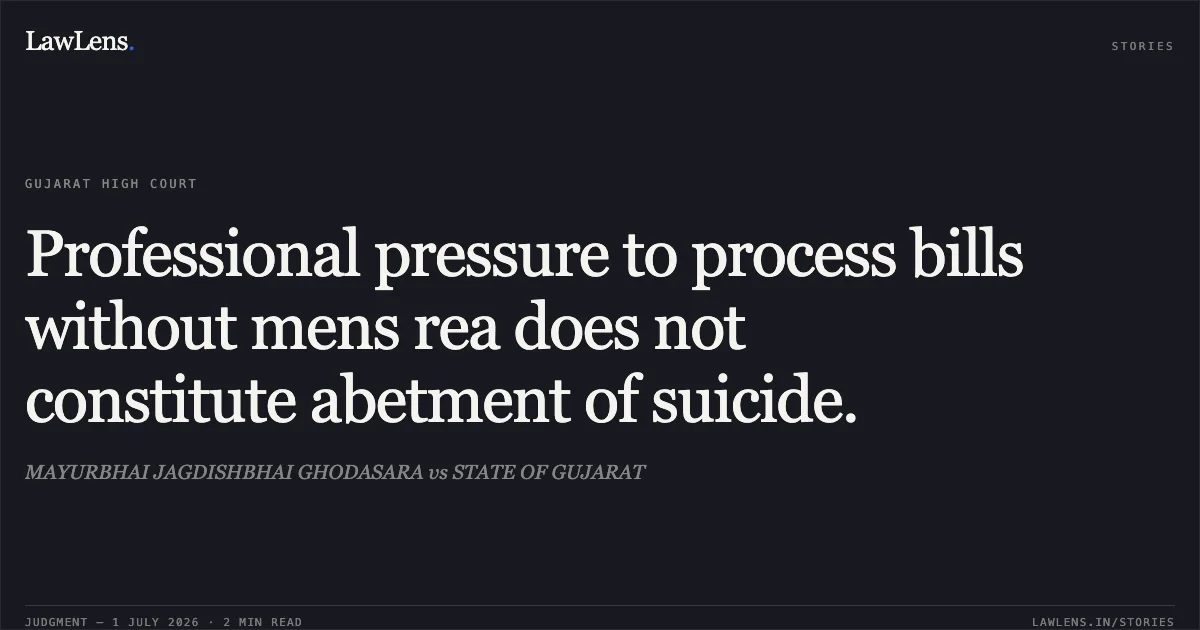
Source reference: para. 11The Court reasoned that abetment involves a mental process of intentional aiding; however, workplace pressure or being "squeezed" between superiors and contractors does not constitute "instigation".
Source reference: para. 10Since there was no evidence that the petitioners intended to drive the deceased to suicide or that their actions left him with no other option, the essential element of mens rea was missing.
Source reference: para. 10, 11Holding
The Court answered in the negative, holding that the allegations did not meet the legal threshold for abetment or obstruction.
The Court allowed the petitions and quashed FIR No. 11208053220012 (Rajkot Taluka Police Station) and all consequential proceedings.
Source reference: para. 12The Court concluded that in the absence of a conscious or deliberate intention to cause death, criminal charges under Section 306 cannot be sustained merely based on the victim's subjective perception of work pressure.
Source reference: para. 11Acts & Sections Cited
5 provisions across 2 statutes referred to in this judgment. Each provision opens on LawLens.
Code of Criminal Procedure, 19731
Indian Penal Code, 18604
Original Court PDF
MAYURBHAI JAGDISHBHAI GHODASARAvsSTATE OF GUJARAT
Click to open original judgment
Original judgment, available to read, download and summarize on LawLens.in