Facts
On March 31, 2010, the CBI registered an FIR against the petitioner (partner of M/s Divya Rice Mill) and others for allegedly conspiring with bank officials to cheat the State Bank of India by using forged documents to obtain financial facilities worth Rs. 113.50 lakhs.
Source reference: para. 2Investigation revealed a diversion of Rs. 9,50,705 for another mill.
Source reference: para. 2While the petitioner was initially on bail, he absconded during the trial, leading to proceedings under Section 512 Cr.P.C.
Source reference: para. 4During his absence, a co-accused was convicted and sentenced to various terms, including five years for conspiracy.
Source reference: para. 4The petitioner was rearrested on March 12, 2026, and his bail application was subsequently rejected by the Special Judge Anti-corruption (CBI Cases), Jammu, on March 24, 2026.
Source reference: para. 4-5Issues
1. Whether the petitioner is entitled to bail under Section 483 of the BNSS, 2023, despite having been an absconder for nearly ten years.
Source reference: para. 5, 122. Whether continued detention during the trial constitutes "pre-trial punishment" in violation of Article 21 of the Constitution.
Source reference: para. 6, 12Law Applied
The court primarily applied Section 483 of the BNSS, 2023, regarding the power to grant bail.
Source reference: no citationIt relied on the constitutional mandate of Article 21, which establishes that "bail is the rule and jail is the exception," as reinforced in Satender Kumar Antil v. CBI and Nikesh Tarachand Shah v. Union of India.
Source reference: para. 9The object of bail is to secure attendance, not to be punitive.
Source reference: para. 9The Court applied the principle from Umarmia vs. State of Gujarat, where the Supreme Court granted bail to an absconder of ten years due to the unlikely completion of trial in the near future.
Source reference: para. 11Reasoning
The court balanced the gravity of the economic offence and the petitioner's past conduct (absconding for ten years) against the principles of personal liberty.
Source reference: para. 10-12It noted that 31 out of 66 witnesses had been examined in the petitioner's presence before he disappeared.
Source reference: para. 4The court observed that the charges do not carry the death penalty or mandatory life imprisonment, and a convicted co-accused had already received a five-year sentence.
Source reference: para. 12The court reasoned that since the investigation was completed in 2010 and the trial is ongoing, prolonged detention would amount to pre-trial punishment.
Source reference: para. 12It determined that the risk of the petitioner absconding again could be mitigated by imposing stringent financial conditions and travel restrictions rather than through continued incarceration.
Source reference: para. 12-13Holding
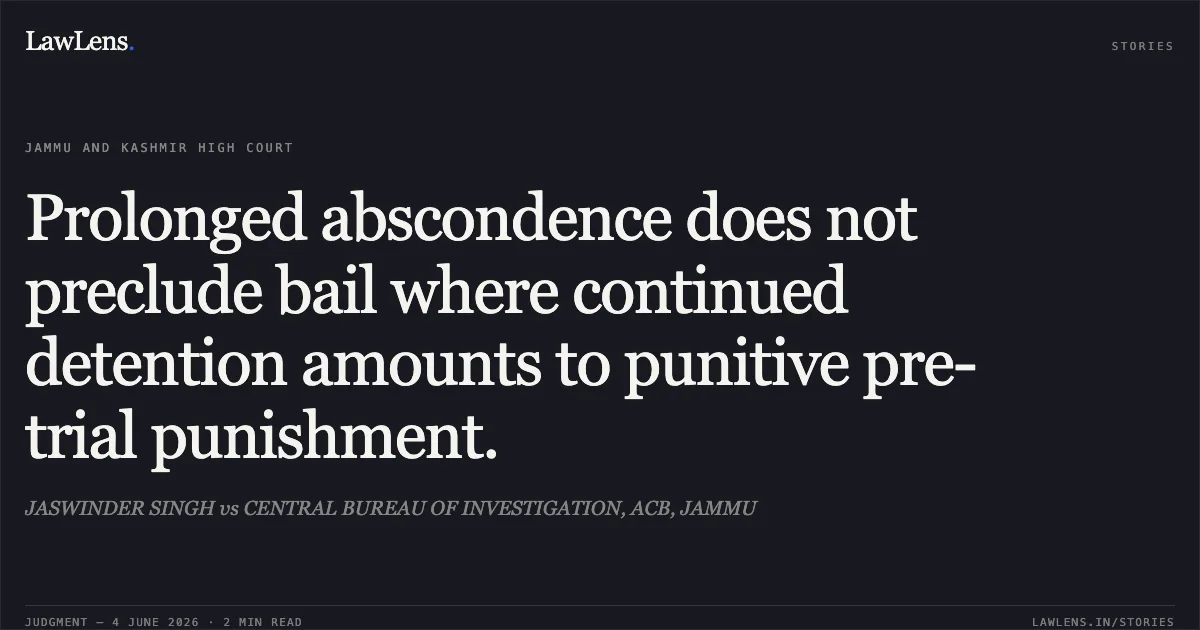
The court allowed the bail application, answering that the petitioner's right to liberty outweighs the punitive nature of detention pending trial.
The petitioner was ordered to be released subject to furnishing a personal bond of Rs. 5,00,000, two sureties of like amount, an FDR of Rs. 3,00,000, surrendering his passport, and a prohibition on leaving Jammu and Kashmir without prior court permission. Any violation of these conditions would result in the cancellation of bail.
Source reference: para. 13Acts & Sections Cited
9 provisions across 4 statutes referred to in this judgment. Each provision opens on LawLens.
Bharatiya Nagarik Suraksha Sanhita, 20231
Indian Penal Code, 18604
Prevention of Corruption Act, 19881
Code of Criminal Procedure, 19733
Original Court PDF
JASWINDER SINGHvsCENTRAL BUREAU OF INVESTIGATION, ACB, JAMMU
Click to open original judgment
Original judgment, available to read, download and summarize on LawLens.in