Facts
The appellant-workman was engaged as a Mali-cum-Chowkidar on 01.06.1992 and worked until his services were terminated on 01.04.1995.
Source reference: para. 2He alleged that the respondent-Management subsequently made fresh appointments to the same post without offering him an opportunity of re-employment, thereby violating Section 25-H of the Industrial Disputes Act, 1947 (“the Act”).
Source reference: para. 2The dispute was referred to the Industrial Tribunal, Amritsar, which, relying substantially on the Management witness’s admission that 15–20 persons had been freshly employed, held that Section 25-H had been violated and awarded reinstatement, back wages and regularization.
Source reference: para. 4The Management challenged the award in CWP No. 3025 of 2016. The learned Single Judge set aside the award on the ground that the workman’s demand notice, issued approximately 14 years after termination, was stale and that no live industrial dispute existed.
Source reference: para. 5In appeal, the workman contended that he had continuously pursued his claim through representations, the last of which was submitted in 2007, before issuing the demand notice in March 2009.
Source reference: para. 7The Division Bench found that the workman’s claim had not been rejected by the Management and that fresh appointments had admittedly been made in 1997.
Source reference: para. 10Issues
Whether the workman’s demand for re-employment under Section 25-H of the Act was stale because it was raised approximately 14 years after termination, or whether his intervening representations kept the industrial dispute alive?
Source reference: paras. 8–10Whether the Industrial Tribunal was legally justified in directing regularization when the reference concerned only re-employment?
Source reference: para. 11Whether, after the workman had remained out of service for approximately three decades, reinstatement should be granted or compensation awarded in lieu thereof?
Source reference: paras. 12–14Law Applied
Section 25-H of the Industrial Disputes Act, 1947 requires an employer, when proposing to employ persons after retrenchment, to give retrenched workmen an opportunity for re-employment in accordance with the prescribed procedure.
Source reference: paras. 2, 10–11Although the Act prescribes no limitation period for raising an industrial dispute, a dispute raised after considerable delay may be treated as stale if the workman cannot establish that it remains alive and subsisting; however, continuing representations, negotiations, assurances or other persistent efforts to pursue the claim may prevent the dispute from becoming dead.
Source reference: para. 10The Court relied on Prabhakar v. Joint Director, Sericulture Department, 2015 (4) SCT 493, for these principles.
Source reference: para. 10The Industrial Tribunal cannot travel beyond the terms of the reference; consequently, it cannot grant regularization where the reference is confined to re-employment.
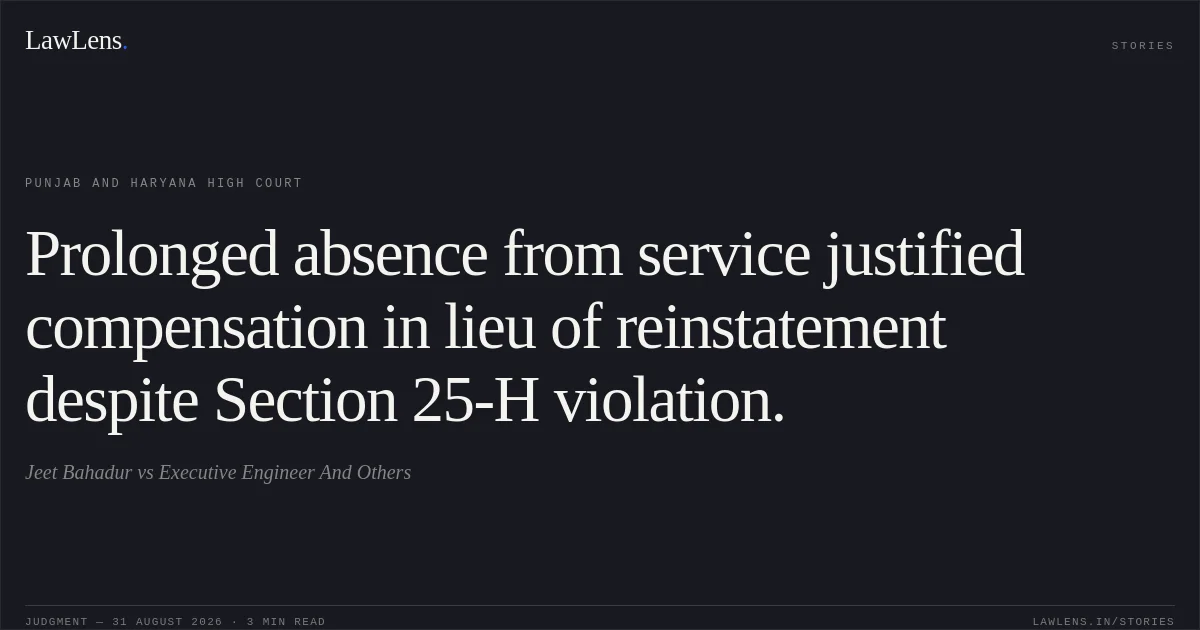
Source reference: para. 11Reinstatement is not automatic even where a statutory violation is established, and the Court may mould relief by awarding compensation instead of reinstatement, particularly where the workman has remained out of service for a prolonged period.
Source reference: paras. 10, 12–13Reasoning
The Court accepted that the Management had made fresh appointments in 1997 and that the workman had not been offered an opportunity of re-employment, supporting the Tribunal’s finding of a violation of Section 25-H.
Source reference: paras. 4, 10Although the demand notice was issued nearly 14 years after termination, the workman had submitted several representations, with the last representation made in 2007, and his claim had never been expressly rejected by the Management.
Source reference: para. 10Applying Prabhakar, the Court held that these circumstances demonstrated that the dispute remained alive when the demand was raised in March 2009; therefore, the Single Judge erred in treating it as stale.
Source reference: para. 10However, the Tribunal exceeded the scope of the reference by granting regularization, since the reference related only to re-employment.
Source reference: para. 11Finally, considering that the workman had remained out of service for approximately 30 years, the Court held that reinstatement was impracticable and that compensation was the appropriate relief in lieu of reinstatement.
Source reference: paras. 12–14Holding
The appeal was allowed in part.
The judgment of the learned Single Judge dated 04.01.2024 was set aside, and the Tribunal’s award dated 05.10.2015 was modified.
Source reference: para. 14The Court upheld the substance of the finding that the workman’s Section 25-H claim was not stale and that re-employment had been denied unlawfully, but declined to grant reinstatement or regularization.
Source reference: paras. 14–15In lieu of reinstatement, the appellant was awarded ₹1,50,000 as compensation.
Source reference: paras. 14–15The respondents were directed to pay the amount within two months, failing which it would carry interest at 6% per annum from the date of judgment until realization.
Source reference: paras. 14–15Acts & Sections Cited
4 provisions across 1 statute referred to in this judgment. Linked provisions open on LawLens.
Industrial Disputes Act, 19474
Original Court PDF
Jeet BahadurvsExecutive Engineer And Others
Click to open original judgment
Original judgment, available to read, download and summarize on LawLens.in