Facts
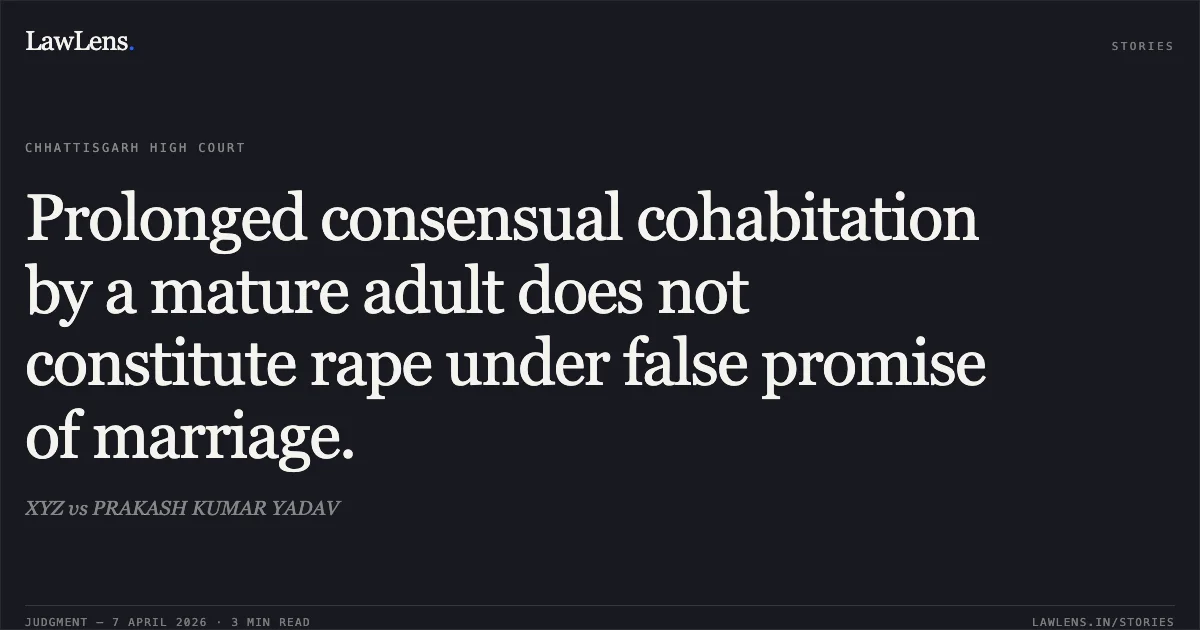
The appellant/prosecutrix challenged the judgment dated 21.02.2023 passed by the Additional Sessions Judge (F.T.C.), Sakti, which acquitted Respondent No. 1 of charges under Sections 376(2)(n) and 417 of the IPC.
Source reference: para 1The prosecutrix alleged that in 2014, the respondent induced her into a physical relationship under a pretext of marriage, subsequently cohabiting with her for seven years in various locations.
Source reference: para 2She further alleged that the respondent abandoned her on 20.08.2021.
Source reference: para 2A written report was lodged on 09.11.2021, resulting in a delay of approximately 2 months and 18 days.
Source reference: para 2, 16During cross-examination, the prosecutrix admitted she was a mature, educated adult (aged 23 at the start of the relationship) who voluntarily lived with the respondent and did not raise any alarm or seek legal recourse during the seven-year cohabitation.
Source reference: para 8, 16Issues
1. Whether the physical relationship between the parties was consensual or vitiated by a "misconception of fact" arising from a false promise of marriage under Section 90 of the IPC.
Source reference: para 13, 142. Whether the trial court’s judgment of acquittal was perverse or legally unsustainable, warranting interference by the appellate court.
Source reference: para 17, 18Law Applied
The court primarily applied Section 376(2)(n) (rape on the same woman repeatedly) and Section 417 (cheating) of the IPC.
Source reference: para 15It relied on Section 90 of the IPC, which stipulates that consent given under a "misconception of fact" is not valid consent.
Source reference: para 15The court cited Pramod Suryabhan Pawar v. State of Maharashtra, establishing that a promise of marriage must be shown to be false from its inception—given in bad faith with no intention to adhere to it—to constitute a misconception of fact.
Source reference: para 13Furthermore, it applied the principles from Deepak Gulati v. State of Haryana and Naim Ahamed v. State (NCT of Delhi) regarding the distinction between a mere "breach of promise" and a "false promise".
Source reference: para 14, 15Finally, the court invoked the doctrine from Mallappa v. State of Karnataka, which dictates that if the trial court's view is "legally plausible," the appellate court should not reverse an acquittal even if a contrary view is possible.
Source reference: para 17Reasoning
The Court observed that the prosecutrix was a mature, educated adult who engaged in a long-term consensual relationship spanning seven years.
Source reference: para 16It noted that "consent" under Section 375 involves active and reasoned deliberation, and the seven-year duration of cohabitation strongly indicated a consensual nature rather than one obtained through deceit.
Source reference: para 13, 16The Court highlighted that the prosecutrix admitted to not making any complaints despite multiple opportunities and living in inhabited colonies.
Source reference: para 8Medical evidence (PW-9) supported this, as no signs of force or coercion were found.
Source reference: para 10The Court reasoned that for a conviction, there must be evidence that the accused had no intention of marrying the victim from the very beginning.
Source reference: para 14, 15The failure to prove such mala fide intent at the initial stage, combined with the unexplained delay in lodging the FIR, led the Court to determine that the relationship was a result of mutual love and passion rather than a fraudulent misconception.
Source reference: para 16Holding
The High Court dismissed the appeal and upheld the acquittal of Respondent No. 1.
It held that the prosecution failed to prove the charges beyond a reasonable doubt, as the relationship was clearly consensual and did not fall within the ambit of "misconception of fact" under Section 90 of the IPC.
Source reference: para 16, 18The Court concluded that the trial court's findings were a "plausible and possible view" and lacked any patent illegality or perversity that would justify appellate interference.
Source reference: para 18Acts & Sections Cited
4 provisions across 1 statute referred to in this judgment. Each provision opens on LawLens.
Indian Penal Code, 18604
Original Court PDF
XYZvsPRAKASH KUMAR YADAV
Click to open original judgment
Original judgment, available to read, download and summarize on LawLens.in