Facts
On 19 August 1994, Chintamani was assaulted by the appellants and another accused with a spade and tangias, sustaining four injuries.
Source reference: paras. 2–3; pp. 1–2He was initially treated and thereafter admitted to hospital, but died on 22 August 1994.
Source reference: paras. 2–3; pp. 1–2The prosecution charged all three accused under Section 302 read with Section 34 of the Indian Penal Code, 1860 (“IPC”).
Source reference: paras. 2–3; pp. 1–2The Sessions Court found that there was no premeditation to cause death, that three injuries were simple and one was grievous, and that death resulted from myocardial infarction; it consequently convicted the accused under Section 304 Part II read with Section 34 IPC and sentenced them to five years’ rigorous imprisonment.
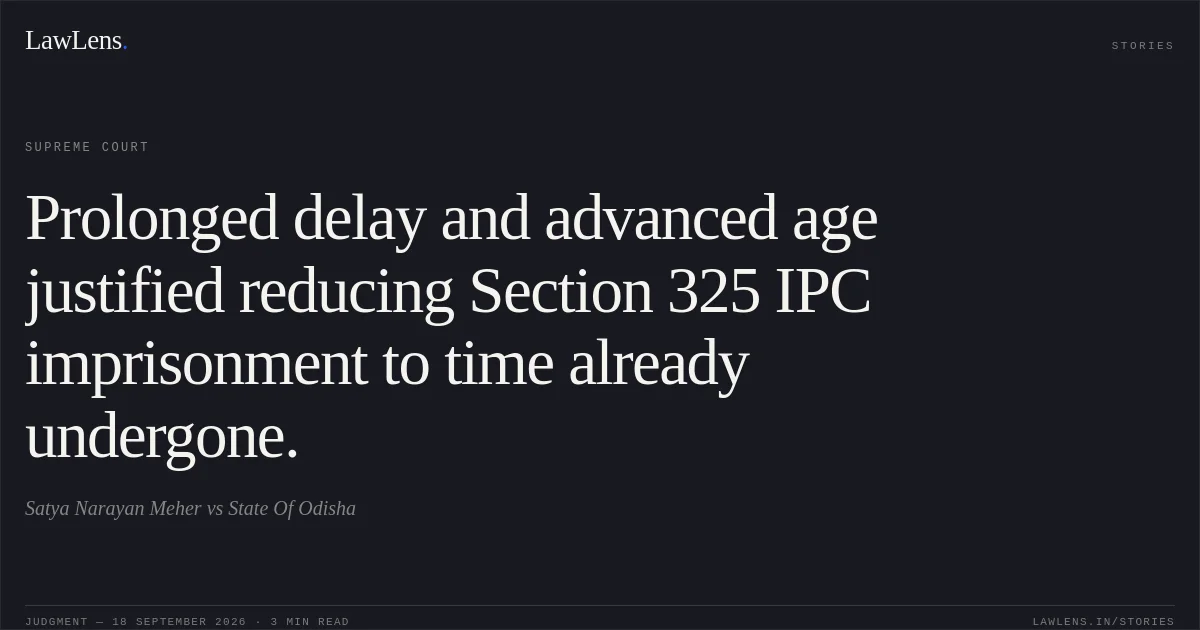
Source reference: para. 3; p. 2On appeal, the High Court held that the death was not homicidal, altered the conviction to Section 325 read with Section 34 IPC, and imposed one year’s rigorous imprisonment with a fine of ₹20,000 each, payable as compensation to the victim’s widow.
Source reference: para. 4; pp. 2–3Before the Supreme Court, the appellants challenged both the conviction and sentence, relying on alleged weaknesses in the evidence and the lapse of nearly thirty-two years since the incident.
Source reference: para. 5; pp. 3–4Issues
1. Whether the appellants’ conviction under Section 325 read with Section 34 IPC was sustainable despite the alleged weaknesses in the prosecution evidence and the fact that certain witnesses were related to the deceased?
Source reference: paras. 5–7; pp. 3–52. Whether, having regard to the appellants’ age, the period already undergone, the prolonged pendency of the proceedings, and the absence of a minimum sentence under Section 325 IPC, the sentence should be modified?
Source reference: para. 8; pp. 5–6Law Applied
The Court applied Section 325 IPC, which punishes voluntarily causing grievous hurt with imprisonment extending up to seven years and fine, without prescribing a mandatory minimum sentence.
Source reference: para. 8; p. 5Section 34 IPC was applied on the basis of the appellants’ common intention in participating in the assault.
Source reference: no citationThe Court also considered Section 357 of the Code of Criminal Procedure, 1973, permitting the fine to be directed as compensation to the victim’s widow or legal representatives.
Source reference: paras. 4, 8; pp. 2–3, 6In exercising its discretionary jurisdiction under Article 136 of the Constitution, the Court considered the appellants’ ages, the six months already undergone, the nearly thirty-two-year lapse since the incident, the prolonged appellate proceedings, and the surrounding circumstances of the occurrence.
Source reference: paras. 5, 8; pp. 3–4, 5–6No precedent was relied upon in the judgment.
Source reference: no citationReasoning
The Supreme Court upheld the conviction because the depositions of PW1 and PW4 were consistent and could not be rejected merely because the witnesses were related to the deceased; the High Court’s appreciation of their evidence disclosed no reason for interference.
Source reference: para. 7; pp. 4–5The Court further noted that the prosecution had not challenged the High Court’s finding that the death was non-homicidal.
Source reference: para. 7; p. 5Accordingly, the alteration of the conviction from Section 304 Part II to Section 325 read with Section 34 IPC was found legally justified.
Source reference: para. 7; p. 5On sentence, the Court exercised its discretion under Article 136, emphasizing that the appellants had already served six months, were then aged fifty-nine and sixty-nine years, and had faced proceedings arising from a 1994 incident for nearly thirty-two years.
Source reference: para. 8; pp. 5–6Since Section 325 IPC prescribed no minimum imprisonment, the Court considered it appropriate to substitute the remaining custodial sentence with an enhanced fine payable as compensation.
Source reference: para. 8; pp. 5–6Holding
The appeal was partly allowed.
The conviction under Section 325 read with Section 34 IPC was affirmed.
Source reference: para. 8; pp. 6–7However, the sentence of one year’s rigorous imprisonment was reduced to the period already undergone, namely six months.
Source reference: para. 8; pp. 6–7The fine was enhanced from ₹20,000 to ₹40,000 for each appellant, to be deposited before the Sessions Court, Balangir within four weeks and disbursed to the widow of Chintamani or his legal representatives through the District Legal Services Authority.
Source reference: para. 8; pp. 6–7Failure to deposit the fine would require the appellants to undergo the remaining sentence imposed by the High Court.
Source reference: para. 8; pp. 6–7Acts & Sections Cited
5 provisions across 2 statutes referred to in this judgment. Each provision opens on LawLens.
Indian Penal Code, 18604
Code of Criminal Procedure, 19731
Original Court PDF
Satya Narayan MehervsState Of Odisha
Click to open original judgment
Original judgment, available to read, download and summarize on LawLens.in