Facts
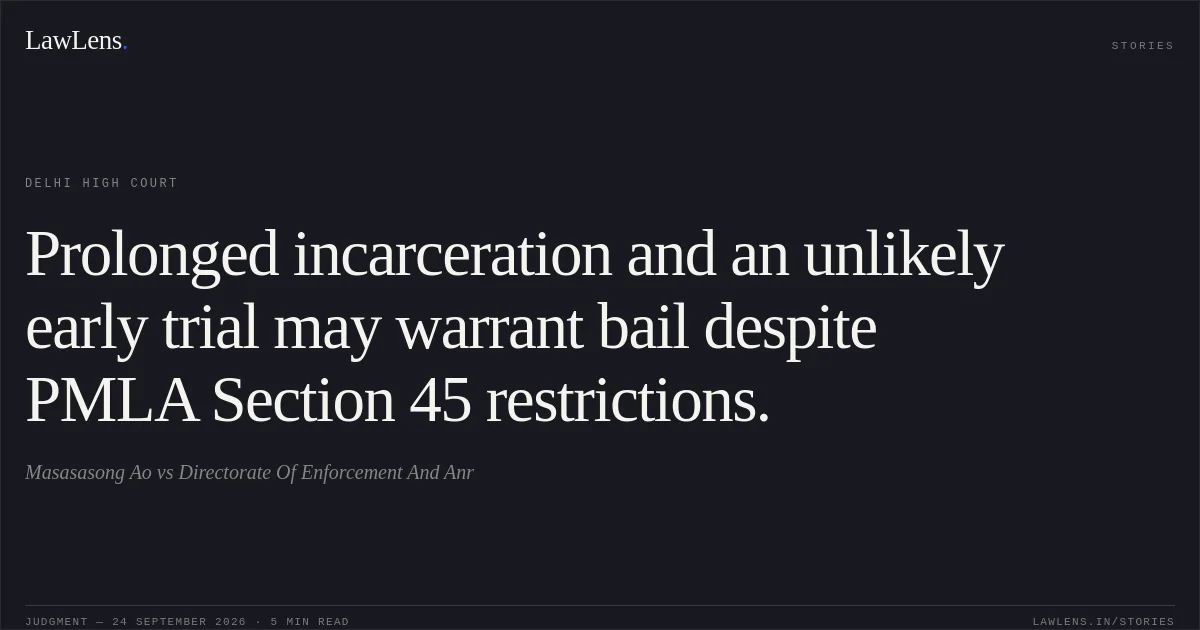
The applicant sought regular bail in Complaint Case No. 145/2022 arising from ECIR No. HQ-09/STF/2021, registered under Sections 3 and 4 of the Prevention of Money Laundering Act, 2002 (“PMLA”). The ECIR originated from an NIA case concerning the alleged collection and routing of funds for NSCN(IM) through extortion and illegal taxation. Although not named in the original FIR, the applicant was subsequently implicated and arrested in the PMLA case on 18 October 2022 while already in custody in the predicate proceedings.
Source reference: pp.1–2; paras.1–3The Enforcement Directorate (“ED”) alleged that the applicant knowingly assisted in routing proceeds of crime through bank accounts held in his name, his wife’s name, and entities associated with co-accused Alemla Jamir. It relied upon alleged payments of approximately INR 4.20 crore, a transfer of INR 70 lakh to A.J. Agency, substantial withdrawals and deposits after Jamir’s arrest, and a statement that the applicant directed the transfer of INR 1.18 crore. The applicant maintained that the accounts were substantially operated by Jamir, that the accounts and signed cheque books had been handed over to her, and that he did not knowingly participate in laundering proceeds of crime.
Source reference: pp.2–3; paras.4–7The investigation was complete and the prosecution and supplementary complaints had been filed. The applicant had remained in custody since 18 October 2022, had crossed one-half of the maximum seven-year sentence under Section 4 PMLA, and, as of 23 July 2026, had undergone three years, nine months and six days of custody. Of 27 prosecution witnesses, only five had been examined as of July 2026.
Source reference: pp.7–9; paras.17, 21His earlier bail application had been rejected by the Special Judge on 16 March 2026.
Source reference: p.1; para.1Issues
Whether the applicant satisfied the twin conditions for bail under Section 45 of the PMLA, namely, whether there were reasonable grounds for believing that he was not guilty of the alleged offence and that he was unlikely to commit any offence while on bail.
Source reference: pp.5–7; paras.10–16Whether the applicant’s prolonged incarceration, after undergoing more than one-half of the maximum sentence prescribed under Section 4 PMLA, justified bail under Section 436A of the Cr.P.C. and Article 21 of the Constitution, notwithstanding the rigours of Section 45 PMLA and the pendency of the predicate UAPA proceedings.
Source reference: pp.7–10; paras.17–25Whether the grant of bail to co-accused Alemla Jamir entitled the applicant to bail on the ground of parity.
Source reference: p.10; para.26Law Applied
Section 45 PMLA imposes mandatory twin conditions for bail, requiring the court to record satisfaction regarding the accused’s likely innocence and non-recidivism; however, the inquiry is based on broad probabilities and does not require a mini-trial or a finding of definitive innocence.
Source reference: p.5; paras.10–11The Court relied on Union of India v. Kanhaiya Prasad, 2025 INSC 210, Prem Prakash v. Union of India, 2024 INSC 637, Vijay Madanlal Choudhary v. Union of India, (2023) 12 SCC 1, and Ranjitsing Brahmajeetsing Sharma v. State of Maharashtra, (2005) 5 SCC 294.
Source reference: p.5; paras.10–11Section 3 PMLA requires involvement, directly or indirectly, in a process or activity connected with proceeds of crime; mere routing of tainted money through an account is not, by itself, conclusive proof of money laundering.
Source reference: p.5; para.12Section 436A Cr.P.C. embodies the protection against excessive undertrial detention and must be read with the constitutional guarantee of a speedy trial under Article 21, though it does not create an absolute or automatic right to release.
Source reference: pp.7–8; paras.18–20The Court further relied on Ajay Ajit Peter Kerkar v. Directorate of Enforcement, 2024 SCC OnLine SC 4055, Arvind Dham v. Directorate of Enforcement, 2026 INSC 12, and V. Senthil Balaji v. Enforcement Directorate, 2024 SCC OnLine SC 2626, for the principle that prolonged incarceration under a statute carrying a maximum seven-year sentence may justify bail where the trial is unlikely to conclude within a reasonable time.
Source reference: pp.8–10; paras.19, 23–25Section 479(2) BNSS requires consideration of other pending proceedings but does not, by itself, bar release on bail.
Source reference: pp.8–10; paras.19, 23–25Reasoning
The Court found that the ED had material prima facie connecting the applicant with the movement of alleged proceeds of crime, including withdrawals, deposits, post-arrest transactions, and the statement regarding his directions to transfer funds.
Source reference: pp.5–6; paras.12–14Nevertheless, the applicant’s explanation that Jamir controlled the accounts could not be dismissed as a bare denial, and the material did not conclusively establish at the bail stage that he knew the criminal source of the funds or consciously participated in laundering them. The first limb of Section 45 was therefore satisfied on the applicable broad-probability standard.
Source reference: pp.6–7; paras.13–14The second limb was also satisfied because the relied-upon transactions were from 2019–2020, no independent criminal involvement apart from the related NIA proceedings was shown, the applicant was a permanent government employee with a fixed residence, his jail conduct was satisfactory, and the documentary evidence had already been secured.
Source reference: p.7; paras.15–16The Court placed decisive weight on the applicant’s nearly four years of custody against a maximum PMLA sentence of seven years, his having crossed the halfway threshold under Section 436A, the slow progress of the trial, and the absence of delay attributable to him.
Source reference: pp.7–9; paras.17–21Although the allegations in the predicate UAPA case were serious and the pendency of that case was relevant, seriousness could not justify indefinite pre-trial detention in the PMLA proceedings.
Source reference: pp.9–10; paras.22–25Since the investigation was complete, the evidence was predominantly documentary, and the risks of flight, tampering, or interference could be controlled through conditions, continued detention risked becoming punitive and was inconsistent with Article 21.
Source reference: pp.9–10; paras.22–25, 28–29Bail granted to Jamir was given limited weight because her circumstances, including the woman-specific proviso to Section 45 and her longer custody, were not identical.
Source reference: p.10; para.26Holding
The Court allowed the bail application and directed the applicant’s release in Complaint Case No. 145/2022 arising from ECIR No. HQ-09/STF/2021 upon furnishing a personal bond of INR 50,000 with one surety of the like amount.
Bail was subject to conditions requiring cooperation with further investigation, surrender of the passport and restriction on leaving India, disclosure and maintenance of current contact details, appearance before the Trial Court, avoidance of unnecessary adjournments, non-contact with or influence over prosecution witnesses, non-tampering with evidence, and abstention from criminal activity.
Source reference: pp.11–12; para.30The Court clarified that the order applied only to custody in the PMLA proceedings and would not affect any custody required in the predicate NIA/UAPA case or any other proceeding.
Source reference: p.12; para.32The observations were expressly confined to the bail decision and were not to influence the trial on merits.
Source reference: p.12; para.33Acts & Sections Cited
13 provisions across 5 statutes referred to in this judgment. Each provision opens on LawLens.
Prevention of Money-Laundering Act, 20023
Indian Penal Code, 18604
Unlawful Activities (Prevention) Act, 19674
Code of Criminal Procedure, 19731
Bharatiya Nagarik Suraksha Sanhita, 20231
Original Court PDF
Masasasong AovsDirectorate Of Enforcement And Anr
Click to open original judgment
Original judgment, available to read, download and summarize on LawLens.in